Author Archives: Hilary
Move On If You’re Monied (Or Now Alone)
 Summary: The status is still unclear of recent proposals that social housing (‘council housing’ and the like in old parlance) be only for those in greatest financial need. But whether simply political musing, or seriously on the agenda, these propositions are, even just for starters, a very bad idea. And so, without very careful preparation, is the idea that if family changes mean your house becomes ‘underoccupied’, or you are job-seeking, you must move on.
Such proposals miss the point that people live in communities, not isolation; and communities require a degree of stability. These ideas can result only in one thing – more so-called ‘no hope’ estates, and fast.
Visit Hilary’s professional website here to read more and post your comments on this article.
Brokering For Adequacy In Austerity
 Summary: There’s little most of us as individuals can add to general commentary about the current fierce financial cuts; but there is perhaps a real role for brokerage, undertaken by non-partisan cross-industry bodies, to find a way forward.
The first priority, beyond politics, must surely be to minimise harm as far as possible in the face of a grim determination to reduce public spending at any cost.
Visit Hilary’s professional website here to read more and post your comments on this article.
Can Swans, Dogs, Families And Fishing Co-exist In Sefton Park?
 This male swan is father to his six cygnets, now surviving without their mother. The female of the adult pair was lost when a dog attacked her, and the fear is now for the safety of the swan family in her absence. So once again we ask the perennial questions about who our city parks are ‘for’. Can dogs and people mix? And how reasonable is it to permit fishing in this urban environment, given that it too destroys waterbirds and scares away young families?
Homes, Job Prospects And Horizons: How Far Is ‘Away’?
 Summary: Iain Duncan Smith, the work and pensions secretary, proposes to help people move house to get work. This is not of itself a new idea; from Norman Tebbit’s ‘on your bike’ onwards it has been proposed in various ways by the main political parties that those without employment need encouragement to become domestically mobile. Inevitably the counter-argument has been that jobs are not necessarily to be found just around the corner, a mere bikeride – or, in Duncan Smith’s proposals, within fifteen miles – of where jobless people currently live. So can this idea work?
Visit Hilary’s professional website here to read more and post your comments on this article.
Longest Day, Lightest Night, Least Energy Lost
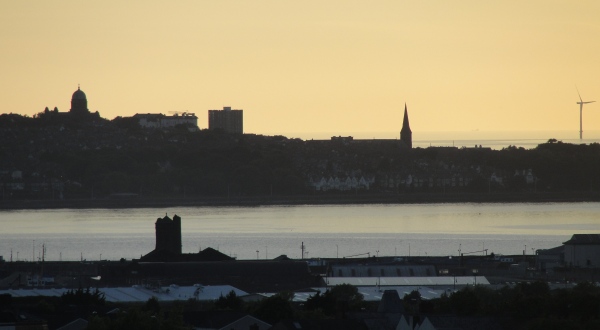
 This is the longest day of the year, a day and night when darkness barely touches the River Mersey or the historic ports of Liverpool and the Wirral to each side of that river’s great estuary. But even on this solstice day it’s not all about heritage. The estuary’s traditional maritime installations are here matched by the forward-looking technology of wind turbines, a constant reminder that energy is not ours to squander. Longer evening light, with the clocks forward year-through as 10:10 proposes, would help reduce this waste consistently without effort.

Inaction On Regional Trains Speaks Louder than Words
 Summary: The electrification of railway lines in the NW of England (and elsewhere) has been planned for some while. Money was allocated for this programme by the last government, recognising the need to modernise regional intercity connections for economic and environmental reasons.
But in the new coalition government’s austerity-focused scheme of things it seems this plan is under threat. Upgrading these lines is essential. It’s the regional economy, people’s livelihoods and issues of energy efficiency which are at stake. Vague words of hope for the future will not do.
Visit Hilary’s professional website here to read more and post your comments on this article.
Liverpool Enjoys Sun And Fun
 The sun shone warmly on Liverpool’s Lord Mayor’s Parade today (Saturday 5 June 2010), and afterwards people thronged happily in the city centre.
Bandspeople made their way along Church Street past a musician with more ancient instrumental traditions, and in the retail area of Liverpool One shoppers took time out to relax on a fake lawn, in the company of an enormous frog and fairy-tale toadstools. The city centre in the sun was fun, and Liverpool was today indeed a World In One City.
A Trial Of Two Localisms
 Summary: Has nationally-prescribed double devolution somehow morphed into nationally-prescribed strategic localism? Is either of them meaningful without generous national resources and serious leadership? Can the previous double devolution consultation model really transmute into genuine local self-determination? And is this proposed shift in the end about strategy for the future, or about nostalgia for the past?
Visit Hilary’s professional website here to read more and post your comments on this article.
The ‘Big Society’ Idea
 The ‘Big Society’ is one of the ideas put forward by new Prime Minister David Cameron to ‘heal’ what he cavalierly refers to as Broken Britain. Based, as this idea is, on the concept of ‘dysfunctional communities’, success as described in Conservative literature is unlikely – not least because the idea that entire communities of themselves can be dysfunctional demonstrates a very pessimistic view of our fellow citizens.
How bizarre, then, that this concept should have appeared unexplained as a large poster pasted onto a telephone box in City Road, London….

The poster which you see stuck on this telephone box is a replica of the title page of the Conservative’s Big Society proposal document.
My reasons for serious and fundamental doubts about whether David Cameron’s ‘Big Society’ can be delivered in the way he anticipates can be seen here.
But whether I prove to be right or not, surely we all struggle to understand why this idea is being promulgated in such strange and stark isolation on a phone box in Hoxton.
What Did Labour Do For Women?
 Yes, I do realise this is a rather outmoded way of putting things – the real question should be, ‘What did Labour do to make things fairer for everyone?’ – but the former question is asked more frequently than the latter.
But, however the enquiry is phrased, the answer is that Labour has done a great deal to change things equality-wise for the better, and sometimes it’s worth remembering where the equity stakes were pre-1997, not least so we can hold on to these improvements for the future.
I hope Laura Barton of the Guardian’s The view from a broad column will forgive me if I lift wholesale her list of changes supporting women at least as much as men which the Labour Government introduced between 1997 and 2010:
Gender and Equity legislation, 1997 – 2010
* The Forced Marriages Act;
* the minimum wage (which helps around a million people, around two-thirds of them women);
* more than 120 specialist domestic violence courts;
* 28 sexual assault referral centres;
* the right to request flexible working for those with caring responsibilities;
* the Pension Credit;
* free bus passes for over-60s;
* pension reforms that will allow a million more people to accumulate a state second pension;
* the Health in Pregnancy Grant (£190 for each woman);
* maternity leave increased from18 weeks to 12 months;
* paternity and adoption leave;
* greatly improved breast cancer treatment … and much more.
Pre-1997
Plus, let us not forget the previous tranches of legislation which have enabled women to play their part in civic life and the formal economy, as well as in the home.
In 1974 maternity leave was just four weeks – a useless amount of time for most of us to establish that precious mother-baby relationship and recover to full strength – and women had to give notice of ‘retiring’ even before their babies had safely arrived… The 1975 Sex Discrimination Act was ground-breaking in its defence of women’s rights in the home and in the workplace.
And before that we had the benefits of the Welfare State and the National Health Service, in that reforming post-War period of 1945-8.
Inequitable representation
But still, after the 2010 elections, only 21% of MPs are female.
The Fawcett Society estimates that at current rates of progress it may take the Labour Party 20 years yet to establish an equal gender split amongst its MPs.
Scandalously, gender equality for the Liberal Democrats at current rates may take twice that long; and the Conservatives are so relaxed (?) on this issue that they could take some four centuries to achieve the same.
Can there be any excuse at all for this foot-dragging and delay? I truly and deeply think not.


 Dreaming Realist