Category Archives: Travel
Can Swans, Dogs, Families And Fishing Co-exist In Sefton Park?
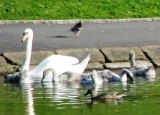 This male swan is father to his six cygnets, now surviving without their mother. The female of the adult pair was lost when a dog attacked her, and the fear is now for the safety of the swan family in her absence. So once again we ask the perennial questions about who our city parks are ‘for’. Can dogs and people mix? And how reasonable is it to permit fishing in this urban environment, given that it too destroys waterbirds and scares away young families?
Inaction On Regional Trains Speaks Louder than Words
 Summary: The electrification of railway lines in the NW of England (and elsewhere) has been planned for some while. Money was allocated for this programme by the last government, recognising the need to modernise regional intercity connections for economic and environmental reasons.
But in the new coalition government’s austerity-focused scheme of things it seems this plan is under threat. Upgrading these lines is essential. It’s the regional economy, people’s livelihoods and issues of energy efficiency which are at stake. Vague words of hope for the future will not do.
Visit Hilary’s professional website here to read more and post your comments on this article.
Liverpool Enjoys Sun And Fun
 The sun shone warmly on Liverpool’s Lord Mayor’s Parade today (Saturday 5 June 2010), and afterwards people thronged happily in the city centre.
Bandspeople made their way along Church Street past a musician with more ancient instrumental traditions, and in the retail area of Liverpool One shoppers took time out to relax on a fake lawn, in the company of an enormous frog and fairy-tale toadstools. The city centre in the sun was fun, and Liverpool was today indeed a World In One City.
A Gathering And A Big Lunch In Toxteth’s Princes Boulevard, Liverpool
 Princes Boulevard in Toxteth, Liverpool, was once a bustling avenue, the home of wealthy merchants and many townspeople. Then local fortunes took a desperate downturn, the nadir being the Toxteth riots in 1981. But more recently things have begun to look up, as demonstrated for instance by The Gathering of May 2008, and today’s Big Lunch in this historic setting.
The Stephenson Rocket Mural In Liverpool Edge Hill
 Liverpool Edge Hill was the location, along with its Manchester, Liverpool Road counterpart, of the first public railway station, opening on 15 September 1830. More recently this historic site was marked by a large mural of the ‘Rocket’ steam engine invented by George Stephenson (1781-1848) – an interesting vision in the grimness of our own contemporary Edge Lane access route into the city.
The Lowry, Manchester Royal Opera House Plans, Infrastructure And Regional Benefit
 The Lowry arts centre has this week stated its opposition to current plans for the Palace Theatre in Manchester to host all elements of a proposed Royal Opera House development in that city. The arguments on both sides seem however to miss some critical points: firstly, this is a regional not a sub-regional issue; and secondly the infrastructure and the local provisions should have been sorted years ago. Some other opportunities to develop the regional cultural offer have already been shunned; and now it looks as though this may happen yet again.
Arts Organisations, Regeneration and Regions, Sub-Regions & City Regions.
Reports this week suggest that the Lowry in Salford feels left out and disadvantaged by the proposed development of a northern (second) home for the Royal Opera House, if as a result all ROH-related northern ballet and opera productions – some of them currently hosted by the Lowry – were to be located in Manchester‘s presently fading Palace Theatre.
This is not the time or place to go into questions of sub-regional and local politics – the cities of Manchester and Salford must get along as best they can – but there are a few larger questions which now arise which might have been addressed earlier.
Regional aspects of the arts organisation proposals
Firstly, investments and development of this size are clearly regional as well as local matters. The Lowry, a Millennium product, cost over £100 million to set up, and doubtless the cost of the new proposals would also reach many millions.
It is surprising therefore that the ‘arts and culture’ debate thus far seems to have centred in its positive aspects only on the ROH and the Manchester orchestras. (Perhaps, as a slightly mischievous aside, there are very few left who recall that it was the Royal Liverpool Philharmonic Orchestra, not a Manchester ensemble, that performed at the Covent Garden Royal Opera House in May 1981 during the Royal Ballet’s golden anniversary celebrations?)
Locating and programming
Whatever, the there is now also a Royal Ballet in Birmingham, and Opera North may be intending like the Royal Ballet to make its northern activities to the Palace Theatre in Manchester; but the Lowry wants to keep them in Salford.
It has to be said however that the Lowry has disappointed some of us in its more recent opera and ballet offering. To begin with we were excited by the range and frequency of national-level opera and ballet at the Lowry, but over time this seems to have been diluted by a preponderance of more local and / or less ambitious scheduling. Once enthusiasms for a venue are lost, it is probably hard to get them back.
Travel and catchment
One unfortunate element in the Lowry scenario is its very poor infrastructure. It is almost impossible for non-Mancunians to reach (and return home from) on public transport. Unless you take the car, you can’t sensibly get there after work or in bad weather….
Despite the trainline from the West of Greater Manchester (Warrington, Liverpool, etc) running within sight of the Lowry, it doesn’t actually stop there, and one has to proceed into Manchester and return out on a local route. It’s perhaps relevant that the first stopping point, Manchester Oxford Road station, is however almost next door to the Palace Theatre.
Regional benefits
The Lowry deserves a measure of sympathy for the situation in which it is placed by Manchester’s proposals; but there is already a huge plan for the relocation of parts of the BBC to that site. And there is a feeling that the Lowry could have positioned itself better as an attractive venue: limited serious arts programming, poor and / or restricted catering provision, little public transport and expensive car parks do little to ensure a consistent and devoted fully regional audience.
There again, Manchester itself needs to explain why it has not, as far as can be seen, looked beyond its own boundaries to other North West areas, in sharing enthusiasm for the ROH proposals.
Lost and endangered opportunities
A few years ago Liverpool had an opportunity, which it decisively shunned, to make a bid for the National Theatre Museum to be relocated to Merseyside. That Museum used to be located right alongside the Covent Garden Royal Opera House; but despite the potential for inside influence of very eminent Merseysiders, not least on the board of the Victoria and Albert Museum (which owned the Theatre Museum), the bid never materialised and there is no longer any dedicated location for the theatre collection at all. Most of the collection is now stored away in Kensington, at the V&A itself.
The possibilities of real cultural synergy between Merseyside and Greater Manchester have already therefore been seriously blunted by lack of vision, imagination and enthusiasm. Let us hope this is not about to happen yet again.
Sir Richard Leese, Chief Executive of Manchester City Council, is surely correct in sharing with previous Secretary of State for Culture, Andy Burnham, the view that the regional benefits of the current proposals for regeneration and investment could and should be significant. But if everyone is not persuaded soon, there will probably be no action, or benefits at all.
Read more articles on Arts Organisations, Regeneration and Regions, Sub-Regions & City Regions.
Flaming June In Ardnamurchan
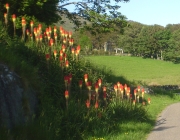 Ardnamurchan, the most westerly point of mainland Britain, is not the first place most of us would look to find the dramatic Shenandoah ‘Red Hot Poker’ or ‘Torch Lily’ in bloom; after all, the Kniphofia group of plants to which Torch Lilies belong originated in Africa. But the remote north-west UK location around Loch Sunart has been showing these spectacular flowers off in profusion during the amazingly hot (up to 24 degrees C) first weekend of June this year.
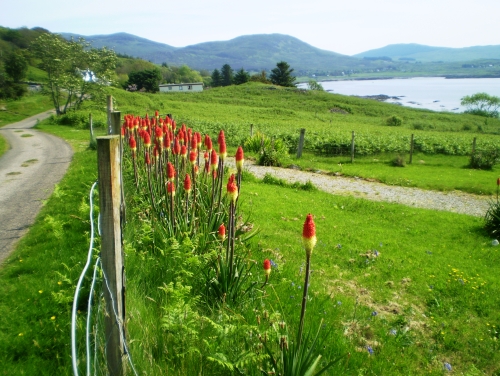
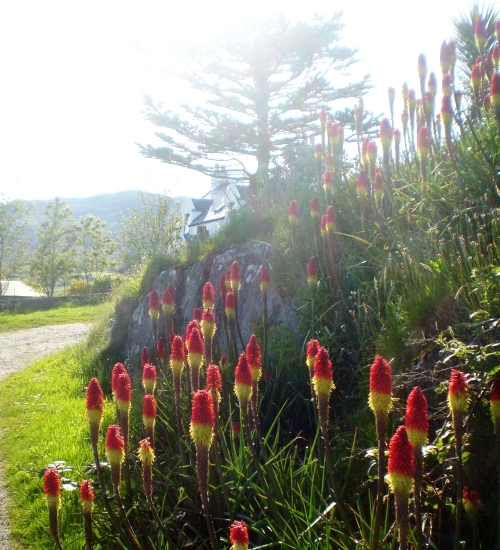
See more photographs at Camera & Calendar and at Locations & Events.
Spring Comes To Sefton Park, Liverpool
 The past few days have convinced us that Spring is finally on its way.
The daffodils in Sefton Park are a glory all of their own – the focus of hope in so many ways, at the equinox when people begin once more to populate our park’s wonderful space, strolling by in chatty groups, with prams, on bicylces, running to raise funds for charity or simply stopping to enjoy.
And then, as the daffodils begin to fade, we see the promise of the next great gift of nature, the delicate blossoms of almond and cherry to delight us yet a while….
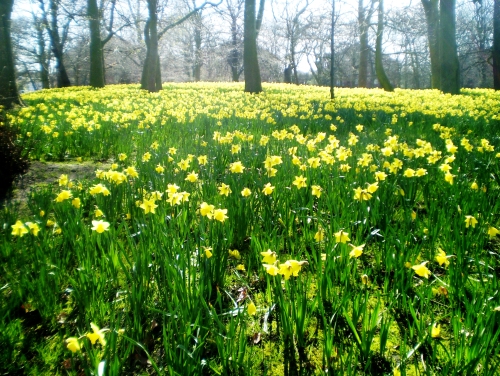

See more photographs of Liverpool & Merseyside and read more about Sefton Park.
The University Of Liverpool Post-Graduate Poster Day
 The University of Liverpool has one Graduate School for all disciplines. The School’s annual Poster Day (27 March, in 2009) enables all these fields to be showcased together. I had the happy task with a few other ‘external’ judges of selecting the first-ever prizewinner for the new ‘North West Hub’ award, to emphasise links between academia and the wider world.
Education & Life-Long Learning and Knowledge Economy.
The exemplary aims of Poster Day are to offer graduate students practice in the skills required to communicate to a degree educated public, and to provide an opportunity for them to learn more about research being undertaken in other parts of the University.

The University of Liverpool Graduate School Poster Day exhibition was fascinating; the cross-faculty range of work under one roof would surely have taken months to get fully to grips with, but we had just a couple of hours. I used the time to talk to some very interesting people, all passionate about their work and the reasons they were doing it.


The involvement of ‘external’ visitors was a new step introduced this year. Here we see some of the Graduate School Team, including Dr Richard Hinchcliffe (Director of Postgraduate Training) with my fellow judges:

But in the end we had to make a decision, spoilt for choice though we certainly were.
The general criteria for the North West Hub overall prize included visual impact, organisation of the material, the accessibility of and rationale for the research, and, last but not least, the enthusiasm and clarity of the researcher him or herself. It seems very fitting that the award was after much discussion made to Andrew Lee-Mortimer for his engineering research project around Design for Sustainability.

Read more articles about Education & Life-Long Learning and about the Knowledge Economy.
Women In Wigan A Century Past; Water And Gendered Sustainability Now
 The 8th of March is International Women’s Day, an occasion to look both back and forward. We have here some photos and text reminding us gently how grim life was for working class women and children in the mills (and often for their mining menfolk too) a mere century ago. Happily, Wigan Pier and the canals are now a tourist destination alongside a modern Investment Centre; but around 1910 a different story – not least about the uses of water – was being told. The challenge remains to secure the same progress as we’ve seen here, in ensuring healthy and constructive lives for women and their families everywhere across the globe.

Here’s the text of this notice, displayed by the towpath at Wigan Pier:
TRENCHERFIELD MILL
When cotton was king
as told by a cotton worker circa 1910
It’s hot int’ mill wi’ lots o’ noise. On a nice day, we’ll take our lunch ont’ towpath an’ eat snaps* from’t snaps tins.
It’s a 5-and-a-half day week for us cotton workers, that’s 12 hours a day and half a day on Saturday.
We’ve all got nimble fingers , especially the Piecers’. They’re mainly children, who nip under the spinning machines to tie the broken cotton back together again.
Some of us work on the spinning machines and some on the carding machines. The mill takes a raw bale of cotton, cleans it, twists it and spins it into fine yarn.
The humidity in the mill keeps the cotton damp so it’s easier to spin without snapping.
There are five floors of machinery – all powered by the Trencherfield Mill Engine.
The noise is deafening – we stuff cotton from the floor in our ears to protect them. We communicate using ‘Me-Mawing’ – a mixture of sign language and lip reading.
We work in our bare feet because our clogs could spark on the concrete floor and set the cotton bales alight.
We wake early doors to the sound of the Trencherfield steam whistle summonin’ us t’mill for another day. But as they say – England’s bread hangs on Lancashire’s thread.
[* a snack favoured also by the men of Wigan, many of them miners, usually bread-and-dripping, with cold tea, carried in a flat tin called a snap-can – see George Orwell‘s The Road to Wigan Pier]
And here is the towpath which a century ago provided fresh air and respite for those mill workers as they ate their lunch-time snaps:


[Public display boards by Wigan Heritage Services]
The power of water
And so, strangely, we come full-circle.
Water – the canals, the steam – was the power behind the early production of textiles, employing many women and children in horrendous conditions, as the full logic of the Industrial Revolution took its vice-like grip on the emerging economies of what we have come to know as the ‘developed world‘; but even now in other parts of the globe water remains both a critical force potentially for good, and often an almost unattainable resource.
Women as water workers
Vast numbers of women and children in the developing world continue to toil many hours a day just to obtain water to sustain their very existence.
Life in places like Wigan was harsh and short for women and men, alike, a century ago. It remains, as Oxfam tells us in the topical context of International Women’s Day, particularly harsh even now for women in places such as Iraq, where water continues to be inaccessible for many.
The gendered meanings of sustainability
This is where we begin to understand what ‘sustainability‘ is really about…. the just and equitable distribution of basic physical resources and accessible socio-economic opportunities, for everyone, women as much as men, the world over.
In terms of future global sustainability and equity, as the Gender and Water Alliance also reminds us, water remains a critically gendered issue.
Read more about Gender & Women and about Sustainability As If People Mattered and Water; and see more photographs of around Liverpool & Merseyside.


 Dreaming Realist