Category Archives: Liverpool And Merseyside
What’s The 2008 Liverpool European Capital Of Culture Year For?
 Liverpool ‘s 2008 European Capital of Culture Year will be upon us in just a few months. But deep divides remain between artists, civic leaders and many local people about what the 2008 Year is ‘for’.
Alex Corina has taken the plunge into controversy on developments with the Liverpool’s plans for the 2008 European Capital of Culture Year. He’s reinvented Edvard Munch’s The Scream as The Liverpool Scream, just as in happier times he produced the Mona Lennon.
How do we measure success?
Despite the intentional playing to the gallery in all this, there is a very serious issue to be considered here. It concerns the rationale/s which lie behind the 2008 culture programme.
For many (not all) in the Culture Company I gather that one of most important ‘real’ ways that success will be measured in 2008 is number of tourist beds (i.e. overnight stays) which are achieved during the year.
The local artists’ perspective
I can see why this is a significant measure, but it’s not the message which most ‘community arts’ people in the city want to prioritise. They, like some Culture Company officers, seek to develop their communities by using ‘culture’ as a socially helpful way to bring people together.
This is however obviously much harder to measure and has less immediate impact on the seriously challenging sub-regional economy (though longer-term it would be good).
A view from cultural institutions
And then of course there are the ‘high arts’ bigger organisations which no doubt see the major outcome for themselves as being numbers of tickets sold for shows, concerts, whatever.
Again, a very valid perspective, and we need to recognise that if these organisations were not to benefit from 2008 ‘celebrations’
they would be in serious trouble in 2009 – which would mean the loss of many very accomplished artists and performers who currently work in the city(but often choose not to live here because the additional employment opportunities are so much better in, say, Manchester – see below).
Nurturing home-based professional artistic talent?
But the requirement to sustain the big arts organisations, though vital for Liverpool’s future status, still ignores the need – not at all as yet recognised as far as I can judge – to support locally-based fully trained and professional artists and performers with very high levels of skill who want to work in the city simply as artists and performers, not as community-based animateurs.
An edgy approach
This may be difficult when, for instance, the new Liverpool
Commissions stream requires that applicants offer something wacky and on the edge; which is good for some, but sounds absolutely daft if you are a historically-inclined fine arts person or a classically trained musician.
Playing to the local Liverpool gallery, which prides itself on being on the edge, is understandable, but it won’t impress many others from elsewhere; and why aren’t local professional artists being respected as artists in their own right – or so it might appear – in the same way as visiting ones?
I have already asked How Will We Know That Liverpool 2007 & 2008 Were Successful? And that debate continues.
At least three views?
In the meantime, I’m still not sure what the answers might be, but they seem to coalesce around the three views above:
1. tourist spend / beds
2. community cohesion and capacity building
3. (potentially) retention of high-level artistic skills in the city
Where’s the dialogue?
Unfortunately however there seems to be very little dialogue between those who promote each of these perspectives.
Indeed, I’m not sure it’s possible to do this under the present ‘consultation’ arrangements, with occasional meetings of large numbers of people – professional artists and others with very different experience together – in sports halls and the like.
Bringing the issues into focus
If Alex Corina’s current activities can help everyone to focus on
the ‘what’s 2008 for?’ message whilst there’s still at least a little bit of time left, that will be excellent.
As a city resident I’d like to see everything succeed so that proposed cultural ‘villages’, respected highly-skilled professional artists and performers, and our tourist trade all flourish ; but we’re still a way from achieving this.
A matter of urgency
The dialogue does need to be getting somewhere, and pretty quickly, please.
Cherry Blossom For May Day In Sefton Park, Liverpool
 The cherry blossom in Liverpool’s Sefton Park has been very early this year; it has already offered much delight to those who stroll along the middle lakesides, the blossoms pink, cream, white and even cerise. But one tree is still in glorious full bloom as we reach May Day eve.

See also: Sefton Park’s Grebes And Swans
Liverpool’s Sefton Park, Swans, Herons And Grebes
Sefton Park, Liverpool: Winter Solstice 2006
Friends Of Sefton Park

The Live-A-Music Children’s Workshops, 5 April 2007: A Fun-Packed Family Day
 The Live-A-Music Children’s Workshops on 5 April in Mossley Hill Parish Church Hall, Liverpool 18 were action-packed, with much creative sparking between the children, musicians and ‘supporting cast’ of accompanying (grand) parents and younger brothers and sisters. Themes included ‘Music, Myth and Magic’, ‘Animal Samba’ and ‘Symphony’ – with the children also performing a work of their own.


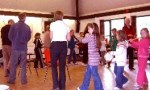


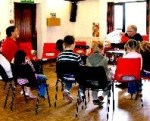
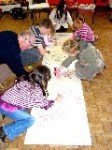


These Live-A-Music workshops ran during the day on Thursday 5 April 2007, in Mossley Hill Parish Church Hall, Rose Lane, Liverpool 18. Background information about the workshops is available on this website. Further workshops are planned for the Summer school holidays.
For more details of the Summer arrangements, or to discuss how Live-A-Music can work to support your own educational / social engagement proposals, please email us.
SuperLambBanana
 SuperLambBanana may be kinda cute, but, made of steel and concrete and 17 feet tall, he’s no lightweight. Created in 1998 by Taro Chienzo for the Art Transpennine Exhibition, he abides in Liverpool city centre, be/amusing all. He’s been Friesian (black and white), pink and sometime graffitied, but ‘really’ he’s yellow.

See more photographs of The City of Liverpool here: Photographs of Liverpool & Merseyside;
and photographs of elsewhere, here: Camera & Calendar
Click here for more information on Super Lamb Banana, alias ‘Superlambanana’.
HOTFOOT 2007 Gets The Go-Ahead!
 The annual ‘HOTFOOT’ Concert in Liverpool’s Philharmonic Hall – set this year for 7 p.m. on Sunday 22 July – has been a Midsummer favourite for over a decade now. HOPES: The Hope Street Association, the charity which promotes and produces the concert, is delighted that the 2007 concert will receive support of £5,000 from the Liverpool Culture Company.
Read the rest of this entry
Big Ships And Big Ambitions For Liverpool
 There’s much emphasis in city centre regeneration on Liverpool’s waterfront. Plans for great ship visits are vital to the city’s resurgence; as are plans to improve the city’s road system. This photograph, taken today (7 February 2007) near St. Nicholas’ Church in the business and commercial district, gives a glimpse of what may be to come.

Liverpool Anglican Cathedral And St. James’ Cemetery And Gardens
 The Cathedral Church of Christ, Liverpool, designed by the then-22-year-old (later Sir ) Giles Gilbert Scott’s, is built on St. James’ Mount at the southerly end of Hope Street Quarter. Bishop Francis James Chavasse, second Bishop of Liverpool, decided to build it in 1901 and King Edward VII laid the Foundation Stone on 19 July 1904. The Cathedral was consecrated twenty years to the day later, but not until October 1978 did Queen Elizabeth II attend a service to mark completion of the largest of our Cathedrals in Britain. And now the civic value of St James’ Cemetery and Gardens is also recognised.

See more photos of Liverpool’s Cathedrals and celebrating communities on Hope Street here [Liverpool’s Two Cathedrals] and below….

>


>


Read more about:
Hope Street Quarter
Liverpool Cathedral
St. James’ Cemetery And Gardens
The Friends of St James’
Liverpool’s Two Cathedrals
Dame Elisabeth Frink (1930-1993; Risen Christ was installed was installed one week before Frink’s death)
Tracey Emin (b.1963; Emin’s Cathedral work, Roman Standard – or ‘bird on a stick’ – was her first public art installation; she intends to do another one for the cathedral in 2008)
See also photgraphs at
Liverpool Metropolitan Cathedral of Christ the King and
Calendar & Camera .
Liverpool’s Ancient Chapel Of Toxteth, Dingle Gaumont Cinema, The Turner Nursing Home & Dingle Overhead Railway Station
 One of Liverpool’s most significant and fascinating historic areas is barely known even by the city’s own residents; so Monday Women arranged a visit. The area lies in the heart of Toxteth – Dingle, comprising four adjacent sites: the early seventeenth century Ancient Chapel of Toxteth (the original place of worship of astronomer Jeremiah Horrox or Horrocks), the Turner Nursing Home built by Alfred Waterhouse in 1882-5, Dingle Overhead Railway Station, constructed deep underground and opened in 1896, and the Dingle Gaumont Cinema, erected on the site of the old Picturedrome in 1937.

The general perception is that Liverpool has few really serious historic sites. Interesting architecture, Yes, in abundance; ‘old’ buildings, No. On Saturday 16 November 2006 several dozen members, families and friends of Monday Women and CAMPAM set out on a beautifully sunny afternoon to discover why this perception is not always accurate.
The Ancient Chapel of Toxteth

We congregated first in the Ancient Chapel of Toxteth, opened especially for us by its warden, Annette Butler. She and local historian Christina Clarke (to both of whom we owe enormous thanks) had a remarkable tale to tell about the history of this simple and appealing building, constructed variously at times between 1604 and 1618. The Chapel is now owned, and used, by the Unitarians, but was built and developed by Puritan dissenters from the Church of England.
The site of the Chapel is that of the thirteenth century royal hunting Park in Toxteth, sold late in the sixteenth century to the Earl of Derby. He in turn sold it to Puritan families from around the Lancashire towns of Bolton and Ormskirk who were seeking more freedom of conscience in their religious practices, using a place which had been Crown property and was thus not subject to parish law or to enforcement of regular attendance at the parish church. [See: The History of the Royal and Ancient Park of Toxteth


 Even with sunshine outside, the inside of the Chapel feels dark and close (perhaps in part because the winters of the seventeenth century were bitter), the pews being closely placed, but with an appealing and open gallery area above them, and an impressively large pulpit at the centre of the south wall. Over the centuries the building itself has been considerably extended, not least to adapt the previous schoolhouse (built in 1611) into the access point for the organ loft.
In contrast to the closeness of Toxteth Chapel itself, our visit to the graveyard found it calm and airy, with dappled light through the mature trees, as we examined the columned arcade and headstones of such local luminaries as Richard Vaughan Yates , who devised Princes Park, and the cartographer Richard Horwood [A to Z of Regency London
Jeremiah Horrox or Horrocks (1618 or 1619 – 1641)
 Amongst other fascinating plaques inside the Chapel is one commemorating the brief life and momentous work of Jeremiah Horrox (as spelt on this plaque; or Horrocks as often spelt in the reference books). Horrocks was the youthful astronomer who first observed the transit of the planet Venus, on Sunday 4 December – 24 November by reference to the Julian Calendar then in use – 1639. (There is an anecdote, possibly apocryphal, that he calculated this rare occurrence and had to pre-empt much of the Curate’s duties he may have performed in Hoole, Lancashire, that day, in order to observe the transit via a telescope he constructed himself, reflecting the sun’s image onto a piece of card.) [Jeremiah Horrocks,Astonomer (1618? – 1641) and His Times: No.6 (Chorley Civic Society Occasional Papers)
Dingle’s Gaumont Cinema
 Toxteth Chapel is on the north-western corner of Park Road (running parallel to the River Mersey) and Dingle Lane (which goes from Princes Park directly towards the river). On the south-western side of this junction is a cinema now unused for its original purpose, the Gaumont, designed by W. E. Trent FRIBA, FSI (Chief Architect of Gaumont-British) specifically to accommodate the large fan-shaped curve of the roads at this corner, and opened on 29 March 1937.
The Gaumont Cinema, an art deco building erected on the site of the old Dingle Picturedrome (photo in Edwardian A-Z and Directory of Liverpool and Bootle: South Liverpool Part 3
It is said that the projection room was the first in Britain to have the Gaumont ‘projectomatic’ system which automatically changed the reels during projection of films, as well as controlling the houselights and stage curtains. There was also a Western Electric Mirrorphonic sound system.
Sadly, the Gaumont lost its originally intended function in September 1966, to become a Top Rank Bingo Club which opened in January 1967. We were not therefore able to go into the building to see more as we passed on to the south-eastern corner of this ‘site visit’ and the next venue of our Monday Women trip in November.
The Turner Nursing (or Memorial) Home
 The story behind the Turner Nursing Home is very sad, but the outcome is a testament to the positive thinking of Mrs Charles Turner, wife of the Liverpool Member of Parliament who was also first Chairman of the Liverpool Docks and Harbour Board – the tale of which Board we shall continue at the next and final stop of our Dingle-Toxteth ‘tour’. The entire Turner Memorial Home project commemorates Anne Turner’s husband Charles Turner MP (13 June 1803 – 15 October 1875) and their son Charles William (16 October 1845 – 13 September 1880), who died tragically.
 In memory of her husband and son Mrs Turner commissioned the architect Alfred Whitehouse to build a strikingly asymmetric and strangely attractive ‘home’ for retired and ‘distressed’ gentlemen – a function which it still has. In the entrance lobby there is a lovely marble statue of the two male Turners, father and son, created for the opening of the Home in 1885 by the London-based sculptor Sir William Hamo Thorneycroft R.A. (1850 – 1925). This sculpture seemed to fascinate our younger companions on this visit, perhaps because it is actually so sympathetic and life-like.

 The red ashlar, turreted Home has a chapel, almost church-sized, with an arcade of octagonal columns and stained glass windows (by Heaton, Butler and Bayne); and beyond the spacious communal living areas we saw wide lawns sweeping down towards the River Mersey. This is a gracious reminder of times gone by, still of great value to the community, which shows us just how elegant Dingle and Toxteth must have been a century or more ago.
Dingle Overhead Railway Station
 Finally on this special afternoon, as the light drew in, we retraced our steps to Kedlestone Street, the road opposite the Ancient Chapel of Toxteth, and to what appeared to be a short side-alley leading to a mechanics’ garage. Few of us had any idea what would come next…. As we approached, the owner, Nigel, opened the doors and we were led down an alarmingly steep slope to another world – the world of the legendary Liverpool Overhead Railway designed by leading engineers of the time, Sir Douglas Fox and James Henry Greathead…. a return to the time of the ‘Dockers’ Umbrella’ and Liverpool’s great era of engineering and transport.
 This was the site of Dingle Station, the final stop of the Overhead Railway route from Southport, Seaforth, Litherland and Aintree, via the city centre and the frantically busy docks, to the south end of the city. Interestingly, especially in the light of current-day debates elsewhere in Liverpool, the Mersey Docks and Harbour Board had on a number of occasions from 1852 onwards had travel route proposals rejected or returned for modification in the light of the increasing demands for public transport to and from the city centre.
 Eventually however, in 1888, a group of prominent businessmen formed the Liverpool Overheard Railway Company and obtained the powers of the Dock Board by an Act of Transfer. Work on the elevated railway therefore began in October 1889. [See: Seventeen Stations to Dingle: Liverpool Overhead Railway Remembered

Dingle Station opened for passengers on 21 December 1896 and closed to the public fifty years ago, on 30 December 1956. The station platform (a full 170 feet by 28 feet) has now been demolished, but the tunnel and entrance subway remain in use as a car repair business, Roscoe Engineering. There is also an astonishing extension to the station – a kilometer long passage from this point to an opening on the Herculaneum Dock ‘down by the river’, and thence to the docks via the factory site of the Herculaneum Pottery which, though the company closed in1840, must have triggered a lot of local industry.
Some of us, hugely curious, then made our wary unlit way down to the Herculaneum tunnel entrance and  back, and others, less nimble, used the time to learn more from our host Nigel about the remaining features of the station (the red buffer
  hidden behind mechanics’ equipment; the sturdy hooks and notices…). And finally we returned to Park Road as the day ended, much enlighted by our visit and debating energetically how future generations would see the places we had visited – places which (as evidenced by the enormously ambitious commissions in Toxteth – Dingle a century or so ago, engaging the most prestigious architects, designers and engineers the nation had to offer) had in times past witnessed great wealth and opportunity and then, nearer to the present day, distressing poverty and huge challenges.
‘Which way now?’ was the question on everyone’s lips as we hit the road for home.
See also: History of Liverpool
Sudley House: Victorian Home Of A Mayor Of Liverpool
Read the discussion of this article which follows the book ‘E-store’…..
The National Theatre Museum Has Closed
 The National Museum of the Performing Arts closed ‘for good’ yesterday. This is a disaster for London (where it has had its home, in Covent Garden) and for the whole of the U.K. If the Trustees of the Victoria and Albert Museum – in whose ‘care’ the Theatre Museum resides – cannot maintain the collection as an entity, perhaps the Theatre Museum should pass to those who can do better? The Chair of the V & A has close Merseyside connections; why not re-open the Theatre Museum in Liverpool?
No-one believed it could happen, but the announcement has been made – the National Museum of the Performing Arts in Covent Garden, London, closed yesterday (Sunday 7 January 2007) because the Trustees decided they couldn’t commit further resources to the venue. This is despite the description of the Museum by its own Trustees, the Victoria and Albert Museum Board, as a ‘world-class collection’.
The protests of people as diverse as Alan Ackbourne, Judi Dench (Guardians of the Theatre Museum) and Ken Livingstone have, it seems, had no effect. Somehow,
the performing arts are not compelling to the Museum Trustees. Apparently there is to be a website and some collections are to be shown at the V & A in Kensington in 2009, but basically that’s it. Just at the time when London is preparing to host the 2012 Olympics, and when Covent Garden can never have been a more popular visitor attraction, the doors have closed. Firmly.
Nonetheless, after the experience we as CAMPAM had in the late 1980s / 1990s of ‘resurrecting’ the Liverpool Everyman – which actually went dark – and the Royal Liverpool Philharmonic Orchestra (which just about clung on) I don’t think anyone should give up all hope yet.
So come to Liverpool
I have already suggested that, if Londoners really don’t want their Theatre Museum, it should come to Liverpool. Here, up
North, we’re preparing for an event even more imminent than the Olympics. 2007 is Liverpool’s 800th Anniversary, and 2008, as everyone knows, will be our year as European Capital of Culture. The arguments for Liverpool taking this venture on have already been rehearsed; and I have been assured (though I await the evidence) that the City Council is considering things, as, one gathers from recent Minutes of the V & A Board, are the NWDA and Blackpool Council.
In the meantime, though, there is one other interesting aspect of this strange situation: The Chair of the V & A is Paula Ridley, a person with strong connections on Merseyside. It would be fascinating to know her view of the proposition that the Theatre Museum come to Liverpool.
Read more articles on the National Theatre Museum.
Monday Women ’06: Liverpool’s No-Cost Mutual Support Group Relocates
![MondayWomen{small].jpg](https://i0.wp.com/www.dreamingrealist.co.uk/MondayWomen%7Bsmall%5D.jpg) Monday Women is a no-cost group, open to all, which meets and has an e-group. With affliliation of hundreds, it welcomes discussion and activities around topics of interest to women from all walks of life. After four years, the meetings are re-locating.
Monday Women is a no-cost group, open to all, which meets and has an e-group. With affliliation of hundreds, it welcomes discussion and activities around topics of interest to women from all walks of life. After four years, the meetings are re-locating.
Please see also the Monday Women section of this website for up-to-date inormation on meetings etc.
Monday Women meetings for early 2007 are moving to the Heart and Soul Cafe-Restaurant in Liverpool.
Monday Women (Liverpool) is an open-access social and e-group for women to share views and news. ‘Members’ keep in touch in two ways: via open meetings-cum-social-events on the first Monday of the month (except Bank Holidays) and through the e-group. Women attending face-to-face events do not need to ‘belong’ to the e-group, nor do e-group members necessarily attend Monday Women events. (N.B. Children are welcome at the social events where this allows their mother / carer to attend the group.)
The Monday Women e-group has just one aim: to facilitate contact and networking between women from all walks of life, some of whom will be able to attend our events and others of
whom may not be able to. The intention is quite simply to encourage the sharing of news, views and companionship.
A no-cost, informal and open-minded network
There is no formal membership for the Group and no Officers, or agenda. There are no costs, fees or admission charges for meetings or for ‘joining’ the e-group, which are both open to all on a no-obligation basis. This is simply a relaxed and informal meeting arrangement for women in Liverpool and Merseyside.
 Topics for discussion and exchange of information between individuals attending / joining in the e-group might be anything from the possible need for a
playgroup, traffic crossing or bank in a particular area, to considering plans for regeneration and renewal of the city, to informing people about a special event, or enquiring who else might be interested in setting up a business or community group!
The group also occasionally shares ‘outside events’ such as the recent highly successful visit to the Ancient Chapel of Toxteth and two other adjacent sites of great civic and historical interest. There is in addition an annual Christmas celebratory event on the first Monday in December, organised, like every other occasion, by volunteer members of the group.
Relocating for 2007
The group was inaugurated on Monday 3 March 2003 in the Liverpool Everyman Bistro, where it has met every month since until the end of 2006. We are much indebted to Paddy Byrne, Geoff Hale and colleagues, the Bistro owners and staff, for their generous support over the past almost four years, as we now move on to new premises for early 2007 – the upstairs room of Chumki Banerjee’s Heart and Soul Cafe-Restaurant , and then from 2 April to Dragon in Berry Street. ‘Meetings’ will be from 5.45 pm until about 7.30 pm (some people stay later), although people come and go within this time span, arriving and attending for as long as they wish.
Each person joining a Monday Women event at our 2007 venues will (as before) select and buy her own refreshments – if required – in the actual cafe and then take them into the ‘meeting’ with
her. This enables everyone to choose items of food and / or drink which suit individual tastes and budgets.
PS Monday 5 February 2007:
Our meeting at Heart & Soul was a big success (thanks, Chumki!!), as the photo below shows….

Becoming a ‘member’ of Monday Women
All women are welcome to ‘join’ Monday Women (Liverpool). To become a ‘member’ all that is required is that women turn up for a meeting – a warm welcome is assured! – or that they join the e-group. To join the e-group women are invited to email Monday Women, or to contact Hilary Burrage direct via this website.
Or perhaps, if you’re a woman reading this away from Liverpool, you’d like to set up a Monday Women group too? If so, do let us know about your plans. There’s room for Monday Women everywhere….


 Dreaming Realist