Author Archives: Hilary
Spring, Four Strings And Four Seasons
 Daffodils in the sunshine take on a new aspect when they’ve just been background to a performance of ‘Spring’ from Vivaldi’s Four Seasons. Members of Elegant Music are here (below) relaxing in a break from rehearsals for a client’s special occasion.
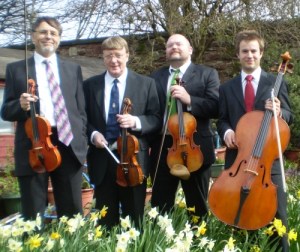
Martin Anthony (Tony) Burrage, Donald Turnbull, David Ruby and Alexander Holladay are members of Elegant Music (which also performs more formal concerts and recitals as Ensemble Liverpool).
For more photographs please see Camera & Calendar.
Read more articles at Music, Musicians & Orchestras.
Should We Keep British Summer Time All Year?
 U.K. clocks go forward on Sunday morning, 30 March ’08, and the lighter evenings which British Summer Time brings will cheer up almost everyone. But there would also be many other anticipated benefits, from road safety to energy conservation and healthier lifestyles, were we to keep ‘Daylight Saving’ all year. A Downing Street petition has now been set up to urge a continuous BST trial period of three years, with research to establish the extent of these benefits.
‘Daylight Saving’ is an issue which won’t go away. And now there’s a Petition to the Prime Minister, asking him to not to let that precious extra hour of afternoon light go away in the Winter either.
Downing Street petition
The Downing Street petition aims to ‘make better use of the limited daylight we receive’. It reads as follows:
We the undersigned petition the Prime Minister to consider a change to the current system of British Summer Time / Greenwich Mean Time (BST/GMT). This could consist of a trial period (similar to that adopted 1968 to 1971) and could take the form of a move to year round BST, or a 1 hour shift to GMT+1/GMT+2. Research shows that such a move could reduce carbon dioxide emissions, reduce road deaths, facilitate business with Europe, potentially boost tourism, increase outdoor activity, promote healthier lifestyles and enhance the well being of UK citizens.
You can read more detail of the Petition, and / or sign it, here.
BST Facebook group
There is also a Facebook group, set up like the Downing Street petition by Dave Alexander, which seeks to ‘raise support of and debate the possibilities and benefits regarding changes / trials of different time zone options for Britain…..This could reduce carbon dioxide emissions, reduce road deaths, facilitate business with Europe, potentially boost tourism, increase outdoor activity, promote healthier lifestyles and enhance the well being of UK citizens.‘
An enduring idea
This is by no means a new proposal, as we have already established very firmly on this website, but the need to get some action becomes greater with each year. If further debate is needed, the BST: British Summer Time & ‘Daylight Saving’ section of this weblog remains a forum where everyone from the South coast to scattered Scottish isles is welcome to share their ideas.
Discussion is however no substitute for evidence-based action. Health, energy sustainability and accident prevention are too important to ignore.
This article was also published as a New Start external blog.
Read more: BST: British Summer Time & ‘Daylight Saving’ (The Clocks Go Back & Forward)
Sefton Park Easter Fitness And Fun
 Sefton Park is the venue for a very organised fitness training programme. The wearers of these cheery Easter bonnets are amongst those for whom even the Bank Holiday weekend offers no let up on the exercise regime.

See more photographs at Camera & Calendar,
and read more about Sefton Park.
The Metropolitan County Councils, Abolished In 1986
 Incredibly, it was twenty two years ago that the Conservative government closed down the Metropolitan County Councils , thereby ensuring control from the national centre of power. The impact on local decision-making was huge, as was the effort subsequently required to rebuild the regional administrative decision-making process.
The Metropolitan County Councils, like the Greater London Council and the Inner London Educational Authority, were powerful bodies representing local and regional interests, and were seen as irritants on the national body politic. So Prime Minister Margaret Thatcher decided they ‘had to go’.
But as Dr Richard Beeching also demonstrated, when years earlier he closed many local and regional railway lines, it takes little time to destroy something which holds together the physical or political regional infrastructure – and an enormous amount of money and effort to reinstate it.

This is the invitation I received to the Merseyside County Council closure reception for ‘Workers in the Merseyside Arts Community’, on 20 March 1986, at Metropolitan House, Old Hall Street, Liverpool. The evening was hosted by Cllr Keva Coombes, a local lawyer and Leader of the Merseyside County Council.
See more photographs at Locations & Events and read more about Regions, Sub-Regions & City Regions.
So Women Leaders Are ‘Less Confident’ Than Men…
 Senior women leaders are often criticised for being less confident than the men, and for feeling unable to delegate. Is this any wonder, when those very men don’t play fair? It’s time for sexist attitudes in the corridors of power to be challenged head-on – which is exactly what Margot Wallström, Chair of the Council of Women World Leaders Ministerial Initiative, has just been doing.
The truth is, men choose men. It is as simple as that – not a question of lack of ambition, of interest or of aptitude from women.
So, in her article A thick layer of men, says Margot Wallström, Chair of the Council of Women World Leaders Ministerial Initiative, a network of current and former women presidents, prime ministers and ministers aiming ‘to promote good governance and enhance democracy globally by increasing the number, effectiveness, and visibility of women who lead at the highest levels in their countries’.
Chaps’ clubs
Well, I of course agree. There has to be some explanation of the neglect of women’s (much-needed) talents, and the most obvious is that they’re not part of the Gang. Until 90 years ago, women in the UK weren’t even permitted to vote, let alone to be members of the UK’s ultimate chaps’ club, Parliament, where many of the really big decisions are made.
We all know that the dynamic of debate and decision-making changes as the gender ratio also changes, both for men and for women.
And of course some men are always fairminded and exemplary in their professional conduct and beliefs; but sadly not as yet in sufficient numbers to secure the fundamental changes essential for genuine gender (or other) equality.
Determined rather than confident?
Maybe this explains claims at the moment that there may now be more women taking leadership roles, but these women are ‘less confident‘ than their male peers, and feel more obliged to ‘check the detail’ and don’t like to delegate.
You can only let the detail go, and feel confident, if you know that what you ask to be done, is indeed being done.
The next step towards gender equality can only be taken by the male half of the workforce. When men (and some other women) are as amenable to women as to men issuing the orders, leaders who happen to be female will feel confident that they don’t need to check up on everything.
Challenge the sexism, not the upshot
Until that’s fully grasped – and until ungendered collaboration and compliance in the workplace becomes a required part of professional behaviour for everyone – criticism of women’s leadership styles is, quite simply, unfair and out of order.
All power, I say, to Margot Wallström’s elbow, as she puts the ball back firmly in the chaps’ court.
Alexander Holladay
 Alexander Holladay is a cellist and a member of the Royal Liverpool Philharmonic Orchestra, which he joined in 2007 aged 25.
A graduate of Cambridge University and the Royal Academy of Music, he is also professor of ‘cello at the University of Liverpool.
Alex is a regular performer with Ensemble Liverpool and Elegant Music and has throughout his studies and career been an enthusiast for the chamber music repertoire, especially that for piano trio.
Alexander Holladay lives in Liverpool, where he is a member of the Royal Liverpool Philharmonic Orchestra. He holds an MA in Natural Sciences from Cambridge University, having also been for five years a member of the National Youth Orchestra. In 2005 Alex graduated from the Royal Academy of Music, London, where he studied with Colin Carr and Philip Sheppard.
Whilst at the Academy he received the prestigious DipRAM and various prizes, including the Thomas Fitton Prize for Strings, for best post-graduate final recital.
Alex then continued performing as a concert soloist and throughout the country with the Lawson Piano Trio. He has been invited to play with numerous professional orchestras, including the Philharmonia Orchestra, the City of Birmingham Symphony Orchestra, Bournemouth Symphony Orchestra, the BBC Philharmonic and the Northern Ballet orchestra.
Various tours have taken Alex to Germany, Hungary, the United States of America, South Africa and New Zealand.
Contact emails: Alexander Holladay; Ensemble Liverpool; Elegant Music.
Read more about Ensemble Liverpool and Elegant Music.
www.ensembleliverpool.co.uk
www.elegantmusic.co.uk
Liverpool’s Hope Street ‘Suitcases’: A Case History
The Hope Street ‘Suitcases’, installed by John King in 1998, are at the junction with Mount Street, by LIPA (the old ‘Liverpool Institute’) and Liverpool School of Art, opposite Blackburne House Centre for Women. The labelled suitcases ‘belong’ to many of Hope Street Quarter’s most illustrious names and organisations.
Coming A Cropper On Global Warming
 It was quite a surprise to see the global warming slogans which appeared from nowhere in Liverpool city centre – especially given the name of the street itself! Someone’s been doing their homework on the stats; and the figures are truly scary…


See more photographs at Camera & Calendar
BURA’s Regeneration Equality And Diversity Network Has Lift-Off
 Today (20 February 2008) saw the formal launch of the British Urban Regeneration Association (BURA)’s Equality and Diversity Framework and Network. The event, at the Abbey Community Centre in Westminster, was attended by people from across the regeneration world, and produced much discussion about how BURA and its partners could move forward.
In my role as BURA Champion for Equality and Diversity I was lucky enough to join our President, Sir Jeremy Beecham, and other colleagues, in presenting and discussing initial ideas about this challenging issue.
Your views too are welcome. To begin the debate, this is what I said:
BURA Regeneration Equality and Diversity Framework Launch
Wednesday 20 February 2008, Westminster, London
This event was set up, as Sir Jeremy explained, because of serious concerns which the BURA Board has about inclusivity in regeneration.
The evidence is before our eyes; the top of the profession is overwhelmingly populated by white men.
Regeneration fits the white male stereotype for leadership in Britain only too well; and the stereotype extends even to the BURA Board itself, where Directors are elected from amongst our hundreds of members.
Something has to be done. No-one disputes that, as regeneration practitioners, we must address inclusion; but few of us have articulated how this intention fits in with regeneration. And fewer still I suspect, are sure how to do it.
The BURA Board has therefore decided to invite your help and support as we move forward on this challenging issue.
What is inclusivity and why does it matter?
A look at the work of the Equality and Human Rights Commission gives us a good feel for what an inclusive society might look like.
It would be a society in which people had safe and secure opportunities to enjoy a happy and healthy life.
In this society people of every sort would find themselves in positions of influence and leadership, and able to work towards a situation which in turn releases the potential of others.
This would be a society in which we, as regeneration practitioners, understood the impact of our work on all our fellow citizens, and then applied that knowledge across all our activities.
It would be a society in which, say, Asian women in Bury had as much opportunity to develop their interests and employment potential as white men in Cheltenham. It would be a society in which families in both these communities were equally likely to see their children born healthy and strong, with an equal expectation of a long and happy life.
In a nutshell, it would be a society which is stable and sustainable.
And if regeneration isn’t about achieving socio-economic stability and environmental sustainability, I don’t know what is.
Regeneration is more than the sum of its parts
I believe firmly that the task of today’s regeneration practitioners is to work themselves out of a job. We need to believe at a very deep level that ‘regeneration’ is not the same as ‘construction’, or ‘remediation’, or even as ‘planning’.
Critical though these callings are, real regeneration is much more than that.
After 30 years of regeneration in Britain, we should now be seeking very actively to reinvent ourselves as ‘sustainability practitioners’, as professionals who work to maintain an equitable, healthy and safe environment for everyone.
This reinvention of ourselves would require massive changes in the way we work, in our collaborations across disciplinary boundaries, and in our perceptions of how fellow citizens who are not exactly like ourselves experience their lives.
We can’t do that if we don’t understand how to achieve inclusivity, and why it matters.
But there is a very long way to go.
What is BURA doing about itself?
* Firstly, we have undertaken a thorough audit of our own organisation.
* We have looked at the gender and ethnicity of all members of staff and the Board, going back for three years, and for staff we have correlated this with salary bands. We shall report these findings to the Board when it next meets, and post a summary of this information thereafter on our website.
* We will also decide as a Board, in consultation with, we hope, our new Chief Executive, how much more data it might or might not be appropriate to record about the Board and staff.
* And we shall consult too on whether and, if so, how we need to look at the ‘inclusion’ characteristics of all BURA members.
* We would hope at the same time to start research on these characteristics as they apply to the regeneration sector as a whole, and to see how this compares with the data for the British population overall.
What is BURA doing to support progress in regeneration overall?
* Importantly, we are not seeking to compete with anyone; we are offering a supportive network which encompasses the whole spectrum of interests – inclusive, not competitive, with the sole aim of moving this positive agenda forward.
* Also, we recognise that no-one as yet has all the answers; we are simply trying, with everyone else, to identify both the challenges and the opportunities.
* We are launching today a Regeneration Equality and Diversity Framework, an ‘umbrella’ group welcoming people and organisations from every part of regeneration, ‘professional’ to ‘community’, to address a wide range of issues around equality and diversity.
This group will not seek to undertake work already done by others, but will help to link together the inclusion themes which regeneration good practice must address.
Some examples of what the BURA E&D Framework seeks to achieve
* We will support the exchange of information and views about what are the most immediate challenges for Equality and Diversity in regeneration in the UK.
* We will seek to collaborate with government at local and national level, and with research bodies already examining aspects of Equality and Diversity.
* We will develop the BURA website as a free open-access resource, available to all, hosting weblinks to legal and professional aspects of regeneration practice – including equality and legal audits – and enabling wider discussion between BURA members and partners.
* We will offer practical help and support to people from different communities who wish to become involved in regeneration – perhaps for instance by offering bursaries and work placements – in a collaboration between BURA and our members and corporate partners.
* But most of all, we will seek to work with all of you to make the BURA Regeneration Equality and Diversity Framework not just a talking shop, but a vibrant and positive reality.
In for the duration
* This is however slow-burn. We’re asking the questions but we don’t as yet have many of the answers; everyone here today can help.
* The BURA Board are unanimous that we must work hard to make our Equality and Diversity Framework a reality, not just an ambition.
We very much hope that you will want to be part of this reality.
Contact Hilary at BURA
Launching The BURA Regeneration Equality And Diversity Framework
 Next week sees the launch in Westminster, London of the British Urban Regeneration Association (BURA) Regeneration Equality and Diversity Framework.
The BURA Board has unanimously resolved to try honestly to do what regeneration is supposed to do – reduce inequality and discrimination through the creation of environments where people can lead sustainable, happy and fulfilling lives.
From the regeneration perspective, equality and diversity are difficult things to get one’s head around. There are so many variables.
I tend therefore to approach these issues from the ‘other end’, and to ask myself the Big Question: what might a community look like when we’ve finished ‘regenerating’ it?
Put that way, things begin to fall into place.
Two futures
Two outlooks are possible for a place or community which has received the full attention of the regeneration professionals.
Either it will thrive, moving forward to a happier future, where people feel fulfilled and their needs are met in a much more embedded way than before; or it will in time lose its expensive new patina and sink into a deeper, sadder, less secure state even than before.
These different outcomes depend largely on the extent to which that community has been enabled to achieve sustainability.
Three aspects to sustainability
Sustainability has three major aspectss: physical (‘environmental’), economic and social. None of these can be achieved longer term without the others.
Sustainability is impossible without equality and diversity; so regeneration too is underpinned by them.
A stark truth
The Commission for Racial Equality’s final blast at the regeneration business, when in late 2007 that organisation became a part of the new Equality and Human Rights Commission, was well placed. It demonstrated, starkly, that ‘race’ issues remain desperately under-addressed in regeneration.
And it certainly made the Board of the British Urban Regeneration Association (BURA) sit up. Already painfully aware of a lack of diversity at the top table, now we had undeniable evidence about one critically core aspect of disadvantage.
Many realities, many ways forward
The more we looked at disadvantage – whether resulting from age, religion and belief, disability, gender, race or sexual orientation – the more it seemed to stem from the same issues; issues most often around opportunities and resources which people feel they have been denied.
The multiple realities of ‘ordinary’ people’s lives are what define our communities and how they interface with the wider society. This then, surely, is what regeneration is all about?
Where to begin?
So here is BURA’s starting point.
As leading players in regeneration, BURA’s Board has resolved to try honestly to do what regeneration is supposed to do – which is to reduce inequality and discrimination through the creation of environments where people can lead happy and fulfilling lives.
To do this we will look carefully and immediately at how we can put our own house in order; we will listen to and liaise with as many other interested parties as we can; we will seek out, and where necessary and possible commission, research which informs our ambition; and we will take the message wherever it needs to go.
We introduced the BURA Regeneration Equality and Diversity Framework concept at our 2008 annual conference, in January. We shall launch it formally at our London event on 20 February; and we will monitor our progress thoroughly as we move forward.
We hope you too will want to be part of this journey.
Hilary Burrage is a member of the BURA Board, and BURA Equality and Diversity Champion. (hilary@bura.org.uk)
The BURA Equality and Diversity campaign is supported by New Start and Ecotec.
This article is a version of the piece published in New Start, 15 February 2008.
See also: New Start survey reveals doubts over cohesion and New Start Editorial of 13 February 2008.


 Dreaming Realist