Blog Archives
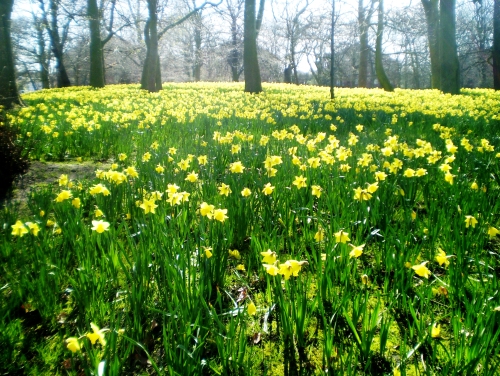
Spring Comes To Sefton Park, Liverpool
 The past few days have convinced us that Spring is finally on its way.
The daffodils in Sefton Park are a glory all of their own – the focus of hope in so many ways, at the equinox when people begin once more to populate our park’s wonderful space, strolling by in chatty groups, with prams, on bicylces, running to raise funds for charity or simply stopping to enjoy.
And then, as the daffodils begin to fade, we see the promise of the next great gift of nature, the delicate blossoms of almond and cherry to delight us yet a while….

See more photographs of Liverpool & Merseyside and read more about Sefton Park.
The University Of Liverpool Post-Graduate Poster Day
 The University of Liverpool has one Graduate School for all disciplines. The School’s annual Poster Day (27 March, in 2009) enables all these fields to be showcased together. I had the happy task with a few other ‘external’ judges of selecting the first-ever prizewinner for the new ‘North West Hub’ award, to emphasise links between academia and the wider world.
Education & Life-Long Learning and Knowledge Economy.
The exemplary aims of Poster Day are to offer graduate students practice in the skills required to communicate to a degree educated public, and to provide an opportunity for them to learn more about research being undertaken in other parts of the University.

The University of Liverpool Graduate School Poster Day exhibition was fascinating; the cross-faculty range of work under one roof would surely have taken months to get fully to grips with, but we had just a couple of hours. I used the time to talk to some very interesting people, all passionate about their work and the reasons they were doing it.


The involvement of ‘external’ visitors was a new step introduced this year. Here we see some of the Graduate School Team, including Dr Richard Hinchcliffe (Director of Postgraduate Training) with my fellow judges:

But in the end we had to make a decision, spoilt for choice though we certainly were.
The general criteria for the North West Hub overall prize included visual impact, organisation of the material, the accessibility of and rationale for the research, and, last but not least, the enthusiasm and clarity of the researcher him or herself. It seems very fitting that the award was after much discussion made to Andrew Lee-Mortimer for his engineering research project around Design for Sustainability.

Read more articles about Education & Life-Long Learning and about the Knowledge Economy.
Women In Wigan A Century Past; Water And Gendered Sustainability Now
 The 8th of March is International Women’s Day, an occasion to look both back and forward. We have here some photos and text reminding us gently how grim life was for working class women and children in the mills (and often for their mining menfolk too) a mere century ago. Happily, Wigan Pier and the canals are now a tourist destination alongside a modern Investment Centre; but around 1910 a different story – not least about the uses of water – was being told. The challenge remains to secure the same progress as we’ve seen here, in ensuring healthy and constructive lives for women and their families everywhere across the globe.

Here’s the text of this notice, displayed by the towpath at Wigan Pier:
TRENCHERFIELD MILL
When cotton was king
as told by a cotton worker circa 1910
It’s hot int’ mill wi’ lots o’ noise. On a nice day, we’ll take our lunch ont’ towpath an’ eat snaps* from’t snaps tins.
It’s a 5-and-a-half day week for us cotton workers, that’s 12 hours a day and half a day on Saturday.
We’ve all got nimble fingers , especially the Piecers’. They’re mainly children, who nip under the spinning machines to tie the broken cotton back together again.
Some of us work on the spinning machines and some on the carding machines. The mill takes a raw bale of cotton, cleans it, twists it and spins it into fine yarn.
The humidity in the mill keeps the cotton damp so it’s easier to spin without snapping.
There are five floors of machinery – all powered by the Trencherfield Mill Engine.
The noise is deafening – we stuff cotton from the floor in our ears to protect them. We communicate using ‘Me-Mawing’ – a mixture of sign language and lip reading.
We work in our bare feet because our clogs could spark on the concrete floor and set the cotton bales alight.
We wake early doors to the sound of the Trencherfield steam whistle summonin’ us t’mill for another day. But as they say – England’s bread hangs on Lancashire’s thread.
[* a snack favoured also by the men of Wigan, many of them miners, usually bread-and-dripping, with cold tea, carried in a flat tin called a snap-can – see George Orwell‘s The Road to Wigan Pier]
And here is the towpath which a century ago provided fresh air and respite for those mill workers as they ate their lunch-time snaps:


[Public display boards by Wigan Heritage Services]
The power of water
And so, strangely, we come full-circle.
Water – the canals, the steam – was the power behind the early production of textiles, employing many women and children in horrendous conditions, as the full logic of the Industrial Revolution took its vice-like grip on the emerging economies of what we have come to know as the ‘developed world‘; but even now in other parts of the globe water remains both a critical force potentially for good, and often an almost unattainable resource.
Women as water workers
Vast numbers of women and children in the developing world continue to toil many hours a day just to obtain water to sustain their very existence.
Life in places like Wigan was harsh and short for women and men, alike, a century ago. It remains, as Oxfam tells us in the topical context of International Women’s Day, particularly harsh even now for women in places such as Iraq, where water continues to be inaccessible for many.
The gendered meanings of sustainability
This is where we begin to understand what ‘sustainability‘ is really about…. the just and equitable distribution of basic physical resources and accessible socio-economic opportunities, for everyone, women as much as men, the world over.
In terms of future global sustainability and equity, as the Gender and Water Alliance also reminds us, water remains a critically gendered issue.
Read more about Gender & Women and about Sustainability As If People Mattered and Water; and see more photographs of around Liverpool & Merseyside.
Josephine Butler House: Liverpool’s Saga Of Civic Shame
 Josephine Butler House in Liverpool’s Hope Street Quarter is named for the famous social reformer, and the site of the first UK Radium Institute. Latterly an elegant adjunct to Myrtle Street’s The Symphony apartments, it sits opposite the Philharmonic Hall. But the intended ambiance has been ruined by a dismal failure and omission on the part of Liverpool City Council, who have permitted Josephine Butler House to be grimly defaced with little prospect of anything better, or even just intact, taking its place.
Can Liverpool’s Arts And Culture Businesses Thrive Post-2008?
 The Liverpool Chamber of Commerce and Industry (LCCI) represents all sectors of business in the city – including those who work in arts and culture. A current Chamber concern is therefore to maintain and promote the gains made in 2008 by Liverpool’s creative, arts and culture sectors. The recent momentum remains fragile, and for continued success it is essential that arts and ‘non-arts’ businesses across the city develop the synergies to be gained by working together in 2009 and beyond.
Enterprising Liverpool and The Future Of Liverpool
The Liverpool Chamber of Commerce and Industry has a Members’ Council which has an Arts and Culture Committee, of which I am chair*. This Committee seeks to help maintain the profile and business health of Liverpool’s creative sector; hence the following article, a version of which has just been published in the “Liverpool Chamber” magazine:
We sometimes forget that arts and culture, as much as any other formal activity, is Business. Artistic enterprise brightens our lives and captures our imaginations, and it’s done by people, often highly trained, who earn their living in that way.
It’s therefore important that Liverpool’s Capital of Culture Year 2008 momentum is maintained into 2009. Liverpool needs the arts to flourish because they enhance both our communities and our economy.
Momentum unsecure?
Some of Liverpool’s arts practitioners fear however that the momentum of 2008 is not yet secured. The Liverpool Culture Company expects the ’09 funding round to be ‘highly competitive’; and everyone anticipates that sponsorship will be difficult to come by in the current financial situation.
So it’s unsurprising that Liverpool’s arts practitioners are currently nervous, some of them already publicly predicting ’09 will be a tough call.
New but vulnerable synergies
Of course this scenario applies to other businesses as well; but the arts have developed new synergies and added value during 2008 which, once lost, it would be extraordinarily difficult to reinvent. The ‘08 cultural gains remain vulnerable, and need more time to embed if they are to bring maximum benefit.
This isn’t simply an academic concern. Liverpool’s established businesses are beginning to wake up to how they can work to mutual advantage with arts providers.
Live music brings in more customers; visual arts encourage customers to linger; drama can be an excellent training tool…. and it also all helps the economy to tick over because practitioners are earning and spending money locally.
A role for all Liverpool businesses
The LCCI Arts and Culture Committee is seeking to encourage this beneficial synergy, but there’s a role here too for companies across the city. We all need to say how important the ’08 cultural legacy is; and we need to think how to conduct real business with arts enterprises.
Hilary Burrage
Chair [* retired June 2008], LCCI Arts and Culture Committee
A version of this article was first published in the January / February 2009 edition (Issue 19) of “Liverpool Chamber”, the magazine of the Liverpool Chamber of Commerce and Industry.
Read more articles about Enterprising Liverpool and The Future Of Liverpool, and see more of Hilary’s Publications, Lectures And Talks.
Liverpool European Capital Of Culture Comes To An End
 So it’s all over, for now. Liverpool has handed on the European Capital of Culture title to Linz and Vilnius, after a rollercoaster year on Merseyside. There have been highlights and muddle, fun, exasperation and exhaustion. The debates and analysis will start soon enough – and we need them, to learn what worked and what didn’t – but tonight the thing everyone, people in their thousands and from many communities, came into town for, was a party….


Read more about Liverpool, European Capital of Culture and see more photographs of Liverpool & Merseyside.
The Future Of Liverpool: One E-Network, Many Prospects?
 There can be few issues, at the local level, more pressing than what’s to happen to one’s city. As Liverpool’s European Capital of Culture Year ends, perhaps the new LinkedIn Group on ‘The Future of Liverpool’ will help to sharpen our ideas.
The Future Of Liverpool
For Liverpool, 2008 has been a year of enormous change, as buildings have come down and gone up, roads have disappeared and re-emerged, and of course the European Capital of Culture has taken, massively, the centre stage.
But now the emphasis must move from these transitions to our longer-term future; new critiques and ideas will emerge and point us in as yet unrevealed directions. And everyone who can will need to be involved; not just those who sit in committee rooms.
To help the debate along a new LinkedIn Group open to all has been formed. To join, simply go to LinkedIn and then search Groups for ‘The Future of Liverpool’. Your contributions will be very welcome.
Read more articles about The Future Of Liverpool and see photographs of Liverpool & Merseyside.
Shining Lights On The Shortest Day
 We’re at the longest night and the shortest day – the Winter solstice. But that doesn’t stop the goodwill shining through, as citizens of Liverpool get together to raise money for worthy causes. Every year at this time the Santa Claus wagon trundles past, tannoy blaring out the carols and youngsters running from house to house as they collect for charity. And private festive collaborations are evident too, with neighbours sharing brilliant illuminated phantasies to cheer us all up.
Culture Secretary Andy Burnham MP Thanks Liverpool Volunteers For Capital Of Culture Efforts
 Liverpool’s great St George’s Hall offered a splendid setting for the event at which Andy Burnham MP, Secretary of State for Media and Culture, offered thanks and encouragement to the people who had made such an effort to deliver the 2008 European Capital of Culture programme. Volunteers and officers alike congregated to hear the Culture Secretary say well done, and to muse on the challenges of 2009. This he opined, as do many of us, is only the beginning…
‘La Princesse’: Arachnid ‘Art’, Big Toys And Cultural Communities In Liverpool
![08.09.04 La Machine [The Liverpool Spider named La Princesse]](https://i0.wp.com/www.dreamingrealist.co.uk/08.09.04%20La%20Machine%20%20007aa%20144x144.jpg) La Princesse, a gigantic metal spider, came to Liverpool in early September 2008. This monster brought huge crowds to the city centre, as it enacted its story of ‘scientists’ and adventure. But the reasoning behind The Spider was no fairy tale. It was there to attract ‘cultural tourism’ business to the city. At almost two million pounds, one hopes this was a success. Whether the same can be said for the rational that it engaged people in ‘culture’ is less certain: at some point real cultural engagement surely also involves empowerment.
La Princesse, a gigantic metal spider, came to Liverpool in early September 2008. This monster brought huge crowds to the city centre, as it enacted its story of ‘scientists’ and adventure. But the reasoning behind The Spider was no fairy tale. It was there to attract ‘cultural tourism’ business to the city. At almost two million pounds, one hopes this was a success. Whether the same can be said for the rational that it engaged people in ‘culture’ is less certain: at some point real cultural engagement surely also involves empowerment.
Few people will not know that Liverpool, in the early Autumn of its European Capital of Culture 2008 year, has been visited by a Big Spider.
This ‘creature’ (for some indiscernible reason named La Princesse) was constructed entirely of metal, wood and bits of hydraulic and was, it is said, fifty feet high. It paraded in the city centre over the first weekend of September 2008, ‘acting’ out a storyline involving ‘scientists’ who had to do ‘experiments’ to control the gigantic techno-insect.
A European connection
A direct descendant of the Sultan’s Elephant (which suddenly appeared in London in May 2006), another construction from the company La Machine, this creation cost even more – apparently something under £2 million. In both cases considerable sums will have gone into the coffers of the French business which built these monster artefacts…. which by their genesis at least bring a much-needed ‘European’ angle to our singularly Scouse Capital of Culture 2008 activities.
And it is worrying to learn from Artichoke, the UK company which brought the machines to Britain, that there was a serious shortfall in anticipated budget (the sum of £300k to £400K has been suggested). Indeed, a charitable appeal was put out to plug the gap.
Arts budget shortfalls and sensible audits?
What, I wonder, would happen if smaller, less publicly vaunted, arts organisations had proportionately similar shortfalls? And if they started from the premise that they could keep the arrangements to themselves, feeling no pressing need to be particularly transparent about anticipated ‘audience’ numbers, budgets, impacts or outcomes?
I ask this as a volunteer community arts promoter threatened last year with the withholding of one thousand pounds from the munificent five thousand promised (our total budget was around £18,000), simply because of a genuine mistake by a single supplier involving very considerably less than just one pound – and which it took many weeks of my (and others’) unpaid time, as well as hours of city employee activity, to resolve.
Proportionality
Which Council officials, I must enquire, have time and salaried capacity to pursue relentlessly a sum amounting to the cost of one postage stamp? (If nothing else, we can now see that corporately they really don’t understand proportionality in accounting.)
Are these the same people who seem happy to permit the continuation of their own projects when over-running by six figures (predictably, since some – how much? – of this was attributed to the fall of the pound against the Euro)? Perhaps La Princesse should be renamed La Suprise.
The rationale: cultural tourism
It might seem here as though I’ve lost the point of what La Machine’s creations are ‘for’. But I don’t think so. The Spider was and remains at its metal heart a vehicle for marketing and tourism; and perhaps also a justification for the self-laudatory outpourings by the powers-that-be which those of us who live in the city encounter on a daily basis from our local media.
But using ‘art’ promotionally is not an especially Liverpool activity. It happens everywhere, from Glasgow to Vienna to South America; just think of the previous UK European Capital of Culture, or the Vienna Philharmonic, or the Andean statue of Christ the Redeemer. Very different ‘arts’, but given in the modern world (if not in origin) the same message and intent.
Marketing becomes the meaning
What bothers me is when the one and only meaning of an art(efact) is the marketing message.
Our Austrian orchestra and South American statue began in very different ways – one started in 1842 as a celebration of the great tradition of European classical music, and the other as a celebration (in 1904) of a peace treaty between Argentina and Chile, bickering over their national boundaries. Only subsequently have these cultural icons become brilliant marketing tools.
Different ‘rules’ for different ventures?
So here’s the rub: whilst perforce relatively junior local government officers were (a) assiduously trying to delay – we can all guess why – the payment of the final grand of the magnificent ‘funding’ allotted to my hard-working on-the-ground arts charity and (b) ignoring equally assiduously (they had to) my remonstrations that this sort of behaviour is exactly why many ‘in the community’ give up and walk away from delivering grassroots community arts and cultural activities, other more senior officers were short-cutting to hugely expensive ‘projects’ which amount to a cross between the disneyesque and hard-sell…. which they then self-declare to have been a massive success even before it’s all finished. QED.
I don’t, as it happens, mind spectacle and fun; entertainment in the right places is great. But entertainment is just not the same as real engagement.
Community engagement
Community engagement in the arts doesn’t ‘hand down’ from on high, it nurtures reaching up and out. It is both responsive and self-determining, a laborious (but never boring) process, building slowly on trust and developing each individual’s confidence and skills, both as a performer / practitioner and as an appreciative perceiver of the art/s on offer.
You have to believe in people for the longer term to be a really good community arts practitioner. You have to understand the skills which other artists – not just in your own genre, but across the whole spectrum – and partners bring to whatever you’re doing. You have to be, quietly, really good yourself at what you’re hoping to engage others in also.
Challenge and aspiration
And, even more quietly, you have to be willing to challenge the people ‘in the community’ with whom you’re working; not in a know-it-all way, but in the sense that you are privileged to have seen in the wider world how well things can be done when real effort is made, and you would like that to be reflected in how those you are collaborating with approach their chosen tasks.
No genuine artist ever thinks (s)he couldn’t do even better. ‘The best’ is at the bottom of the rainbow. All any of us can do is aspire.
The Spider’s legacy
I’m not at all sure The Spider achieved much in these lights. Its impacts will (I hope) be revealed later. But did it challenge and focus anyone? Did it leave a message for the people of Liverpool? Will it somehow still do so, if plans for its return to the city are confirmed? Only, I think, if there’s a lot more debate between then and now about how to encourage local people, in ‘the community’, to see that as yet we all have plenty of scope for delivering even better what is good about our city.
And in the meantime, small arts enterprises such as my own try to stagger on, largely sidelined and called to account in really silly ways, far more often (however much some of them might like to) than we are actively helped, supported and appreciated by the powers-that-be.
To be truthful, I suspect both that most of those in charge (not of course all – there are some very decent and reality-based people too) have no experience of struggling at the grassroots, and that people who do work on the ground are simply not a part of the high level strategic landscape.
Pre-packaged for ‘the community’
The real decision makers often talk about ‘the community’, but this in their understanding is something to be done unto, to be delivered predetermined culture in predetermined ways.
Rarely is this ‘community’ seen as hugely complex and nuanced (infinitely more nuanced than the standard ‘community’ cultural stereotypes), encompassing many possible ways of contributing to, developing and appreciating arts and culture of all sorts. But it takes time, resources, effort, belief and courage on all sides to get there.
Engaging, or just entertaining?
How much easier – as those amongst cultural managers who are genuinely community-facing will confirm – to deliver a pre-packaged monster spider, than to work patiently for days, weeks or months with the people it has been decreed ultimately will pay for it, to produce something wondrous of their own. Too many of those at ‘the top’ would, if they gave it a thought, have no idea how they could actually help here, anyway.
For me personally that doesn’t matter. I have other quite different things to think about as well, and I didn’t go into this for the bouquets. But if recent experiences were my first or only way of engaging through culture with the city in which I have lived for many years, I would be thoroughly downhearted.
Imagination and vision
‘Real’ art and culture captures the imagination and, in so doing, enables people to see things which they didn’t perceive before. Maybe La Princesse fleetingly did the first; but I haven’t seen much evidence that it does the second. And for roughly the same amount of money as the cost of the European arachnid, we could undertake programmes the same size as my own charity’s single venture in every ward of the city, ‘engaging’ hundreds of people directly and truly meaningfully on each and every occasion.
To keep this member of the local ‘community’ happy, the hard-edged longer-term marketing outcomes for Liverpool from La Machine had better be pretty spectacular.
A version of this article first appeared in a-n magazine, December 2008.
Read more about Liverpool, European Capital Of Culture 2008 and see more of Hilary’s Publications, Lectures And Talks.


 Dreaming Realist