A Gathering And A Big Lunch In Toxteth’s Princes Boulevard, Liverpool
 Princes Boulevard in Toxteth, Liverpool, was once a bustling avenue, the home of wealthy merchants and many townspeople. Then local fortunes took a desperate downturn, the nadir being the Toxteth riots in 1981. But more recently things have begun to look up, as demonstrated for instance by The Gathering of May 2008, and today’s Big Lunch in this historic setting.
Judge Sonia Sotomayor: Not ‘White’ And Not Male, Simply An Expert In U.S. Law
 Sonia Sotomayor is the lawyer and judge who has been nominated by President Barack Obama to fill the vacancy on the bench of the American Supreme Court. This week Judge Sotomayor has been grilled at a senate hearing about her suitability for the post. She is also Hispanic and a woman. This it seems gives rise to fears by interrogating Senators that her judgements may differ from those made previously.
Social Inclusion & Diversity
The hearings on whether Sonia Sotomayor should become an Associate Justice of the US Supreme Court have been both predictable and in some ways depressing: her eleven inquisitors include just two women and the dialogue has reflected this.
Obama’s broad church
On the other hand President Obama, in nominating Judge Sotomayor, has demonstrated again (as he has with other appointments, such as that of Hillary Rodham Clinton to the post of Secretary of State) that he intends his administration to be a broad church, inclusive of the talents of people of many sorts.
It’s interesting that Sonia Sotomayor was able, in sworn evidence, to affirm that the President did not ask her personal views on matters such as abortion and gun control – issues which persistently appear in every hearing for appointments to the Supreme Court. Nor, apparently, do Sotomayor and Obama agree about the relevance or otherwise of ’empathy’ in legal judgement (she says she puts it aside; he sees it as relevant).
The obstacles of gender and ethnicity – and class?
It looks increasingly likely that Judge Sotomayor’s appointment will be confirmed. After the usual party political jostling, significant Republicans on the panel have indicated they will not oppose her nomination.
But why, and how, do these people think it appropriate to suggest that Sonia Sotomayor’s gender and ethnicity are critical issues which might mitigate in the future against fair and transparent interpretation of the law?
Sotomayor’s personal background is not unlike that of Obama; her early life, living in public housing in the Bronx, was uncompromisingly unprivileged. Perhaps social class also plays an unacknowledged part here. The Republicans amongst the Senators grilling her are not of the Grand Old Party (GOP) for nothing.
Privileged white men
But surely even they can see that the Supreme Court has thus far been an enclave of privileged white men? In its entire history it has been administered by 111 justices, only two of them so far women (the majority of the population), and none Hispanic (the fastest growing ethnic group in the USA).
Perhaps the Supreme Court has always adhered to interpretation of the law, with no fear or favour (though frightening statistics on what sorts of criminals are not excused judicial slaughter, for instance, might suggest otherwise).
But as far as I can tell, not many of these white, male, privileged nominations for the Supreme Court have been quizzed for days and days about whether their personal demographic provenance will endanger justice for all US citizens.
Politics and competencies
Assurances of propriety and competence are essential before any Supreme Court justice is appointed. Party political posturing is inescapably part of the game.
It’s a ritual of Supreme Court nomination that questions have to be asked about every imaginable variable, and that Senators at the hearing go to extraordinary lengths not to set procedural precedence which they may later find uncomfortable.
Striking failures of insight
But, glaring omissions of insight about how and by what sorts of people the US law and constitution have been determined in the past…..?
Small wonder during her inquisition that Judge Sotomayor has stuck unservingly to the position simply that: “The task of a judge is not to make law. It is to apply the law.”
I’m not a US citizen, but I am a citizen of a country which, like the US, seeks, in however flawed a way, to achieve fairness and equality. That fundamental – and perhaps intended? – apparent omission of insight on the part of Sonia Sotomayor’s inquisitors I find downright bizarre.
Read more about Social Inclusion & Diversity and Political Process & Democracy.
Where Should We Put The ‘Evidence Base’ When We Make Policy?
 How do ‘evidence’ and ‘policy’ fit together? It’s one thing to hope the evidence will tell us what to do; it’s another to persuade everyone else that the logic of how to resolve a given situation is so compelling. Evidence-based policies are a great idea; but different people ask for different sorts of evidence. And policy makers can only deliver what electors will accept. There’s a dialogue challenge here somewhere.
Political Process & Democracy
We all know that public policies these days ‘should’ be based on evidence; but I’m not clear about when and how the full might of rational thought is best brought into the public policy arena. We seem sometimes to have mislaid the ‘politics’ part of ‘policy’, in our reliance on ‘the evidence’….
The logic of the evidence
Scientists and researchers in areas where policy is being developed frequently tell us all that their evidence points this way, or that way, and I have no doubt that in their minds this is so.
I don’t however recall, ever, hearing one of these very well-informed and rational observers reflect on whether the way forward they propose is actually understood or acceptable to the public who will be paying for the implementation of the policy.
The art of the possible
It’s a cliché, but true, that politics is the art of the possible; the evidence base may be pristinely rational and logical. People, on the other hand, are not.
If we really want to see decent and well-founded changes in policy, ‘the evidence’ has to lie alongside what we can reasonably expect our policy-makers to deliver, in the pragmatic contexts of public understanding and mood.
Communicating findings
Perhaps we should find routine ways to use ‘the evidence’ to inform real dialogue and debate, not to jump straight to policy.
This is likely to happen only when more scientists and researchers start to communicate on a human level, and not just as rational-legal beings. Maybe research has to become a communicated art, as well as a science, if it’s to be really, really useful where it matters.
Changing how we do things
Perhaps scientists need (in general) to learn more about the art of communicating.
Perhaps policy-makers need to learn more about how to explain that research must actively address what at any given time is possible, as well as what’s best in an ideal, rational world.
And perhaps the rest of us have to understand that sometimes we need to move from what ‘they’ should be doing on our behalf , to what we ourselves can do to help each other see where evidence best fits into the very human process of decision-making and change.
A version of this article was first published as a blog in New Start magazine on 14 July 2009.
Read more articles about Political Process & Democracy. and see Hilary’s Publications.
Hilary Burrage Ltd….
 Well, I’ve taken the plunge. From today I’m no longer a Sole Trader, but, rather, a Private Limited Company. It’s a sensible move in business terms, but it’s also definitely a stepping stone towards a way of working which even three or four years ago I never thought would be for me. In part, this is because my circumstances have changed through happenstance, and in part it’s a changed mode of professional functioning which has developed its own logic over the past few years.
It may feel a bit daunting right now, but it’s also a very positive challenge…. so wish me luck!
See also HerStory (1950-)
The Stephenson Rocket Mural In Liverpool Edge Hill
 Liverpool Edge Hill was the location, along with its Manchester, Liverpool Road counterpart, of the first public railway station, opening on 15 September 1830. More recently this historic site was marked by a large mural of the ‘Rocket’ steam engine invented by George Stephenson (1781-1848) – an interesting vision in the grimness of our own contemporary Edge Lane access route into the city.
The Lowry, Manchester Royal Opera House Plans, Infrastructure And Regional Benefit
 The Lowry arts centre has this week stated its opposition to current plans for the Palace Theatre in Manchester to host all elements of a proposed Royal Opera House development in that city. The arguments on both sides seem however to miss some critical points: firstly, this is a regional not a sub-regional issue; and secondly the infrastructure and the local provisions should have been sorted years ago. Some other opportunities to develop the regional cultural offer have already been shunned; and now it looks as though this may happen yet again.
Arts Organisations, Regeneration and Regions, Sub-Regions & City Regions.
Reports this week suggest that the Lowry in Salford feels left out and disadvantaged by the proposed development of a northern (second) home for the Royal Opera House, if as a result all ROH-related northern ballet and opera productions – some of them currently hosted by the Lowry – were to be located in Manchester‘s presently fading Palace Theatre.
This is not the time or place to go into questions of sub-regional and local politics – the cities of Manchester and Salford must get along as best they can – but there are a few larger questions which now arise which might have been addressed earlier.
Regional aspects of the arts organisation proposals
Firstly, investments and development of this size are clearly regional as well as local matters. The Lowry, a Millennium product, cost over £100 million to set up, and doubtless the cost of the new proposals would also reach many millions.
It is surprising therefore that the ‘arts and culture’ debate thus far seems to have centred in its positive aspects only on the ROH and the Manchester orchestras. (Perhaps, as a slightly mischievous aside, there are very few left who recall that it was the Royal Liverpool Philharmonic Orchestra, not a Manchester ensemble, that performed at the Covent Garden Royal Opera House in May 1981 during the Royal Ballet’s golden anniversary celebrations?)
Locating and programming
Whatever, the there is now also a Royal Ballet in Birmingham, and Opera North may be intending like the Royal Ballet to make its northern activities to the Palace Theatre in Manchester; but the Lowry wants to keep them in Salford.
It has to be said however that the Lowry has disappointed some of us in its more recent opera and ballet offering. To begin with we were excited by the range and frequency of national-level opera and ballet at the Lowry, but over time this seems to have been diluted by a preponderance of more local and / or less ambitious scheduling. Once enthusiasms for a venue are lost, it is probably hard to get them back.
Travel and catchment
One unfortunate element in the Lowry scenario is its very poor infrastructure. It is almost impossible for non-Mancunians to reach (and return home from) on public transport. Unless you take the car, you can’t sensibly get there after work or in bad weather….
Despite the trainline from the West of Greater Manchester (Warrington, Liverpool, etc) running within sight of the Lowry, it doesn’t actually stop there, and one has to proceed into Manchester and return out on a local route. It’s perhaps relevant that the first stopping point, Manchester Oxford Road station, is however almost next door to the Palace Theatre.
Regional benefits
The Lowry deserves a measure of sympathy for the situation in which it is placed by Manchester’s proposals; but there is already a huge plan for the relocation of parts of the BBC to that site. And there is a feeling that the Lowry could have positioned itself better as an attractive venue: limited serious arts programming, poor and / or restricted catering provision, little public transport and expensive car parks do little to ensure a consistent and devoted fully regional audience.
There again, Manchester itself needs to explain why it has not, as far as can be seen, looked beyond its own boundaries to other North West areas, in sharing enthusiasm for the ROH proposals.
Lost and endangered opportunities
A few years ago Liverpool had an opportunity, which it decisively shunned, to make a bid for the National Theatre Museum to be relocated to Merseyside. That Museum used to be located right alongside the Covent Garden Royal Opera House; but despite the potential for inside influence of very eminent Merseysiders, not least on the board of the Victoria and Albert Museum (which owned the Theatre Museum), the bid never materialised and there is no longer any dedicated location for the theatre collection at all. Most of the collection is now stored away in Kensington, at the V&A itself.
The possibilities of real cultural synergy between Merseyside and Greater Manchester have already therefore been seriously blunted by lack of vision, imagination and enthusiasm. Let us hope this is not about to happen yet again.
Sir Richard Leese, Chief Executive of Manchester City Council, is surely correct in sharing with previous Secretary of State for Culture, Andy Burnham, the view that the regional benefits of the current proposals for regeneration and investment could and should be significant. But if everyone is not persuaded soon, there will probably be no action, or benefits at all.
Read more articles on Arts Organisations, Regeneration and Regions, Sub-Regions & City Regions.
1968 And All That: The Tale Of A Jobbing Sociologist
 Sociology as a discipline in the UK was shaping up during the 1960s; but there was still an air of mystery about the whole thing when I chose to study it. There was no clear role model on which to base expectations. The discipline has however served me well ever since. For most of my working life I’ve been what might be called a Jobbing Sociologist. This is a version of the account I gave of my interwoven personal and professional experience, writing for the British Sociological Association’s ‘Sociologists Outside Academia’ newsletter, published today.
Pre-History / HerStory (1950-), Social Science and Gender & Women.
1968 remains an iconic year for many. For some it represents a time of dramatic change preceding one’s own individual history, for others it was the start of a new way for us all to see the world.
But for me, 1968 was the point where the personal really hit the political-professional – the year I finished being a teenager and abandoned plans to be a natural scientist or a coloratura soprano (I’d tried both), and the year I got married and then enrolled for a degree in the most daring and mysterious subject I could think of: Sociology.
Realities
Needless to say, people opined that it would never last; but truth to tell my heart has stayed on both counts where I put it so long ago, and on many levels the two have interwoven over and over again as time marches on. Allies older and new will confirm that I’ve never been less than a fully paid-up feminist, but hard realities can sometimes get in the way of the more seductive theories of autonomy and self-determination.
My personal journey from undergraduate social science in the Nissen huts of the then North East London Polytechnic, to a freelance career as a writer and regeneration / sustainable communities consultant, via research and teaching Sociology and Social Policy in various institutions of Further and Higher Education and a decade of temporary ill-health ‘retirement’ when community activism was the only way to mitigate the tedium of physical immobility, has been part-moulded by my life as a spouse, mother, daughter, citizen and wage-earner. And I regret not a minute of it.
Following careers
I started my career in Sociology in London, because the Royal Academy of Music is where putative violinists such as my other half studied; we moved to Liverpool when he was appointed a member – as he still is – of the Royal Liverpool Philharmonic Orchestra; I undertook my Master’s (Sociology of Science and Technology, 1973; the first serious piece of research on women scientists in the UK) at Salford, because by a miracle the (then very unusual) exact course I wanted was accessible from our new home city; my PGCE was at Liverpool, so every morning before lectures I could take our baby daughter to nursery.
Having been forced (just pre-1975 and the Sex Discrimination Act) to leave my original FE teaching post when I started a family, I taught the new Open University distance courses at home whilst also sewing in pre-school name tapes, and then returned to teach ‘O’ and ‘A’-levels to many engaging young and older college students alongside checking juvenile homework. Later, I wrote the first-ever Sociology Access-to-HE modules, and academic papers and book chapters on aspects of Sociology. For some years I was (unpaid) commissioning editor for the journal Social Science Teacher, working from my prototype Amstrad computer.
Getting involved
I was also an active member of the British Sociological Association (BSA) Executive Committee, instigating the organisation, FACTASS (Forum of Academic and Teaching Associations in the Social Sciences), which eventually saw off the Margaret Thatcher-Keith Joseph proposal effectively to remove any notions of personal, health, social and civic education (PHSCE) from the school curriculum: ‘History finishes at 1945’ …. Oh no, it doesn’t, not if you’re teaching a decent school curriculum.
And as we all debated in those difficult times, I was learning for real how the prism of Sociology can offer a focus and analysis which rarely fails to stimulate or challenge.
Work experience
Early on, I was a social worker in Liverpool’s dire council estates, and briefly a youth worker; later I was Research Associate in teenage pregnancy at Liverpool Medical School, and then Head of Health and Social Care at a Merseyside FE college. And in the 1980s and ‘90s I had to take several years out of employment with severe arthritis; so I learnt first hand to cope with illness and disability (which much illuminated my later work as an NHS Trust Non-Executive Director and as a Lay Partner of the Health Professions Council) alongside how, as a volunteer and political activist, to lobby for arts and community organisations, so finding my way into the local and regional centres of decision-making.
Eventually from that arose the initiative to regenerate the area in Liverpool I designated as Hope Street Quarter – and thereby my re-involvement in the whole sustainable development agenda, on a very different basis from when my 1970s membership of Friends of the Earth and Scientists Against Nuclear Arms had been seen as almost subversive. Being Vice-Chair of the North West (region of England) Sustainable Development Group, and a Non-Executive Director and Equality and Diversity Champion of BURA, the British Urban Regeneration Association, are pretty respectable activities.
Widening the portfolio
And in the meantime I have undertaken independent consultancies on Sure Start and local authority Youth Services, helping to realign public service provision; I’m working with Muslim colleagues on a mosque project to engage disaffected young people, and to establish a Foundation for the inspiring black British composer Samuel Coleridge-Taylor. I’ve spent three fascinating years as Lay Member of the Defra Science Advisory Council (actually working in the corridors of power of which C.P. Snow wrote so compellingly, not long before I went to Salford all those years ago).
I’m currently teaching practitioners about sustainable communities online for the Homes and Communities Agency Academy; I’ve addressed conferences on my take on regional science and the new knowledge economy (‘Knowledge is like water – it flows where it can…’). I write and am a referee for regeneration journals; I have a very active website; plus I suspect I’m about to become the author of a book on communicating to achieve grounded sustainability.
The personal and the professional
So many hours on trains with the laptop, so much still to do; and now delightful Grandma duties too. My personal life trajectory has always and indelibly framed the professional one, but how else could it have been?
Free-lancing as a social scientist isn’t an easy way to earn a living, but I don’t think that’s the point. Knowledge may be like water, but sociological analysis is pure crystal. It sharpens perceptions and illuminates the social world. That’s invaluable in innumerable ways, not least as a consultant-practitioner and enabler of progressive social change.
This article was first published in the British Sociological Association‘s newsletter for its Sociologists Outside Academia group: Sociology for All, Issue No. 7 (Summer 2009).
Read more articles about Pre-History / HerStory (1950-), Social Science and Gender & Women, and see Hilary’s Publications, Lectures & Talks.
Regional Sustainable Development, Citizens And Strategy
 Sustainable development is a challenge for us all. If we don’t engage everyone, future generations will soon begin to pay for our neglect. For this reason, there are in the UK Sustainable Development bodies with national, regional and more local focuses. But what should these groups actually do? Here are some of the ideas which I as one individual have thought about as a member of a sustainable development group with a regional remit.
Sustainability As If People Mattered
What are the regional Sustainable Development (SD) bodies in the UK for? Is their role to provide ‘advice’ to politicians and state-employed policy-makers at the regional level? Is it to lead by example and implement programmes of work? Is it to be a talking shop between people representing different ‘stakeholding’ interests in SD? Is it something else altogether? Or is it all of these things?
Meaning and leadership in regional Sustainable Development
My personal view is that good regional approaches to SD are all these things.
Regions in the UK are all of a size (between 5 and 10 million people) where well-crafted action for sustainable development can have meaningful impacts. Regional SD groups should therefore:
* work together, with each other and with others, on the basis of mutual confidence and shared understandings – both of the factors shaping the region’s physical and socio-economic contexts, and of the perspectives of all partners;
* recognise that everyone is a stakeholder in this difficult challenge, not just those who are formally represented at the regional level;
* understand that SD is different from almost all other processes in that what happens now and in the near future cannot be revisited on the same basis and revised at some point later on: SD is globally shaped and uni-dimensional in respect of time;
* also understand that ‘good enough’ and actually deliverable has some chance of success, whilst ‘beyond any scientific doubt’ but not yet actionable is of very limited value in this period of rapid eco- and socio-economic change;
* offer visible and clear thought leadership to ‘people on the street’, as well as more formal and conventional strategic advice to those who formulate regional policy;
* recognise that this is real life; our current insights into the challenges of SD are far from perfect. Nurturing an ethos of shared responsibility in all who live and work in a region is however critical, right now.
Supporting regional approaches to sustainable development
The UK government has been working with the Sustainable Development Commission (SDC), Defra and others to promote regional SD. To this end, there does now seem to be a modest level of financial support.
It is nonetheless puzzling that these national bodies apparently imagine that each regional SD group can identify without further effort what the specific or even unique challenges for their region are. Yet, whilst this can be done for matters such as flood risk, the issues are far less obvious in many other respects. Not many policy makers and politicians at the local level, for instance, are even aware of what the risks might be.
Much work still needs to be done to bring together the relevant social, economic and environmental profiles for each region of the UK, and to encourage regional SD protagonists to share pro-actively their assessments and responses to these profiles. Just as UK regional strategies in science remain weak, so do those for SD.
Hearts and minds
There is a compelling case for regional SD bodies to recognise that ‘advice’ alone is not enough – especially in a time of flux for overall regional development policies, even before we come to the ultimately much more pressing matters of global warming, diminishing bio-diversity, economic difficulties (domestic and global) and the general well-being of current and future citizens.
Regional SD approaches are about leading from the front (no-one else has that specific focus and remit…). They must recognise the stakeholding of every person in their region, and find ways to reach them all. This is about encouraging dialogue, sharing good practice, aligning policy and developing the ideas which will help us all to face the future.
To achieve this requires not only analysis of the current regional state of play, but also commitment to help change the cultural climate as well as the environmental one.
Here is one challenge which a rational-legal or scientific approach alone simply cannot resolve.
Read more about Sustainability As If People Mattered.
World Environment Day (1994-2044?)
 Fifteen years ago today, this time capsule was ‘planted’ in Ness Gardens on the Wirral; and now we see sitting by it a little person who will be 35 years old when the capsule is opened. What will her world be like? Will we have made it a good and safe place for her and her own children to live in? And are we moving in the right direction, now, to ensure this will happen? Do we now understand what ‘sustainable’ living entails? Can we ensure that future generations – not the ones who felt obliged to ‘apologise’ in the time capsule letters – will manage to live sustainably and well?
Sustainability As If People Mattered
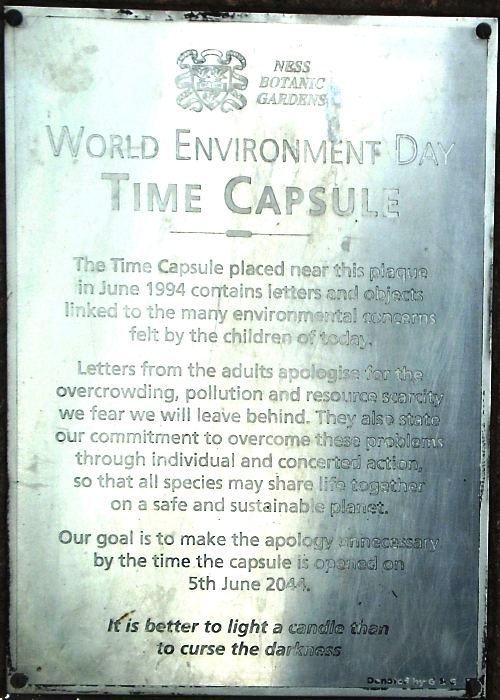
Here’s the text on this time capsule plaque:
Ness Botanic Gardens
World Environment Day
TIME CAPSULE
The Time Capsule placed near this plaque in June 1994 contains letters and objects linked to the many environmental concerns felt by the children of today.
Letters from the adults apologise for the overcrowding, pollution and resource scarcity we fear we will leave behind. They also state our commitment to overcome these problems through individual and concerted action, so that all species may share life together on a safe and sustainable planet.
Our goal is to make the apology unnecessary by the time the capsule is opened on 5 June 2044.
It is better to light a candle than to curse the darkness.
And so, indeed, it is…..
Read more about Sustainability As If People Mattered and Wirral’s Ness Gardens, and see more photographs at Locations & Events
Critical Choices: 4 June ’09 European Elections And The BNP
 The 2009 European Elections on June 4 are no ordinary political exercise; this time it’s about fundamental democracy, not ‘just’ party politics. There is a real danger the BNP will gain seats, unless everyone gets out and votes strategically – especially in the NW of England, where the BNP are focusing much attention. European Parliamentary seats are allocated proportionally, so the BNP will probably gain a NW seat unless Labour receives enough support for three candidates to be successful. Essentially that means it’s Theresa Griffin (Labour) versus N. Griffin (BNP leader)…
The world (as Albert Einstein reminded us) is a dangerous place, not because of those who do evil, but because of those who look on and do nothing.
In this case, the result of doing nothing could be very unpleasant indeed. There is a real risk, if turnout in the 4 June ’09 European elections is low, that the British National Party (BNP) will gain a seat in the European Parliament.
Once a BNP member was elected, they would have the resources which are required to be allocated to each and every MEP, and the legal right to have their far-right-wing opinions heard. This frightening prospect of real power for the BNP is why they are fighting so hard to win a NW of England European Parliamentary seat.
Proportional representation
In the 2004 European elections the BNP got 6.4% of the vote in the NW of England region, but no seat. This time they could need as little as 8% to gain one*.
[* Later: this is exactly what happened; please refer to footnote below.]
It has been calculated that only a strong vote for the Labour Party candidates (see note to follow) is likely to ensure the critical 8% level is not reached.
Keep the BNP out
As well as yourself voting against the BNP, you can help to keep the them out by supporting the non-party-political HopeNotHate campaign.

How to vote: the practicals
But actually making the effort to vote yourself is fundamentally important, whatever else you do.
The mechanics of voting are easy, but not everyone has voted before, so please bear with me whilst I do a quick run-through of what happens. Unless you already have a postal vote (which comes with its own instructions), all you need do is take some ID – preferably but not essentially your voting card – to a Polling Station on election day.
You can find out where the (many, local) Polling Stations are by phoning your town council, if needs be. They are open from 7 am till 10 pm on the day of the Election, Thursday 4 June.
At the Polling Station you will be given a voting slip which you take into a private booth, where a pen will be provided. How you vote is entirely up to you alone, but in the European elections you can only vote once, with a cross – nothing else – against the political party you have chosen. For example:

When you have made your choice, you simply fold the paper so your vote can’t be seen, and take it over to post into the nearby ballot box.
That’s it. Just a very few minutes of your day, and an infinitely smaller sliver of your life, to keep democracy alive.
How European Parliamentary seats are allocated
After polling closes, the votes will be counted, and the political parties with the most votes will be allocated seats in the European Parliament on a proportional basis.
The names of the individuals who will take these seats has already been decided in rank (preference) order by each of the political parties – you can see what this order of preference is when you look at the voting paper itself.
Most parties in the NW of England European elections have listed eight names, because that’s how many seats are allocated to this region; but no party expects to send all eight of their candidates to the European Parliament.
The allocation of European Parliamentary seats is calculated proportional to the total vote – and since there are in fact thirteen Parties contesting just eight seats, any party with over [13 party options divided by 8 seats = about] 8% will very probably gain a seat.

This is why it’s so crucially important to ensure the BNP gets an extremely low proportion of the vote – and this will only be achieved if a high percentage of the electorate actually get out to vote for the main political parties, and especially (in the NW of England particularly) Labour.
In other regions of the UK alternative ways to vote strategically against the BNP may apply.
NW Labour fights the BNP
The candidates whom the Labour Party ‘slate’ (list of candidates) emphasise are Arlene McCarthy, Brian Simpson and Theresa Griffin; the first two have already been MEPs for several years, and Theresa Griffin*, who lives in Merseyside, has also been active in local European politics for a very long time.
[*NB no relation to any other non-Labour candidate with the same surname]
You can check these candidates out, or contact them direct, through the links attached to their names as above.

But whatever you do, it’s crucial to realise that your vote can help keep the BNP out.
If you prefer other, non-Labour candidates that’s absolutely your democratic choice; but everyone needs to know that not-voting (or indeed voting – however earnestly – for small parties which cannot realistically win a seat) may end up with just the same result as actually voting for the BNP.
For me, having decided my personal politics already, it’s straightforward. I am a member of the Labour Party and will vote for its European Parliamentary candidates.
Strategic voting
This is not however a party-political blog, and I have never written a piece just supporting a party line for the sake of it, or asking anyone to vote simply along party political lines.
If you think there are other strategically feasible and decent ways of ensuring the BNP does not blight British politics through gaining a European Parliamentary seat from the NW of England, this space is yours to make the case… and to accept the political debate, as I have done here.
Democracy in action
Caring about democracy means being open about things and exercising the freedom to discuss without fear what you believe in, and why.
Never in modern times has it been more important to do so.
Whatever your mainstream political party of choice, please be sure to exercise your democratic right to vote on 4 June 2009 – and encourage other people, every way you can, to do the same.
~ ~ ~ ~ ~ ~ ~ ~ ~
P.S. 8 June 2009
Exactly what we all so much hoped wouldn’t happen has become a reality. The BNP NW candidate has gained a seat in the European Parliament.
The final results for the NW of England are:
Seats: 8 (previously, 9)
Turnout: 1,651,825 (31.9%)
Electorate: 5,206,474
Votes for main parties
Conservative: 423,174 (25.6%, up 1.5%) 3 seats (as before)
Labour: 336,831 (20.4%, down 6.9%) 2 seats (3 before, lost 1)
UK Independence Party: 261,740 (15.8%, up 3.7%) 1 seat (none before)
Liberal Democrats: 235,639 (14.3%, down 1.6%) 1 seat (as before)
British National Party: 132,094 (8.0%, up 1.6%) 1 seat (none before)
Green Party: 127,133 (7.7%, up 2.1%) no seats (as before)
To quote Nick Robinson, on his surgically precise BBC Newsblog:
Nick Griffin [British National Party: BNP] is now a Member of the European Parliament even though he won fewer votes than he did five years ago.
That’s right, fewer.
In 2004, the BNP in the North West polled 134,959 votes. In 2009, they polled 132,194 [132,094?]. So, why did he win?
In short, because of a collapse in the Labour vote from 576,388 in 2004 to 336,831 in 2009. In Liverpool, Labour’s vote dived by 15,000; in Manchester by almost 9,000; whilst in Bury, Rochdale and Stockport, its vote halved.
The switch away from postal votes for all in the last Euro election in the region also led to a fall in turnout.
Thus, the BNP could secure a higher share of the vote whilst getting fewer votes.
…. and this, sadly, is the very thing we most feared (above) might come to pass.
Read more about Political Process And Democracy.


 Dreaming Realist