Communities And The Public Realm: Places For People
 If anything belongs to ‘the people’, it is surely the streets where we live and work. Streets are usually owned by the public authorities who exist to serve our interests. But where are the civic procedures to reflect this common ownership in renewing or developing the public realm? And who and where are the ‘communities’ which must be consulted?
I recently contributed to a masterclass on community engagement in development of the public realm.
The scope for discussion was wide. ‘Public realm‘ can be streets, highways, open spaces, parks, brownfield sites and even waterways and ponds. Where does one start? And who is entitled to have a say?
Origins and ideas
Public realm works often start from a plan by the authorities to renew or regenerate an area of deprivation or poor housing, or perhaps because a new system of roads and highways is about to be constructed.
Sometimes, however, the initiative comes from a group of interested or concerned ‘community stakeholders’ – perhaps people who live or work in the area, or people who have a concern for the environment (in whatever guise) or, for instance, conservation and heritage.
Where are the place-makers?
All these are legitimate origins, but they are different. What happens next however tends to be more monochrome, more ‘standard issue’.
The idea of place-making seems over time to have been mislaid.
Legitimacy and control
If a proposal to improve the public realm is integral to a wider regeneration programme, the way ahead is clear: community consultation is the next step.
But who is held to comprise ‘the community’ will often be determined largely by those formally ‘in charge’ of the overall developments, rather than by that community (or communities?) itself.
Physical ownership or social stakehold?
The temptation to take the easy route, to see the public realm as simply physical space, is great. If it’s that, the relevant authorities can just get on with it, consulting along the way about how members of the public would like their pavements, bins or street lamps to look. (See e.g. an example of ‘another’ Liverpool, looking at another way to consider ‘place making’ and ‘liveability’.…)
But this is an dreadful waste of an opportunity for engagement between civic officials and those who pay them. How much better to work towards wide involvement of the people who live and work on those streets, even if this does take more time and effort.
‘Community’ voices
Communities do not comprise just one sort of person – there are many voices which must be heard – but if we want people to come together for the common good, developing a shared sense of place is an excellent starting point.
We need then to begin by recognising whilst physical location is a given, the variety of people and interests which comprise meaningful stakehold is large.
New skills for new challenges
Involving the general public as stakeholders in their localities is still an emerging art.
Those who currently have the knowledge and experience to implement improvements to the public realm are perhaps unlikely, without stepping outside their formal roles, or perhaps further training, to be the best people also to engage communities to the extent which is required.
‘Translating’ knowledge and skills
Here, yet again, is an instance of the need for ‘translation’ in delivery between professional knowledge and the skills required to reach deep into often – though not always – disadvantaged communities.
The public realm is exactly what it says it is – the place where, ideally, we all encounter each other, safely, comfortably and constructively.
Getting everyone involved
Perhaps the move towards Local / Multi Area Agreements (LAAs and MLAs) and regular Your Community Matters-style events will help to encourage meaningful engagement for the future.
Whatever, the challenge is to make the public realm everywhere a place where everyone really can feel they are a part of the action.
Read more about Urban Renewal
Big Science In Regional Economic Context: Daresbury And ALICE
 Investment in scientific programmes often has added socio-economic value. But there is little evidence that good indices are available to measure what this impact might be for large-scale scientific regionally-based development. Whilst private investors guard their capital with care, only rarely do the criteria for evaluation of Big Science proposals include adequate consideration of the wider impact of public funds invested.
The bovine foot and mouth pyres of a few years ago are testament to unintentional damage inflicted when strictly focused ‘science’ is applied crudely in wider socio-economic contexts.
Everyone wanted to do the right thing; but the upshot of scientific best advice was rural economic devastation.
What criteria?
The same scenario may be enacted again, if the judgement of a panel of leading scientists results in removal of the Alice (Accelerators and Lasers in Combined Experiments) programme at the Daresbury Laboratory in North-West England.
The science will carry on elsewhere, most probably in the USA, but the NW regional economy, which could have benefited hugely, will instead take a hammerblow.
Best value for government investment
Scientists quite rightly concentrate on what they understand – in this case physics, engineering and the like. I cannot comment on their scientific judgements about ALICE; though it is always open to their colleagues have views on this.
Whatever, the investment of significant government monies must also, as numbers of parliamentarians have argued, be about best value in socio-economic terms, as well as indicated by narrower scientific parameters; and the scientists would without doubt agree they are not best placed to adjudicate all this.
Socio-economic impact studies
If the relevant science councils have undertaken regional socio-economic impact studies on their proposed investments, these, like the scientific appraisals, must now be opened to public scrutiny.
If they have not, we must challenge the science councils to undertake these comparative impact studies immediately, before potentially devastating decisions are made.
Added value – or otherwise
‘Added value‘ (perhaps significantly, a term often used to evaluate the impact of educational initiatives) and ‘unintended consequences‘ (c.f. Robert Merton’s work) may be indices beyond the lexicon of physical science; but, as the rural economists acknowledged after foot and mouth disease, they can never be outside the remit of decisions about big investment, in the public interest, of taxpayers’ money.
A version of this article, entitled ‘Alice in economic context’, was published on the Letters page of Guardian Education on 15 April 2008.
Read more:
Science, Regeneration & Sustainability
Science & Politics
Spring, Four Strings And Four Seasons
 Daffodils in the sunshine take on a new aspect when they’ve just been background to a performance of ‘Spring’ from Vivaldi’s Four Seasons. Members of Elegant Music are here (below) relaxing in a break from rehearsals for a client’s special occasion.
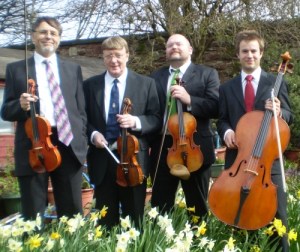
Martin Anthony (Tony) Burrage, Donald Turnbull, David Ruby and Alexander Holladay are members of Elegant Music (which also performs more formal concerts and recitals as Ensemble Liverpool).
For more photographs please see Camera & Calendar.
Read more articles at Music, Musicians & Orchestras.
Should We Keep British Summer Time All Year?
 U.K. clocks go forward on Sunday morning, 30 March ’08, and the lighter evenings which British Summer Time brings will cheer up almost everyone. But there would also be many other anticipated benefits, from road safety to energy conservation and healthier lifestyles, were we to keep ‘Daylight Saving’ all year. A Downing Street petition has now been set up to urge a continuous BST trial period of three years, with research to establish the extent of these benefits.
‘Daylight Saving’ is an issue which won’t go away. And now there’s a Petition to the Prime Minister, asking him to not to let that precious extra hour of afternoon light go away in the Winter either.
Downing Street petition
The Downing Street petition aims to ‘make better use of the limited daylight we receive’. It reads as follows:
We the undersigned petition the Prime Minister to consider a change to the current system of British Summer Time / Greenwich Mean Time (BST/GMT). This could consist of a trial period (similar to that adopted 1968 to 1971) and could take the form of a move to year round BST, or a 1 hour shift to GMT+1/GMT+2. Research shows that such a move could reduce carbon dioxide emissions, reduce road deaths, facilitate business with Europe, potentially boost tourism, increase outdoor activity, promote healthier lifestyles and enhance the well being of UK citizens.
You can read more detail of the Petition, and / or sign it, here.
BST Facebook group
There is also a Facebook group, set up like the Downing Street petition by Dave Alexander, which seeks to ‘raise support of and debate the possibilities and benefits regarding changes / trials of different time zone options for Britain…..This could reduce carbon dioxide emissions, reduce road deaths, facilitate business with Europe, potentially boost tourism, increase outdoor activity, promote healthier lifestyles and enhance the well being of UK citizens.‘
An enduring idea
This is by no means a new proposal, as we have already established very firmly on this website, but the need to get some action becomes greater with each year. If further debate is needed, the BST: British Summer Time & ‘Daylight Saving’ section of this weblog remains a forum where everyone from the South coast to scattered Scottish isles is welcome to share their ideas.
Discussion is however no substitute for evidence-based action. Health, energy sustainability and accident prevention are too important to ignore.
This article was also published as a New Start external blog.
Read more: BST: British Summer Time & ‘Daylight Saving’ (The Clocks Go Back & Forward)
Sefton Park Easter Fitness And Fun
 Sefton Park is the venue for a very organised fitness training programme. The wearers of these cheery Easter bonnets are amongst those for whom even the Bank Holiday weekend offers no let up on the exercise regime.

See more photographs at Camera & Calendar,
and read more about Sefton Park.
The Metropolitan County Councils, Abolished In 1986
 Incredibly, it was twenty two years ago that the Conservative government closed down the Metropolitan County Councils , thereby ensuring control from the national centre of power. The impact on local decision-making was huge, as was the effort subsequently required to rebuild the regional administrative decision-making process.
The Metropolitan County Councils, like the Greater London Council and the Inner London Educational Authority, were powerful bodies representing local and regional interests, and were seen as irritants on the national body politic. So Prime Minister Margaret Thatcher decided they ‘had to go’.
But as Dr Richard Beeching also demonstrated, when years earlier he closed many local and regional railway lines, it takes little time to destroy something which holds together the physical or political regional infrastructure – and an enormous amount of money and effort to reinstate it.

This is the invitation I received to the Merseyside County Council closure reception for ‘Workers in the Merseyside Arts Community’, on 20 March 1986, at Metropolitan House, Old Hall Street, Liverpool. The evening was hosted by Cllr Keva Coombes, a local lawyer and Leader of the Merseyside County Council.
See more photographs at Locations & Events and read more about Regions, Sub-Regions & City Regions.
So Women Leaders Are ‘Less Confident’ Than Men…
 Senior women leaders are often criticised for being less confident than the men, and for feeling unable to delegate. Is this any wonder, when those very men don’t play fair? It’s time for sexist attitudes in the corridors of power to be challenged head-on – which is exactly what Margot Wallström, Chair of the Council of Women World Leaders Ministerial Initiative, has just been doing.
The truth is, men choose men. It is as simple as that – not a question of lack of ambition, of interest or of aptitude from women.
So, in her article A thick layer of men, says Margot Wallström, Chair of the Council of Women World Leaders Ministerial Initiative, a network of current and former women presidents, prime ministers and ministers aiming ‘to promote good governance and enhance democracy globally by increasing the number, effectiveness, and visibility of women who lead at the highest levels in their countries’.
Chaps’ clubs
Well, I of course agree. There has to be some explanation of the neglect of women’s (much-needed) talents, and the most obvious is that they’re not part of the Gang. Until 90 years ago, women in the UK weren’t even permitted to vote, let alone to be members of the UK’s ultimate chaps’ club, Parliament, where many of the really big decisions are made.
We all know that the dynamic of debate and decision-making changes as the gender ratio also changes, both for men and for women.
And of course some men are always fairminded and exemplary in their professional conduct and beliefs; but sadly not as yet in sufficient numbers to secure the fundamental changes essential for genuine gender (or other) equality.
Determined rather than confident?
Maybe this explains claims at the moment that there may now be more women taking leadership roles, but these women are ‘less confident‘ than their male peers, and feel more obliged to ‘check the detail’ and don’t like to delegate.
You can only let the detail go, and feel confident, if you know that what you ask to be done, is indeed being done.
The next step towards gender equality can only be taken by the male half of the workforce. When men (and some other women) are as amenable to women as to men issuing the orders, leaders who happen to be female will feel confident that they don’t need to check up on everything.
Challenge the sexism, not the upshot
Until that’s fully grasped – and until ungendered collaboration and compliance in the workplace becomes a required part of professional behaviour for everyone – criticism of women’s leadership styles is, quite simply, unfair and out of order.
All power, I say, to Margot Wallström’s elbow, as she puts the ball back firmly in the chaps’ court.
Alexander Holladay
 Alexander Holladay is a cellist and a member of the Royal Liverpool Philharmonic Orchestra, which he joined in 2007 aged 25.
A graduate of Cambridge University and the Royal Academy of Music, he is also professor of ‘cello at the University of Liverpool.
Alex is a regular performer with Ensemble Liverpool and Elegant Music and has throughout his studies and career been an enthusiast for the chamber music repertoire, especially that for piano trio.
Alexander Holladay lives in Liverpool, where he is a member of the Royal Liverpool Philharmonic Orchestra. He holds an MA in Natural Sciences from Cambridge University, having also been for five years a member of the National Youth Orchestra. In 2005 Alex graduated from the Royal Academy of Music, London, where he studied with Colin Carr and Philip Sheppard.
Whilst at the Academy he received the prestigious DipRAM and various prizes, including the Thomas Fitton Prize for Strings, for best post-graduate final recital.
Alex then continued performing as a concert soloist and throughout the country with the Lawson Piano Trio. He has been invited to play with numerous professional orchestras, including the Philharmonia Orchestra, the City of Birmingham Symphony Orchestra, Bournemouth Symphony Orchestra, the BBC Philharmonic and the Northern Ballet orchestra.
Various tours have taken Alex to Germany, Hungary, the United States of America, South Africa and New Zealand.
Contact emails: Alexander Holladay; Ensemble Liverpool; Elegant Music.
Read more about Ensemble Liverpool and Elegant Music.
www.ensembleliverpool.co.uk
www.elegantmusic.co.uk
Liverpool’s Hope Street ‘Suitcases’: A Case History
The Hope Street ‘Suitcases’, installed by John King in 1998, are at the junction with Mount Street, by LIPA (the old ‘Liverpool Institute’) and Liverpool School of Art, opposite Blackburne House Centre for Women. The labelled suitcases ‘belong’ to many of Hope Street Quarter’s most illustrious names and organisations.
Coming A Cropper On Global Warming
 It was quite a surprise to see the global warming slogans which appeared from nowhere in Liverpool city centre – especially given the name of the street itself! Someone’s been doing their homework on the stats; and the figures are truly scary…


See more photographs at Camera & Calendar


 Dreaming Realist