Category Archives: Arts, Culture And Heritage
Life In A Professional Orchestra: A Sustainable Career?
 Will the next few decades see reduced opportunities to follow a performing career in the UK’s major (inter-)national orchestras? On current evidence, that the answer may be Yes. Whilst ‘classical’ music at the highest levels will continue to stake its claim in the cultural universe, extended career progression for most orchestral musicians is probably diminishing.
It took centuries to establish professional symphonic orchestras as bodies which employ large numbers of accomplished performers, contracted full-time and as permanent employees within formal artistic companies.
The first instances of engaged orchestral players are to be found in the Mannheim of around Haydn’s time (Joseph Haydn, 1732-1809), when conspicuous by extraordinarily wealthy patrons consumption – a whole orchestra just for me! – was the order of the day; but it was another century or so before civic patronage supported the regional and national orchestras which we see today. And even then, full-time professional orchestral posts have become the norm often only in the second half of the twentieth century.
British orchestras in transition
Britain has an honourable orchestral tradition, as home to some of the longest-established orchestral societies in the world. Proportionately, the UK may have fewer civic professional orchestras than some other parts of Europe – a situation which is justifiable cause for regret – but what Britain lacks in quantity it compensates in quality, with a long and distinguished history in the orchestral tradition from the origin of the great institutions, right up to the present.
So what is the problem? Perhaps contemporary British experience is different from that of continental Europe, but there is a sense on the part of some in the UK (such as Norman Lebrecht) that ‘the classical orchestra is dead’.
Endangered careers
This view I would emphatically deny. It does seem however that the ‘career of orchestral performer’ is indeed becoming endangered.
Whilst the UK conservatoires produce more and better technically prepared instrumental performers (whether they are thereby necessarily greater individual artists than their predecessors may be another debate), the standing of and prospects for career orchestral players now is probably even worse than it has been for many years.
But despite claims to the contrary, this is not because the current government is hostile to classical music. It is because, over the years and however unintentionally, players have acquiesced whilst managers have allowed it to happen.
Shifting contexts
The situation of the major London orchestras (which we will not consider further here) is different from that of most other UK establishments, of which there are now considerably more than even a few decades ago. New flexibly sized ensembles have arisen across the country in response to changing cultural and popular demands, whilst the traditional ‘regional’ orchestras – all of them institutions of international standing – have remained the benchmark against which serious professional artists in the British orchestral tradition measured their careers.
Until now, that is. For the past fifteen years or so have seen major shifts in the professional experience of those instrumentalists who hold full-time posts in the leading non-London orchestras.
Demographics redistributed
No longer are orchestras bastions of white male middle-aged hegemony. That stereotypical profile actually evaporated quite a while ago, but changes have been increasingly rapid in the past few years.
Whilst rows of older men were previously the norm across least the front desks of major ensembles, their replacements are often now young women, and often this gender turnabout extends to large parts of the string sections if not always elsewhere. Many orchestras have become feminised. And they have also taken on many keen if less experienced young players, not always to the delight of their seniors, for whom a thorough knowledge of the repertoire, gained by years of experience, remains the hard-won key to professional self-respect.
Interpretational consequences for the music
Few professional musicians would deny that a combination of experience and fresh enthusiasm is critical in the orchestral mix; but numbers of more seasoned players claim that a substantial core of professionally mature performers is still required – people who literally know the score and can be relied upon to sustain their own orchestra’s corporate memory in the interpretation of great works.
Indeed, it has been argued this loss of specific corporate memory is why orchestras now allegedly sound more similar than they did previously – a ‘sameness’ of interpretation which many listening classical music enthusiasts regret, and which perhaps adds to the future challenges facing the genre.
Career musicians, or instrumental operatives?
But it is not just the orchestral art form which has changed because of the new demographics. The actual experience of being an orchestral player has likewise changed. And principally this is because many of the newer performers do not, it seems, perceive orchestral music as a career in the longer-term formal sense.
In the words of some backstage wags, the role of the orchestral performer has become that of ‘instrumental operative’. Rather than perceiving themselves as individual performers of standing who are increasingly valued over time, the newer generation of players perhaps sees the role as one to be experienced for a few years before moves away from the symphonic platform offer diverse ways forward.
Multiple roles and core roles
In part the greater opportunities orchestras now provide to engage in small ensemble work, to develop skills in ‘community education, and in some cases to take on leadership roles (with parallel in-service training) at an early stage in a career, are to be welcomed.
British orchestras can lay legitimate claim to being at the developmental forefront in terms of the orchestra as a body of fine players with a range of skills and approaches. But in so doing they are also in danger of neglecting their core role – the propagation of classical music by performers of the highest standard, of course illuminating their work with fresh insights both musicological and technical, but also bringing to bear the understandings and traditions of previous generations of inspired composers, conductors and performers.
Strange scenarios
It is a strange situation where some orchestras offer substantial on-the-job training in community education, but no continuing professional development at all in the central role of any orchestral musician – that of playing his or her chosen instrument. Human resource formal issues apart, this is extraordinary in terms of the institutional failure to invest in core business – no-one can continue comfortably for years with zero personal support in their central role, especially when it is as open to scrutiny as that of performing musicians.
It is also a strange situation where the contractual position of many orchestral players, especially tutti players, leaves them with no expectation ever of a reasonable salary. (In early 2007, the average minimum salary for tutti / ‘rank and file’ players in the fourteen BBC and major ‘regional’ orchestras was marginally more than £26,000 – with hardly higher pay at the top end of that scale.) one are the days when longer service was recognised and financially rewarded. Now maximum income can be achieved in just a few years, leaving the prospect of decades on the same sub-optimal income.
Not a sensible long-term option
Add to that the loss through contractual change (secured by managements since the demographic changes outlined above) of most small additional income through recordings and television appearances, as well as often the 24/7 on-call requirement at no extra cost within the hourly averaged week (not ever good for family life).
It is little wonder that orchestral musicians increasingly see their long-term futures elsewhere. It perhaps was fun whilst it lasted, but it’s no way, they may decide, to earn a sensible adult living.
Western classical music on the cusp?
In other musical genres artists trace their artistic ancestry back through the generations. Western classical musicians too are able if they wish to do this; but in general they do not.
Whilst the orchestral role remains so unpromising for many in terms of professional progression and opportunities, the prospects for the art form too must be in doubt.
Valuing skills and talent
Colleges, players and managements all have some part to play in reversing this situation. When managers, and more players themselves, demonstrate in real ways that they lay store by performers’ skills and enduring careers, the paying public is more likely to do the same.
The way forward for orchestras is clear. Encourage a positive and purposive view of orchestral life, and other things will fall into place.
Read more about Music, Musicians & Orchestras.
What’s The 2008 Liverpool European Capital Of Culture Year For?
 Liverpool ‘s 2008 European Capital of Culture Year will be upon us in just a few months. But deep divides remain between artists, civic leaders and many local people about what the 2008 Year is ‘for’.
Alex Corina has taken the plunge into controversy on developments with the Liverpool’s plans for the 2008 European Capital of Culture Year. He’s reinvented Edvard Munch’s The Scream as The Liverpool Scream, just as in happier times he produced the Mona Lennon.
How do we measure success?
Despite the intentional playing to the gallery in all this, there is a very serious issue to be considered here. It concerns the rationale/s which lie behind the 2008 culture programme.
For many (not all) in the Culture Company I gather that one of most important ‘real’ ways that success will be measured in 2008 is number of tourist beds (i.e. overnight stays) which are achieved during the year.
The local artists’ perspective
I can see why this is a significant measure, but it’s not the message which most ‘community arts’ people in the city want to prioritise. They, like some Culture Company officers, seek to develop their communities by using ‘culture’ as a socially helpful way to bring people together.
This is however obviously much harder to measure and has less immediate impact on the seriously challenging sub-regional economy (though longer-term it would be good).
A view from cultural institutions
And then of course there are the ‘high arts’ bigger organisations which no doubt see the major outcome for themselves as being numbers of tickets sold for shows, concerts, whatever.
Again, a very valid perspective, and we need to recognise that if these organisations were not to benefit from 2008 ‘celebrations’
they would be in serious trouble in 2009 – which would mean the loss of many very accomplished artists and performers who currently work in the city(but often choose not to live here because the additional employment opportunities are so much better in, say, Manchester – see below).
Nurturing home-based professional artistic talent?
But the requirement to sustain the big arts organisations, though vital for Liverpool’s future status, still ignores the need – not at all as yet recognised as far as I can judge – to support locally-based fully trained and professional artists and performers with very high levels of skill who want to work in the city simply as artists and performers, not as community-based animateurs.
An edgy approach
This may be difficult when, for instance, the new Liverpool
Commissions stream requires that applicants offer something wacky and on the edge; which is good for some, but sounds absolutely daft if you are a historically-inclined fine arts person or a classically trained musician.
Playing to the local Liverpool gallery, which prides itself on being on the edge, is understandable, but it won’t impress many others from elsewhere; and why aren’t local professional artists being respected as artists in their own right – or so it might appear – in the same way as visiting ones?
I have already asked How Will We Know That Liverpool 2007 & 2008 Were Successful? And that debate continues.
At least three views?
In the meantime, I’m still not sure what the answers might be, but they seem to coalesce around the three views above:
1. tourist spend / beds
2. community cohesion and capacity building
3. (potentially) retention of high-level artistic skills in the city
Where’s the dialogue?
Unfortunately however there seems to be very little dialogue between those who promote each of these perspectives.
Indeed, I’m not sure it’s possible to do this under the present ‘consultation’ arrangements, with occasional meetings of large numbers of people – professional artists and others with very different experience together – in sports halls and the like.
Bringing the issues into focus
If Alex Corina’s current activities can help everyone to focus on
the ‘what’s 2008 for?’ message whilst there’s still at least a little bit of time left, that will be excellent.
As a city resident I’d like to see everything succeed so that proposed cultural ‘villages’, respected highly-skilled professional artists and performers, and our tourist trade all flourish ; but we’re still a way from achieving this.
A matter of urgency
The dialogue does need to be getting somewhere, and pretty quickly, please.
Cherry Blossom For May Day In Sefton Park, Liverpool
 The cherry blossom in Liverpool’s Sefton Park has been very early this year; it has already offered much delight to those who stroll along the middle lakesides, the blossoms pink, cream, white and even cerise. But one tree is still in glorious full bloom as we reach May Day eve.

See also: Sefton Park’s Grebes And Swans
Liverpool’s Sefton Park, Swans, Herons And Grebes
Sefton Park, Liverpool: Winter Solstice 2006
Friends Of Sefton Park
Pianos For Peace
 Rarely are artistic installations truly inspirational, but the use by George Michael and Kenny Goss of John Lennon’s piano, on which Lennon composed the song Imagine, is one such example. This travelling piano scenario is art, goodwill and common humanity all rolled into one.
George Michael is taking John Lennon’s piano on a roller coaster ride of emotions. Or that, at least to my eyes, seems to be what’s happening.
Singer-songwriter Michael acquired Lennon’s piano, on which the song Imagine was written, at the turn of the Millennium, and he and his partner Dallas art gallery owner Kenny Goss have now resolved the question of what special use to put it to: It has been given the central role in the world-tour Imagine Piano Peace Project.
Genuinely inspired art
It is a stroke of genius to take that humble piano to troubled places – sites of gruesome events such as assassinations, state-sanctioned executions, bombings, multiple murders and the like. The piano and its associations bring to these grimly horrible and
almost unthinkable acts a sort of dignity and calm.
The piano itself cannot and need not speak. It shows and incites no fear. All it has to do is occupy these sites as physical spaces. We can, each of us, work out the rest for ourselves.
John Lennon started life an unremarked child, attending our local school in Liverpool. He ended it a tragic victim of sudden very public violence in New York. As he himself might also have said of his travelling piano, just “Let it be.”

Introducing Elegant Music ~ Classical Music & Easy Listening For Events
 Elegant Music is a long-established, independent free-lance ensemble of fully professional classically-trained musicians who provide high quality music and easy listening for private, family and corporate events, after-dinner and soiree concerts, and special occasions. As individual players and singers we appear in our own rights with the North West’s most prestigious symphony orchestras and other performing arts organisations; and we come together as Elegant Music to offer classical music and lighter musical entertainment in venues across the region and beyond.
From Salon to Celebration, from Intimate to Corporate, we have music to suit your requirements. Please contact us, or read on…
Amongst Elegant Music‘s many previous engagements are concerts, dinners and weddings in venues as varied as Liverpool Town Hall, St. George’s Hall, Blackburne House, Croxteth Hall, Sefton Park Palm House and many hotels in the region – including the opening event of the Liverpool Crowne Plaza – as well as at numerous private parties and exclusive corporate events.
In addition to the numerous events which have been organised by private individuals and families, our clients have included the the Liverpool Chamber of Commerce, the University of Liverpool, Sefton Flower Show, Liverpool’s Met Quarter and many professional and commercial organisations.
Every occasion is unique
Elegant Music treats every occasion as unique. We know that you, the client, will have particular requirements, preferences,
themes or whatever which will make the occasion special for you, and we are happy to collaborate with you to produce a tailor-made programme of music, formal or light entertainment, which will be exactly right for that specific event.
A small but flexible group
Generally, Elegant Music comprises three to five performers (perhaps a string quartet – two violinists, a violist and a ‘cello; or maybe a trio with keyboard, strings and / or a singer); but we can provide any number of performers from one (say, a pianist, singer, violinist or organist) or two up to, e.g., a whole Viennese or symphony orchestra, to suit your requirements.
Contact us early to discuss musical options
We suggest you contact us as early as possible in the preparation of your event planning, to discuss the sort of music you would
like; with notice we can usually meet a wide range of requirements. But if you prefer, we can of course offer a ready-made package, should time or other pressures make this the best option.
Jazz or classical, modern or romantic, Beethoven or Beatles, we have the music to meet your needs.
Styled to suit
And similarly with presentation – we know that how things look is also important. The style of the event is yours to choose. Jazzy waistcoats to full evening dress, day wear to black tie, your Elegant Music musicians will be pleased to perform in whatever dress code you select!
Advice to help you decide
We will happily provide information on our fees, answer any
questions and, if perhaps you are new to organising events (e.g. for a family wedding), guide you through the preparations which will ensure that the music for your special occasion is just as you want it.
We are also of course very pleased to discuss options and possibilities with the organisers of larger and / or corporate events.
No obligation discussion
For a no obligation discussion, please contact us with your phone number and information about your general requirements via this link.
We look forward to hearing from you!

The Live-A-Music Children’s Workshops, 5 April 2007: A Fun-Packed Family Day
 The Live-A-Music Children’s Workshops on 5 April in Mossley Hill Parish Church Hall, Liverpool 18 were action-packed, with much creative sparking between the children, musicians and ‘supporting cast’ of accompanying (grand) parents and younger brothers and sisters. Themes included ‘Music, Myth and Magic’, ‘Animal Samba’ and ‘Symphony’ – with the children also performing a work of their own.


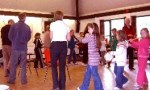


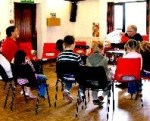
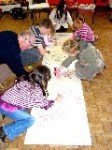


These Live-A-Music workshops ran during the day on Thursday 5 April 2007, in Mossley Hill Parish Church Hall, Rose Lane, Liverpool 18. Background information about the workshops is available on this website. Further workshops are planned for the Summer school holidays.
For more details of the Summer arrangements, or to discuss how Live-A-Music can work to support your own educational / social engagement proposals, please email us.
SuperLambBanana
 SuperLambBanana may be kinda cute, but, made of steel and concrete and 17 feet tall, he’s no lightweight. Created in 1998 by Taro Chienzo for the Art Transpennine Exhibition, he abides in Liverpool city centre, be/amusing all. He’s been Friesian (black and white), pink and sometime graffitied, but ‘really’ he’s yellow.

See more photographs of The City of Liverpool here: Photographs of Liverpool & Merseyside;
and photographs of elsewhere, here: Camera & Calendar
Click here for more information on Super Lamb Banana, alias ‘Superlambanana’.
World Water Day (22 March 2007)
 World Water Day, today, is a little-remarked event but concerns an absolutely vital aspect of life. Wherever we live, and whatever we do, we can’t be without water. This is an opportunity to pause and take a check (should we say, a ‘raincheck’?) on how we view this most critical commodity, and on what we can do to help.
Coping With Water Scarcity is the theme of World Water Day 2007. There can be few themes as important as this.
World Water Day as an initiative grew out of the 1992 United Nations Conference on Environment and Development (UNCED) ‘Earth Summit’ in Rio de Janeiro.
Marking the day
One interesting idea about how to mark WWD 2007 has been to send an e-card, with a choice of pictures and stamps. This helps to spread the word that we all need to think carefully about water and what it means for everyone. Other years have seen initiatives such as the Celebrating Water for Life booklet, published on the internet in 2005.
Central and critical
To those of us in Western Europe and North
America water is a commodity which seems to amount to a right. We know there are issues about water and sustainability, but we never really doubt it will be there for us.
In other parts of the world there is neither enough water for health and hygiene, nor any acceptable way to get access to it; I was shocked recently to read that in some parts of the world the fetching and carrying of water is a task undertaken by young girls, daily walking many miles, who thereby miss out on huge chunks of their schooling.
Take action to help
I have mentioned before that WaterAid is a charity set up simply to get clean water to people who desperately need it. Supporting this focused and straightforward objective [here] is something we can do any day, not just on World Water Day.
See also: Water, Water…
International Mother Language Day
 Today is International Mother Language Day. Celebrated for the first time in the Millennium Year, it is a programme promoted by UNESCO, the 2007 theme being multilingualism.
But why is it important?
The promotion of multilingualism lies at the heart of International Mother Language Day. Introduced in 2000 by UNESCO, the United Nations Educational, Scientific and Cultural Organization, 21 February is the day in the year when we are asked to recognise the uniqueness and significance of the 6,000 languages known to humankind.
In doing this however UNESCO has not set itself against the grain of ‘progress’, for the other emphasis on this date is acknowledgement of the value of shared language, of the ability to communicate in more than simply one’s own mother tongue.
Powerful instruments
UNESCO offers a strong rationale for its promotion of mother languages and multilingualism.
These are, it says, ‘the most powerful instruments of preserving
and developing our tangible and intangible heritage…. [helping us to develop a] fuller awareness of linguistic traditions across the world and to inspire solidarity based on understanding, tolerance and dialogue.’
Linguapax
A corollary of this approach is the on-going (since 1986) UNESCO Lingupax project, which aims to promote a ‘culture of peace’ through the promotion of multilingual education and respect for linguistic diversity.
In that respect it seems sensible that people resident in a country learn to speak its main, official language/s, that they are also encouraged to respect and use the language of their immediate culture, and that schools offer those who wish it the opportunity to learn languages which may be culturally and geographically far
removed from immediate experience.
Idealistic but important
Idealistic and architypically platitudinous these notions may be….. but who could deny the truths behind them?
The need to talk meaningfully and insightfully with one another has surely never been more pressing.

Children’s Music Workshops In Liverpool: 5 April 2007
 Live-A-Music (Liverpool) is planning a series of Children’s Music Workshops at Easter (Thursday 5 April) and over the Summer break. The workshops, run by fully qualified and experienced leaders, are for children aged 7-plus (younger siblings may be accepted) and will be in Mossley Hill Parish Church Hall, Rose Lane, Liverpool 18.
Purpose of the Children’s Music Workshops
The workshops will encourage children to enjoy, explore and create music, bringing together stories, music, ideas and imagination in different ways.
Every child will have something individual and personal to bring to this very positive and engaging musical process.
Venue and date/s
The first Children’s Workshop will be held on Thursday 5 April , in Mossley Hill Parish Church Hall, Rose Lane, Liverpool L18 8DB.
Further Workshops are planned for the Summer holiday period.
Sessions and times
Each Children’s Music Workshop will run for just under two hours, with a dedicated theme for each session. Sessions will be 9 am – 10.45, 11.15 – 1 pm, and 2 pm – 3.45.
Children may attend as few or as many of the sessions as they wish, within the constraints of the maximum number of places available for each workshop.
To register your interest, please click here, or via the link below.
Instruments and themes
The themes of the workshops will be varied and challenging, to engage the participating children fully.
Musical equipment will be provided for the sessions and children who already play musical instruments are encouraged to bring these with them.
Workshop leaders
The workshops will be run by two very experienced professional musicians and animateurs / teachers:
Martin Anthony (Tony) Burrage, LRAM, GRSM, ARAM and
Richard Gordon-Smith, ARCM, GRSM, Cert. Ed.
Additional teaching and professional support will also be available.
Children’s ages; parents & other family members
It is expected that most children will be aged seven or over. Parents, Guardians or other previously agreed responsible adults are welcome also to attend the sessions, and younger children may be accepted for the sessions if accompanied at all times by older siblings or an agreed adult.
Cost
The fee per child per session is £6.50. (Two sessions: £13; three sessions: £19.50.) Any available combination of sessions is
permissible. Accompanying adults and infants may attend at no additional cost.
Each child (except infants with adults) must have a formally booked and paid-for place by the beginning of the session.
Lunchtime supervision responsibilities
Please note that
*** supervision of children can be arranged separately if required between 1 pm and 2 pm ***. (Details on request.)
Refreshment and supervision arrangements for the lunchtime break are the sole responsibility of Parents / Guardians or other previously agreed responsible adults. Children may stay in the venue at lunchtime under direct adult supervision.
Refreshments during sessions
Water and juice will be provided, but children are asked to bring any other suitable refreshment / special preferred drinks for the brief interval which will occur midway in each session. (It will be assumed that children may have the juice provided, or any other refreshments, unless there are clear instructions that this is not the case.)
Parents, Guardians or other agreed responsible adults are, as above, very welcome to accompany children for particular sessions or the entire day, and may also bring their own refreshments. Tea and coffee will be provided.
Registration
To register your interest in the Children’s Music Workshops on Thursday 5 April or in the Summer break please contact us with full details (name and age of child/ren, address, name of
responsible adult contact etc) via this link.
Please click here for a report and pictures of this Live-A-Music (Liverpool) Children’s Music Workshop.


 Dreaming Realist