Author Archives: Hilary
Wheelie Pretty
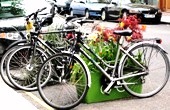 They say that going green keeps you healthy, so the owners of these bicycles in London must be doubly fit.
Not only are they getting exercise as they navigate the city using pedal power, but when they arrive they can enjoy these potted tubs of budding shrubs and flowers too.
Once the bulbs and cyclists are out, we know the Summer sunshine can’t be far behind.

The Lighter Later Campaign For Single/Double Summer Time (SDST)
 Well, hardly had the Publish button been clicked on my last posting, than The Guardian newspaper arrived, announcing that the 10:10
Lighter Later campaign has been launched, to achieve what we have proposed for Daylight Saving and energy conservation on this website for several years. A whole range of politicians and many researchers and other organisations agree that we need to keep BST+ for entirely pragmatic reasons of sustainability, not to mention well-being.
The test now will be to see how soon these claimed good intentions are translated into reality. The more everyone supports such very sensible proposals, the easier it will be for the changes to happen. This is the text of the letter being sent to the Prime Minister:
Dear Prime Minister,
We the undersigned believe that the time is right to look again at moving the UK to “Single Double Summer Time” (SDST), with clocks set to GMT+1 during the winter and GMT+2 during the summer. A large and growing body of evidence suggests that this simple change would bring about a wide range of environmental, social and economic benefits.
On the environmental front, aligning the hours of sunlight more closely with people’s daily routines would yield important reductions in energy use and carbon emissions. Recent research from experts at Cambridge University predicts that shifting to SDST would save around half a million tonnes of CO2 in the winter alone, with substantial extra savings expected in the summer period too.
The social benefits would be equally significant. The Department for Transport has accepted evidence from groups such as the Royal Society for the Prevention of Accidents that advancing Britain’s clocks forward by one hour throughout the year would avoid a hundred deaths and many more serious injuries annually by making the roads safer, especially in Scotland where the winter days are shortest.
Other expected social benefits include a reduction in crime and the fear of crime; an increase in the quality of life for elderly people; increased participation levels in sports and other outdoor activities that make people healthier and tackle obesity; and a reduction in the effects of Seasonal Affective Disorder.
The economic case for changing to SDST is strong, too. Industry groups predict a £3.5 billion boost for British leisure and tourism that would create up to 80,000 new jobs in the sector, while the NHS could expect large cost savings through a reduction in road casualties. SDST would also help reduce fuel poverty and lower energy bills by alleviating demand during the evening peak when the cost of generation is highest.
The evidence is clear that the advantages of a move to SDST strongly outweigh the disadvantages. And, as the Department for Transport has noted, the change would be relatively quick and inexpensive to implement. Supporters of the Lighter Later campaign are calling for a three-year trial of SDST in order to prove that we can make better use of the daylight hours.
We ask that you schedule the time to debate this proposal in Parliament at the earliest opportunity, and we very much hope that your Government will lend this positive and ambitious proposal its full support in the House.
You can sign up to support this letter here, at www.lighterlater.org.
~ ~ ~ ~ ~ ~ ~ ~ ~ ~ ~ ~ ~ ~ ~ ~ ~
The Royal Society for the Prevention of Accidents (RoSPA), has also been campaigning for SDST for many years (please see below).
You can support RoSPA’s campaign here.
This is their position:
- RoSPA’s Lighter Evenings Campaign
Proposals to amend the system of timekeeping have a long history in Britain, with RoSPA spearheading the campaign for a change that would bring lighter evenings all year round.
Press Release : RoSPA CHIEF URGES SUPPORT FOR LIGHTER EVENINGS CAMPAIGN
In the UK at present, clocks follow Greenwich Mean Time (GMT) from October to March and British Summer Time (BST) which is GMT plus one hour from March to October.
RoSPA has been calling for many years for a move to a system called “Single Double Summer Time” (SDST), which would put the clocks one hour ahead of GMT in winter and two hours ahead of GMT in summer. Complementing RoSPA’s campaign, a move to SDST has been the subject of a number of bills laid before Parliament.
Reducing the number of people killed and injured on the roads is the key aim behind RoSPA’s campaign. The most recent research found that a move to SDST could reduce road deaths by around 80 per year and serious injuries by around 212 per year.
…a move to SDST could reduce road deaths by around 80 per year and serious injuries by around 212 per year.
The Department for Transport’s consultation paper, “A Safer Way: Making Britain’s Roads the Safest in the World”, cited these figures in 2009. It also stated that while moving to SDST would involve a one-off cost of £5million to publicise the change, it would then result in benefits of £138.36million a year due to the reduction in road casualties. It said the cost-benefit case in road safety terms was “clear”, but that the issue went beyond the scope of the strategy consultation.
Also in 2009, the National Audit Office published a report called “Improving Road Safety for Pedestrians and Cyclists in Great Britain”. In a section looking at seasonal road casualty patterns from 2000-2007, the report stated that there were 10 per cent more collisions killing or injuring a pedestrian in the four weeks following the clocks going back than in the four weeks before the clocks changed.
And a report published by the Public Accounts Committee in 2009 stated that there was “substantial evidence” that fewer people would be killed and seriously injured on the roads if the clocks were put forward by one hour throughout the year.
…extra evening daylight protects vulnerable road users like children, the elderly, cyclists and motorcyclists.
The latest findings confirm earlier research which showed that during an experiment which ran from 1968-71, when British Standard Time (GMT + 1) was employed all year round, around 2,500 deaths and serious injuries were prevented each year of the trial period.
The road safety benefits of SDST would be achieved because there are far more road casualties in the evening. Any increase in casualties in the morning during the winter would be outweighed by the reduction in casualties due to an hour of extra daylight in the evenings.
Extra evening daylight protects vulnerable road users like children, the elderly, cyclists and motorcyclists, making them more visible to motorists. Motorists are more tired after a day’s work and concentration levels are lower. Children tend to go straight to school in the morning but often do other things on their way home, increasing their exposure to road dangers. Social trips are generally made in the afternoon and evening.
In 2008, pedestrian deaths in Britain rose from 55 in October to 62 in November – the month in which the most pedestrian fatalities were recorded.
Tourism, leisure and sporting organisations generally support a move to SDST, welcoming the increased opportunities for activity presented by more daylight on weekday evenings – an increasingly important point given concerns about obesity and public health.
The environmental benefits of switching to SDST have also been cited in recent years. According to a Cambridge University study published in 2009, moving to SDST would cut carbon emissions by 450,000 tonnes each year. The energy saved would be equivalent to 85 per cent of all the power generated by wind, wave and solar renewable energy in England.
… it is time for the issue to come off the shelf and for the full implications to be considered.
Tom Mullarkey, RoSPA chief executive, said: “We need to keep the momentum behind this long-running campaign. In view of the reports published in 2009, plus casualty data, we will continue to call for a change which, we believe, would save lives and reduce injuries.
“More pedestrians are killed and injured in the afternoon and early evening than in the morning. Therefore, by moving to SDST, vulnerable road users like children walking home from school would have an extra hour of daylight in which to make their journeys.
“It is time for the issue to come off the shelf and for the full implications to be considered.”
RoSPA recommends a trial is run for 2-3 years to provide objective, up-to-date evidence about the effects of SDST. It would also enable the public and the industry and business sectors which would be affected to experience the change for themselves.
RoSPA continues to encourage pedestrians and cyclists to ensure they can be seen and motorists to watch their speed and keep an extra look out for vulnerable road users.
British Sustainable (Summer) Time
 British Summer Time (BST) starts this morning, Sunday 28 March 2010. After a long hard winter we are at last back to what I’d call British Sensible Time – or, to be more explicit, actually British (energy) Sustainable Time.
We know, all the established and critical benefits to health, safety and business apart, that using summer settings for our clocks the full year round would save energy as well.
We need to drop the silliness about Scottish cows (only a minority even of the Scots want to keep BST as it is, and they could do so anyway if they wished) and about not being like the continental Europeans (they’re human beings too), and start looking at the real, increasingly urgent, situation. The evidence has been examined over and over again (see here). In the energy stakes every little truly does matter.
Let’s put aside the urban myths and unsubstantiated dramatic demands when permanent BST was last tried, around 1970, for reflective waistcoats for children going to school. Something sensible must be done, and soon.
As they say, it’s time to get real and move on…. to permanent British Summer Time.
World Water Day (22 March)

Today is World Water Day.
This year (2010) the theme is Clean Water for a Healthy World – something which we all want to see.
But it’s worrying that even now, when our awareness of environmental issues is so much more acute than it was, the United Nations feels the need to emphasise this basic requirement.
To borrow from the World Water Day website:
Every year, 1,500 cubic kilometres of wastewater are produced globally. While waste and wastewater can be reused productively for energy and irrigation, it usually is not. In developing countries 80 percent of all waste is being discharged untreated, because of lack of regulations and resources. And population and industrial growth add new sources of pollution and increased demand for clean water to the equation. Human and environmental health, drinking and agricultural water supplies for the present and future are at stake, still water pollution rarely warrants mention as a pressing issue.
So what can we in the western world do about this, other than ask our governments to attend to leaking pipes, sun-parched land and flooding plains?
Obviously, we can try to conserve our water – attend to our own leaking taps, save that waste water for the garden and so forth. There’s even going to be a conference today in Scotland on how that nation uses one of its own main rivers.
But we can also help those in other places whose need for water is so much more pressingly immediate than anything we will normally experience. There are several organisations which help to get clean water to those who really, really need it.
One of these is Water Aid, and you can offer your support here.
Spring Comes To Sefton Park
 Last night (20 March 2010) was the Vernal Equinox, which makes today the First Day of Spring.
Nowhere was this more apparent than in Liverpool’s Sefton Park, where the crocuses are out, last year’s cygnet was centre of attraction (with the turtle) near the bandstand, and, after a fallow year or two whilst the park was drastically revamped, the nesting swans have again taken residence on the island in the main lake. 


Climate Change Deniers: Going Cold On The Evidence

Where are the experts when you need them? The BBC reports today that climate change scepticism is on the increase. Apparently only 26% of 1001 Britons asked this month think climate change is happening and is now established as largely man made – a massive drop of 15% since just last November, when those agreeing with this statement constituted 41% of the respondents.
Richard Gordon-Smith
 Richard Gordon-Smith is a composer, music animateur and violinist. Previously a member of the Royal Liverpool Philharmonic Orchestra, he now commits himself full-time to educational and community activities in schools and elsewherework, and to serious composition.
A Gathering And A Big Lunch In Toxteth’s Princes Boulevard, Liverpool
 Princes Boulevard in Toxteth, Liverpool, was once a bustling avenue, the home of wealthy merchants and many townspeople. Then local fortunes took a desperate downturn, the nadir being the Toxteth riots in 1981. But more recently things have begun to look up, as demonstrated for instance by The Gathering of May 2008, and today’s Big Lunch in this historic setting.
Judge Sonia Sotomayor: Not ‘White’ And Not Male, Simply An Expert In U.S. Law
 Sonia Sotomayor is the lawyer and judge who has been nominated by President Barack Obama to fill the vacancy on the bench of the American Supreme Court. This week Judge Sotomayor has been grilled at a senate hearing about her suitability for the post. She is also Hispanic and a woman. This it seems gives rise to fears by interrogating Senators that her judgements may differ from those made previously.
Social Inclusion & Diversity
The hearings on whether Sonia Sotomayor should become an Associate Justice of the US Supreme Court have been both predictable and in some ways depressing: her eleven inquisitors include just two women and the dialogue has reflected this.
Obama’s broad church
On the other hand President Obama, in nominating Judge Sotomayor, has demonstrated again (as he has with other appointments, such as that of Hillary Rodham Clinton to the post of Secretary of State) that he intends his administration to be a broad church, inclusive of the talents of people of many sorts.
It’s interesting that Sonia Sotomayor was able, in sworn evidence, to affirm that the President did not ask her personal views on matters such as abortion and gun control – issues which persistently appear in every hearing for appointments to the Supreme Court. Nor, apparently, do Sotomayor and Obama agree about the relevance or otherwise of ’empathy’ in legal judgement (she says she puts it aside; he sees it as relevant).
The obstacles of gender and ethnicity – and class?
It looks increasingly likely that Judge Sotomayor’s appointment will be confirmed. After the usual party political jostling, significant Republicans on the panel have indicated they will not oppose her nomination.
But why, and how, do these people think it appropriate to suggest that Sonia Sotomayor’s gender and ethnicity are critical issues which might mitigate in the future against fair and transparent interpretation of the law?
Sotomayor’s personal background is not unlike that of Obama; her early life, living in public housing in the Bronx, was uncompromisingly unprivileged. Perhaps social class also plays an unacknowledged part here. The Republicans amongst the Senators grilling her are not of the Grand Old Party (GOP) for nothing.
Privileged white men
But surely even they can see that the Supreme Court has thus far been an enclave of privileged white men? In its entire history it has been administered by 111 justices, only two of them so far women (the majority of the population), and none Hispanic (the fastest growing ethnic group in the USA).
Perhaps the Supreme Court has always adhered to interpretation of the law, with no fear or favour (though frightening statistics on what sorts of criminals are not excused judicial slaughter, for instance, might suggest otherwise).
But as far as I can tell, not many of these white, male, privileged nominations for the Supreme Court have been quizzed for days and days about whether their personal demographic provenance will endanger justice for all US citizens.
Politics and competencies
Assurances of propriety and competence are essential before any Supreme Court justice is appointed. Party political posturing is inescapably part of the game.
It’s a ritual of Supreme Court nomination that questions have to be asked about every imaginable variable, and that Senators at the hearing go to extraordinary lengths not to set procedural precedence which they may later find uncomfortable.
Striking failures of insight
But, glaring omissions of insight about how and by what sorts of people the US law and constitution have been determined in the past…..?
Small wonder during her inquisition that Judge Sotomayor has stuck unservingly to the position simply that: “The task of a judge is not to make law. It is to apply the law.”
I’m not a US citizen, but I am a citizen of a country which, like the US, seeks, in however flawed a way, to achieve fairness and equality. That fundamental – and perhaps intended? – apparent omission of insight on the part of Sonia Sotomayor’s inquisitors I find downright bizarre.
Read more about Social Inclusion & Diversity and Political Process & Democracy.


 Dreaming Realist