Flaming June In Ardnamurchan
 Ardnamurchan, the most westerly point of mainland Britain, is not the first place most of us would look to find the dramatic Shenandoah ‘Red Hot Poker’ or ‘Torch Lily’ in bloom; after all, the Kniphofia group of plants to which Torch Lilies belong originated in Africa. But the remote north-west UK location around Loch Sunart has been showing these spectacular flowers off in profusion during the amazingly hot (up to 24 degrees C) first weekend of June this year.
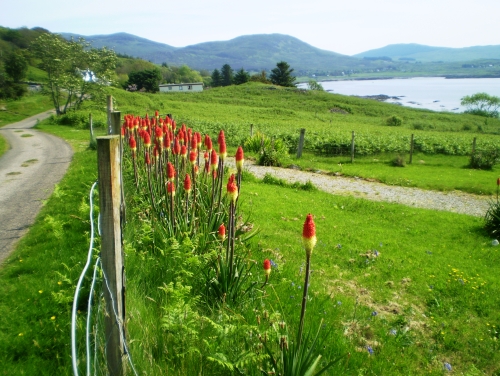
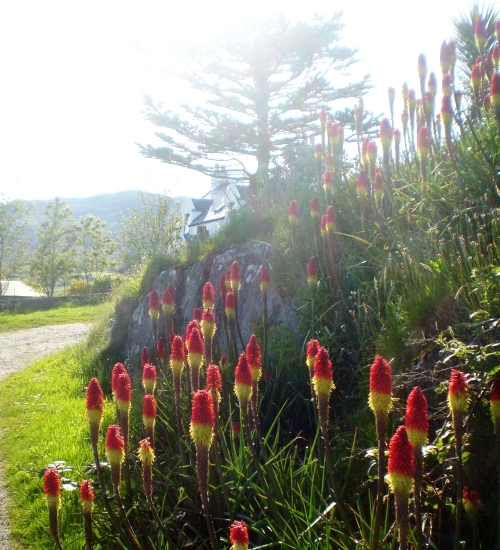
See more photographs at Camera & Calendar and at Locations & Events.
Future Currencies: Carbon? Water? Knowledge?
 What will be the fundamental ‘currencies’ of the future? What, if we are serious about global sustainability in all its forms, should these currencies comprise now? It’s likely, if we collectively are ever going to achieve a level of long-term viability for the human race, that we will have to shift the emphasis from money (or the gold standard) to the really basic requirements for life on earth – carbon, water and nitrogen, plus knowledge of all sorts to keep the whole show on the road.
C. P. Snow’s ‘Two Cultures’ Is Fifty Years Old Today
 C.P. Snow introduced the idea of the Two Cultures in the annual Rede Lecture in Cambridge of 7 May 1959. Himself both an eminent scientist and contemporary historian of science, and a novelist, in that lecture he lamented the gulf between scientists and ‘literary intellectuals’, arguing that the quality of education in the world is on the decline. Now fifty years later (as on the fortieth anniversary) a range of commentators continues to debate this claim.
Science & Technology.
Some of us may feel that the great contribution to British culture of Charles Percy Snow (1905 – 1980) was in fact to write novels and commentaries about science which are still remembered for the light they shed on how science works in modern society.
For me that’s certainly true: the dozen novels of the Strangers and Brothers saga (1949 – 1970) and his non-fiction (if not undisputed) accounts of how science ‘works’ – especially Science and Government (The Godkin Lectures at Harvard University) (1961), The Two Cultures and a Second Look (1963) and The Physicists: A Generation that Changed the World (1982, republished 2008) – have helped to bridge that science – humanities chasm.
Focus on the Corridors of Power
These were the books which, as a post-grad student of the sociology of science, opened my eyes to a world I hadn’t even previously known existed: the world of high level science and policy, the world as Snow himself styled it, of The Corridors of Power.
But this focus has been largely lost in the debate about the Two Cultures and the heavyweight attack which the literary critic F.R. Leavis (1895 – 1978) made on C.P. Snow’s thesis a couple of years after the Rede Lecture, suggesting that Snow was a dreadful novelist and rejecting the validity of his concerns that the literary elite was not scientifically literate.
Not always incompatible
Isn’t it interesting in this context that quite a lot of excellent musicians are also good at maths and science; and probably just as many very good scientists are also decent musicians?
There remains as ever a cultural gap between the humanities and ‘science’, but they are both very complex enterprises, and it does not follow that all those in the arts are unaware of science, any more than the converse must always be true.
The nature of evidence
What is more worrying is that sometimes people don’t seem to understand the nature of evidence (not ‘science’) … that whenever possible it needs to be good enough to rely on, before conclusions are drawn.
Of course all evidence in the end is relative, but we have to start somewhere…. the important thing in a democratic society, is that the basis on which we as individuals, and those with influence, choose to decide actions and positions is open to scrutiny.
Moving towards rationality
Slowly, modern western society is becoming more rational and moving out of the mists of myth and cultural comfort zones. There is without doubt a limit to how much this can or should happen, but I think we’re nearer to a balance on this than we were even a few decades ago. Many scientific terms are commonplace in everyday debate.
When C.P. Snow wrote his Two Cultures lecture we as a society ‘knew’ less than we do now. It’s difficult to accept the claim that education for most people is ‘worse’ than it was in the 1950s and 60s – and I say that as the product of an inner-city grammar school of that era. Then we just didn’t perceive the awfulness of the education which most children received; this was still the post-war era when anything was better than nothing.
For most people, cultural memory is it seems very short. We can surely now, despite all the naysayers, learn more, quickly, about anything, than ever before.
The longer view
It’s said that 90% of the scientists who ever lived are here on this planet now. Possibly the same applies to artists, for what it’s worth. But what I’m sure of is that C.P. Snow has excited a lot of people – including me – over several decades, with the debate he sparked.
Snow’s perspective is of course now dated; but those who currently deny that things have got better have (potentially) the benefit of hindsight ,and they need to think quite carefully about whether they are using that very valuable vantage point properly. More people now know something about science and the arts, than ever before.
You don’t need to be able to describe the double helix and the works of great poets in detail to share some mutual understanding about our complex cultural underpinnings.
Evidence and ideas for sustainability
What you do need to be able to do is draw threads together to make sense of where you find yourself in the world… and never has that been more true than now, with the ‘one planet living’ challenges we all face.
Indeed, Lord Snow argued himself that the breakdown of communication between the “two cultures” of modern society — the sciences and the humanities — was a major hindrance to solving the world’s problems.
Bridging the gap
I’m not therefore sure that the most important debate around education can continue now be an arid discussion of so-called ‘standards’; surely it has to be about searching for common understandings? And in that debate C.P. Snow and those who followed have helped a lot.
If the musicians and their counterparts can sometimes bridge the gap, then maybe the rest of us should start to be more positive, and have a go too.
Read more about Science & Technology.
For more commentary on the fiftieth anniversary of the ‘Two Cultures’ Rede Lecture, see e.g. here and here.
A Happy Hatching In The Hedge
 In the garden in early May last year, a broken piece of ivy jutting out from the hedge caught our attention.
Then a thrush darted into the greenery, and we realised this was in all probability the site of a nest – as indeed it turned out to be, a neatly solid little structure with three beautiful blue eggs in it.
Waiting patiently, carefully positioning the camera well away and using a zoom lens, this is what we then saw emerging, almost at our back door….

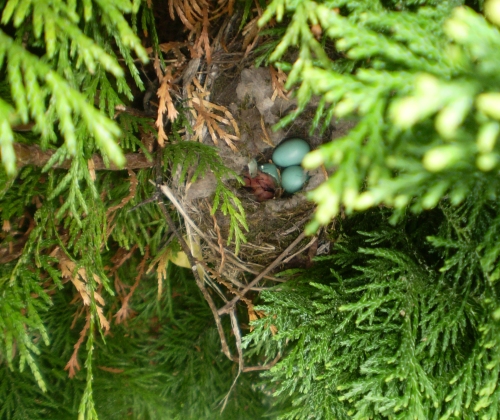
The other eggs hatched later, and we saw the adult birds going about their parental duties forseveral days thereafter, flying to and fro with titbits for their young. And perhaps the process is being repeated again this year, now the gap in the hedge has covered over, for the garden thrushes seem to be very active once more.
Read more articles about Living Things, Nature & The Seasons and The Philospohy Of Hedges, and see more photographs at Calendar & Camera.
For more information on thrushes, their nests and eggs, click here.
Earth Day: The Green Generation Campaign
 Earth Day, the annual event on 22 April, was devised in 1970 by a US Senator from Wisconsin. Today the Earth Day Network has a global reach. 2009 marks the start of The Green Generation Campaign, leading to 2010, the fortieth anniversary of this important day. A billion people already participate in Earth Day activities, now the largest secular civic event in the world. It’s time for us all to take the Green Generation route to the future.
Sustainability As If People Mattered.
We all have to ‘Go Green’…. and even back in 1970 many of us knew it.
Whilst we in the UK were busily promoting the then very new Friends of the Earth – at the time perceived by some as a dangerously radical organisation – our eco cousins in the USA were going about their business, it seems, in a rather more formal fashion, via a proposal by Gaylord Nelson, a then US Senator, that there be a national Earth Day.
Today (22 April 2009) sees the thirty ninth anniversary of what has evolved into International Earth Day, with a network of more than 17,000 partners and organizations in 174 countries looking forward the fortieth such event, to occur in 2010.
The Green Generation
Now, the focus is on the new-wave Green Generation, a cohort with unambiguously ambitious aims:
* A carbon-free future based on renewable energy that will end our common dependency on fossil fuels, including coal.
* An individual’s commitment to responsible, sustainable consumption.
* Creation of a new green economy that lifts people out of poverty by creating millions of quality green jobs and transforms the global education system into a green one.
Sharing responsibility for sustainability
People of every sort have begun to recognise their responsibility for sustaining the future of our shared environment. Those who have their own challenges, living in a complex multi-cultural society, work together sharing a common resolve to make things better, just as others also do.
But the further you are from where decisions are made, the harder it is to get the support you need to do your part. Sometimes it’s money and resources you require; other times it’s the encouragement of family, friends and neighbours who don’t always understand why wider environmental and community issues matter.
People at the grassroots can feel they have little power to change things.
Small actions are important
But every small effort is part of the greater scheme of things, with important ramifications.
Perhaps it’s ‘only’ planting some vegetables with the kids in an urban space, or explaining to our children why they need to respect their environment – or indeed digging up the White House lawn to plant organically produced vegetables, as Michelle Obama has just done – but from these acts the idea can grow. We’re all part of the same shared world.
The environmental movement is growing quite quickly now, even in inner cities. People undertake small projects – helping with a city farm, supporting older people who want to shop locally, or whatever – but over time the ripples of these activities will begin to overlap, as more and more people join in.
Individual initiatives become communal
You may start a small project almost alone but, as others start also do the same elsewhere, there is somehow a change in perceptions.
Through sharing ideas and action we begin to see why everyone must understand that there is only ‘one planet’ to live on, and that we all have to do our bit to save our environment. Big supermarkets or small traders, there is now an active acknowledgement green issues and eco-initiatives.
All together in common cause
But there’s another important thing here too: It doesn’t matter where you come from, or what your culture, gender or age is. We must all to ‘Go Green’, and quickly.
Different people from different places will start in different ways, but we all need to rely on each other. Nobody can ‘save the planet’ on their own: Environmental sustainability is quite a new idea, no-one rich and powerful ‘owns’ it.
The idea of sustainability belongs to us all. Here is something we can all contribute to.
A green leveller
The ‘green agenda’ is a great social leveller, because we are all part of the problem and likewise all part of the solution. Environmental actions, even tiny ones, are critical if we are to sustain our fragile planet; and, happily, sharing our concerns and our ideas for action can bring us together regardless of creed or nationality.
It’s not easy to work, often unpaid and in small ways, protecting the environment and looking after the people in local communities. You can feel alone and perhaps unappreciated. But that work is vital and slowly it is being recognised – which is the first step to the work being properly supported.
With luck the Green Generation Campaign and the run-up to Earth Day 2010 will help to make that happen.
Read more about Sustainability As If People Mattered.
Easter Sunday Is Eco-Sunday: The Day UK Resource Self-Sufficiency Ends In 2009
 The new economics foundation (nef) tells us that, as of today, the UK has used the levels of resources it should consume during an entire year, if it were environmentally self-sufficient. In 1961, nef calculates, the UK’s annual eco-debt began on 9 July; by 1981 it was 14 May, but in 2009 it falls on 12 April, Easter Sunday. But how can we help people in their daily lives to address and cope with these frightening calculations constructively, rather than such information just causing further alarm? Science and ‘facts’ alone won’t get us where we all need to be.
Sustainability As If People Mattered.
I’m not sure that those of us already concerned with sustainability approach these matters in the best way to engage others yet to be converted – nef* says Easter Sunday (eco-debt day 2009) is ‘a day which for many has become synonymous with over-indulgence’. That’s a pretty unempathetic perspective on one of the UK’s few annual family holidays.
Sometimes perhaps the force of our convictions and fears about sustainability can make us sound a bit crass.
Offering hope, not inferring guilt
Inducing guilt and/or alarm is not often the most effective mode by which to gain mass support, in an open democracy, for complex and uncomfortable change. Personally, I’d rather see Easter as an occasion with a message, whether sacred or secular, of new beginnings and hope – an opportunity for positive reflection on the future.
Eco-protagonists and scientists are vitally important to our understanding of what’s happening to the environment. But they’re not always good at helping people in the wider community to face up to the enormous environmentally-related challenges which, we must urgently acknowledge, are already upon us.
Research findings and predictions based on rational calculation do not always translate as clearly as the scientists imagine into policy acceptable to the wider citizenry. To the person in the street it can all seem just too difficult and scary, well beyond the scope of ‘ordinary folk’.
Engaging people for positive change
Nonetheless, the UK’s increasing eco-debt is desperately alarming, and something we need to get everyone to think about, right now.
The question is, how?
[* Andrew Simms (2009) Ecological Debt: Global Warming and the Wealth of Nations, cited in Transition Network News, March 2009. Andrew Simms is nef Policy Director and Head of the Climate Change Programme.]
Read more articles on Sustainability As If People Mattered.
Spring Comes To Sefton Park, Liverpool
 The past few days have convinced us that Spring is finally on its way.
The daffodils in Sefton Park are a glory all of their own – the focus of hope in so many ways, at the equinox when people begin once more to populate our park’s wonderful space, strolling by in chatty groups, with prams, on bicylces, running to raise funds for charity or simply stopping to enjoy.
And then, as the daffodils begin to fade, we see the promise of the next great gift of nature, the delicate blossoms of almond and cherry to delight us yet a while….
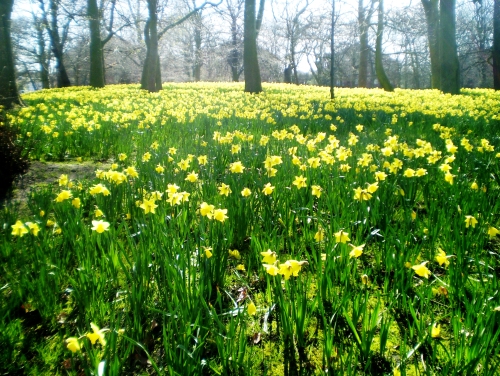

See more photographs of Liverpool & Merseyside and read more about Sefton Park.
The University Of Liverpool Post-Graduate Poster Day
 The University of Liverpool has one Graduate School for all disciplines. The School’s annual Poster Day (27 March, in 2009) enables all these fields to be showcased together. I had the happy task with a few other ‘external’ judges of selecting the first-ever prizewinner for the new ‘North West Hub’ award, to emphasise links between academia and the wider world.
Education & Life-Long Learning and Knowledge Economy.
The exemplary aims of Poster Day are to offer graduate students practice in the skills required to communicate to a degree educated public, and to provide an opportunity for them to learn more about research being undertaken in other parts of the University.

The University of Liverpool Graduate School Poster Day exhibition was fascinating; the cross-faculty range of work under one roof would surely have taken months to get fully to grips with, but we had just a couple of hours. I used the time to talk to some very interesting people, all passionate about their work and the reasons they were doing it.


The involvement of ‘external’ visitors was a new step introduced this year. Here we see some of the Graduate School Team, including Dr Richard Hinchcliffe (Director of Postgraduate Training) with my fellow judges:

But in the end we had to make a decision, spoilt for choice though we certainly were.
The general criteria for the North West Hub overall prize included visual impact, organisation of the material, the accessibility of and rationale for the research, and, last but not least, the enthusiasm and clarity of the researcher him or herself. It seems very fitting that the award was after much discussion made to Andrew Lee-Mortimer for his engineering research project around Design for Sustainability.

Read more articles about Education & Life-Long Learning and about the Knowledge Economy.
Sure Start Success And A Million Small Conversations
 Professor John Bynner’s piece in today’s Guardian concerns the need for a ‘science of the family’ – the need to recognise how families large and small work, and to debate how those who seek to support children and their parent/s should best interface on the basis of that knowledge. Of course this is essential; but then we need also a mechanism for sharing these ideas. My own work with Sure Start suggests it’s all those little, day-to-day, conversations between colleagues as they explore common understandings, which may best deliver this.
Early Years & Sure Start.
I’d agree strongly with John Bynner – who has followed closely the national Sure Start evaluation (NESS) programmes – that an applied ‘science of the family’, frameworked around the emerging shape of Sure Start Children’s Centres, is now critical to prospects for longer-term success.
In summary Bynner’s message is that involving parents and studying projects which work is crucial to improving children’s wellbeing.
The transition to Sure Start Children’s Centres
I have undertaken quite a lot of work with Sure Start programmes, as they make the transition, within various Local Authorities settings, to Children’s Centres. This is a vitally important programme, and there’s a pressing need for even more research into how best, in the interests of everyone, we should support children and their parents in the task of ensuring a happy childhood and positive ways of achieving adulthood.
The Sure Start evaluation programme has already indicated many ways this could happen; now we must equip more professionals and other practitioners working with children and their parents, to make these examples of good practice the norm.
From pilot programmes to good practice
But we have to remember that Sure Start programmes began at the turn of the Millennium as individual, isolated, almost silo-ed, initiatives, trying to find their way in uncharted waters.
Studies such as those of NESS have helped everyone to move towards a more coherent whole; but the emphases within Sure Start programmes in different places are often still different, within the overall requirements, because people working on the programmes come from different practitioner backgrounds.
As one example, early years and health practitioners are not often geared towards the more formal end of adult basic education and employment skills training – which is in many cases the key to unlocking doors to the future for those who have, so far, had not a lot.
Commonalities between professional disciplines
Despite the increasingly clear insistence from government on joined up frameworks to support children and their families, not enough senior people ‘on the ground’ are as yet willing to concede that this really must happen in meaningful ways.
This change in perspective would require further revisiting professional / practitioner silos; GPs, teachers, social workers and so on are not always good at that sort of thing. But early years practitioners, midwives, community volunteers etc have essential understandings to offer in cross-disciplinary terms, if they can be put in a position (and fully supported in these extra intra-professional skills?) to do so.
There’s a need for substantial elements of advocacy and aspiration in all this. ‘Good’ parenting and happy childhoods don’t just happen; they occur when the context is right. This is where Sure Start can help.
Working together
We need to find ways to encourage all concerned to work closely together; and that has to start with valuing and learning from a million small and positive conversations between practitioners of all sorts, to help us focus on delivering our aspiration of every child being a happy child.
My own experience tells me we need to keep translating these perspectives between those on the ground and the decision-makers, so as to realign and focus collaboratively, in our different ways, on supporting the people, individuals, families and communities, whom we are in the business of helping.
A million small conversations
It’s the ‘million small conversations’ – hopefully based on everyone, not just the powers-that-be, knowing the fundamentals of good practice and what the research tells us – which make this transition.
Practitioners talk all the time to individuals in families and local communities; their wisdom is essential; they are trusted by clients where others may not be.
But the flow of information has to be two-way. The decision-makers know the outcomes of wider research on ‘what works’, for instance, and they need to share that much more proactively than they often currently do.
Learning from each other
Talking with those who are on the ground day-by-day isn’t an optional extra here; it’s how we all learn. And this these conversations are what, in my opinion, are most often lacking so far…. which perhaps is also why progress to enabling those who experience disadvantage is so painfully slow.
I’ve started several explorations of how to align different disciplines towards the overarching Sure Start objective, only to be told by those working in the service that they ‘haven’t got time’ to meet me as a group to examine what’s happening.
Before we finish, the reverse is always true: these practitioners and professionals have by then become autonomous in their desire to keep in touch and share good practice. Change can happen, albeit not always as we expect.
In the end this becomes a virtuous circle; we really do need to value the currency of relaxed inter-disciplinary discussion, forgetting the hierarchies and valuing the common goals.
Different approaches, different outcomes
It’s been instructive to see how the structures of programmes such as Sure Start may and / or may not help to raise the aspirations of local people; and that’s no criticism of people who have chosen as best they can one set of ways over another to try to support those who are less fortunate.
But the disconjunctions of different practitioner perspectives need to be acknowledged as a challenge, to get this enabling of aspirations on the agenda.
I’ve started projects which focused on health in early years, and ended up with serious discussions also about local economic strategies and adult ed.
There wasn’t in the end a problem here, it was just that the economic and education people felt as unknowledgeable about early years, as the early years practitioners did about them.
How do families ‘work’?
To return to the theme of John Bynner’s piece, we don’t as yet have very complete knowledge of how families (whether of two or ten…) work, especially when it comes to positive service delivery.
And we can add to that that the community volunteers and mums and dads had never been asked till then what they thought either about the ‘education and training’ side of things. What sort of local enterprises would they like? (The answer was often healthy local food….) What sort of education and training is best? (Answer, usually: the sort you can get near home, with childcare…)
Once again, the way forward was to get those small conversations going….
Synergies to reduce disadvantage
The goodwill is certainly there; it’s the synergies that need to be nurtured until they can stand up for themselves.
There has to be a better model for reducing disadvantage. I seriously propose that part of it is to embrace the idea of everyone (clients, where they wish to, practitioners on the ground, and decision-makers) talking to each other, as equals, in those million small conversations.
Read more about Early Years & Sure Start.
The Economist Debate: Keynes Vs. The Free Market
 The Economist magazine has had an online debate on the proposition that ‘We’re all Keynesians now’. The outcome was not encouraging. By two-to-one that proposition was rejected in favour of a free-market position. Perhaps some economists have yet to learn that the current day physical realities of the context itself keep shifting, and that the science of human behaviour is in the end an art, with outcomes that depend on how we handle the interaction between fact and feeling.
Economics Observed.
In 1936 the British economist John Maynard Keynes (1883 – 1946) pointed out that in a downturn the economy is operating below its potential, so expanding demand can create supply, which will in turn give people jobs and more prosperity, thus creating (to quote the view in 2009 of the US economist James Furman) an economic ‘virtuous circle’.
That, says Furman (along with many others) is ‘the paradox of economics in a downturn. Normally, the only way to grow the economy is the old-fashioned way: delaying gratification through reduced deficits and increased savings to encourage more investment. But in a downturn, these steps would just compound the problem and worsen the vicious circle of rising unemployment, underutilized capacity and falling consumption.’
We can argue the toss about how much economic ‘growth’ we should pursue in a world which already uses far, far more than it should of environmental resources, but intentionally causing devastating poverty by restricting government and other large-scale spending – the preference of the free-marketeers and monetarists – won’t help.
Socio-economic expectations and sustainability
Sustainable futures depend not only on what will in theory happen next, but what’s happening now.
There is a cost attached to severe recession: the people whom it hurts on a daily living basis get very upset. And upset people become disenfrachised and disaffected – which is in no-one’s interest.
Those of us engaged in regeneration and renewal know only too well, despite the apparent logic of the free market position, that this cannot be the way forward.
The Economist debate
The Economist debate on the theme that ‘We’re all Keynesians now’ is therefore timely; but disappointingly it transpired to be very largely a discussion – or so it seemed – between a cohort of people who work in the financial sector, mostly in the USA…. and who also therefore have huge influence on the lives of us all.
Doing his best for the Keynesians we had Prof. Brad DeLong, professor of economics at the University of California at Berkeley, a research associate of the National Bureau of Economic Research, and in the Clinton administration a deputy assistant secretary of the U.S. Treasury.
Those opposing the Keynesian position were led by Prof. Luigi Zingales of the University of Chicago Booth School of Business, co-author of Saving Capitalism from the Capitalists, acclaimed as “one of the most powerful defenses of the free market ever written”, and co-creator of the Financial Trust Index, an indicator of the level of trust Americans have in financial markets. Prof. Zingales’ position was to defend the idea of the Free Market.
Money or men and women?
There was little discussion in the Economist debate of people as people, and almost none about the extraordinarily complex issues we now face in our global physical environment.
Money and Monetarism or at least the Free Market (themes favoured by the Chicago School of economics) were the positions which, from my reading of the proceedings, ruled the day.
But when we start to disaggregate socio-economic outcomes and impacts in respect of the diverse downturn experiences of different people (gender, age, physical state, cultural background and other factors) it is very hard – in both the intellectual and the affective sense – not to go for Keynesianism.
Haves and Have Nots
Other, more austere, approaches may seem attractive in the long-run to people who won’t in the interim really go without; but surely even they recognise that the legacy of a deeply disenfranchised social hinterland – under-educated and sick children, depressed and impoverished families without focus, and all the rest – will not be an advantage in times to come?
We have to keep people in work as far as possible (preferably eco- and socially sustainable schemes), or we risk more than we may gain. It’s how the Keynesian approach is handled that really matters.
Sustainability is no longer a given
Yet most commentators continued to debate as though everything ‘except’ the economy will stay the same. It won’t; and the versatility of neo-Keynesianism surely helps us here more than the strictures of the Chicago School .
Gas /oil, carbon, water… one or more of these will become the major financial ‘currency/ies’ of the future; and my guess is that the new gold-standard currency will soon be simply knowledge.
If economics can’t take account of these factors in meaningful, rather than soul-less, ways, we’re in for a rougher ride even than needs be already.
Keynes was creative
Nor did I see much about John Maynard Keynes the person in this debate.
Wasn’t Keynes a man with a wide range of interests, a member of the Bloomsbury Group (that intellectual and progressive force in the London of the 1930s), married to the ‘Bloomsbury Ballerina‘ Lydia Lopokova, a talented Russian ballet dancer?
Wouldn’t Keynes have been worried to read about the sterile dehumanised theoretical models which continue to be proposed by the Monetarists and Free Marketeers? What if anything, he might have asked, has been learnt in the past eighty years?
Imagination in the face of multiple challenges
Only Keynesian-style approaches accommodate the changing realities of life across the globe for millions upon millions of different people (men and women in many diverse cultures, all cruelly hit by the credit crunch) who simply can’t live without jobs of some sort, because they have no resource other than their daily labour.
Surely Keynes would have urged us to use imagination as well as mathematical models, to try to resolve the dilemmas we now face.
How can we cope, all at the same time, with economic crises, climate change, famine and much else, unless we seek the application of intentionally humane and decent economic frameworks?
Decision-makers and destinies
It’s worrying that so few of the Economist’s debaters looked outside their models to the contexts in which we actually live. They are after all also generally the people in the private sector (and in right wing governments) who decide what to do with ‘their’ economies.
The Free Market folk undoubtedly believe they have incorporated human motivation and behaviours into their models. The problem seems to be that – the behaviour perhaps of economists themselves apart? – rationality has little to do with behaviour in reality; and in any case the language of the Chicago School does belies an understanding of the human condition for ‘ordinary’ people.
Perhaps – could it have been said before? – such people simply don’t count in the face of the Free Market?
Humanity and economics are inseparable
Recent experience in developing sustainable communities has seen those in regeneration forced to understand it’s not just logic which influences how people behave; we ignore their humanity and need for stakeholding and inclusion at our peril.
The same applies in the face of terrifying outcomes if we get the economics wrong. A lot more insight into the day to day realities of the human condition is required.
Read more articles about Economics Observed.


 Dreaming Realist