Sure Start’s Approach To Health Inequalities Does Work
High Infant Mortality Rates (IMR) are a distressing measure, but they tell us a lot about the nation’s health. In the UK today the risk of infant death is about one in two hundred live births. But still seven times as many babies die in some working class Northern towns as do in the wealthiest parts of the South East. The Sure Start programme, alongside the Government’s IMR health inequalities initiative, shows promise in addressing these massive inequalities; but the next step must be to strengthen Sure Start’s interdisciplinary framework.
Fundamental issues such as human health and well-being are rarely a challenge for only one part of public sector services.
The really big problems almost always straddle a wide range of service provision, which can add substantially to the difficulties of resolving them – no one service provider alone ‘owns’ the issue, and it is often unclear who should head up programmes to address the problem.
Differentials in life expectancy
A classic example of this is the challenge in the UK of reducing the gap between the life expectancy of richer and poorer people, to achieve the goal of everyone who possibly can enjoying a long and healthy life.
The better the start in life, the more likely a person is to have a good outcome also in the future. For this reason there has been much emphasis in recent years on Infant Mortality Rates, which are generally agreed to be amongst the most sensitive overall indicators of a nation’s health.
Infant Mortality Rates (IMR) are usually stated as numbers of deaths per 1000 live births. The figures are often broken down into rates for the first four weeks of life (neonatal rate) and then for the rest of the first year of a child’s life (post-neonatal rate), i.e. from the end of week four till first birthday.
Infant Mortality Rates in Britain
The national statistics show that even since the 1970s, in the UK IMRs have fallen by about 60%. In 1978 the neonatal (first four weeks) rate was 8.7 deaths per 1000 live births, and the post-neonatal rate, up to a child’s first birthday, was 4.5.
By 1988 the rates were 4.9 and 4.1 respectively, and in 1997 they were 3.9 and 2.0.
In 2007 the UK neonatal mortality rate was 3.3 per 1000 live births, and the post-neonatal rate was 1.5 – in other words, a child born in the UK in 2007 had a probability of dying before his or her first birthday of just about one half of one percent. (You can see international comparisons here.)
Regional differences
Sadly, these national statistics include both good and bad news. The good news is that decent housing, income and environments can support people in long and healthy lives.
The bad news is that the opposite conditions can be lethal. There are parts of the North of England, for instance, where IMR is about twice that national average, and up to seven times that of the very best outcomes.
Specifically, high IMR and low life expectancy often go hand-in hand in the Spearhead areas; the 70 local authority areas with the worst health and deprivation indicators, and for which a programme of public service interventions has been developed.
High risk factors in health inequality
The target does not however take into account all dimensions of health inequalities in infant mortality. The statistics show e.g. that in 2002–04, the infant mortality rate of babies of mothers:
* born in Pakistan (10.2 per 1,000 live births) was double the overall IMR;
* born in the Caribbean (8.3 per 1,000 live births) was 63% higher than the national average;
* aged under 20 years (7.9 per 1,000 live births) was 60% higher than for older mothers aged 20–39;
* where the birth was registered by the mother alone (6.7 per 1,000 live births), was 36% higher than among all births inside marriage or outside marriage or jointly registered by both parents.
Improving life chances
Obviously, these significant inequalities are just not acceptable. The Government therefore introduced a Public Service Agreement (PSA ) Target in 2007 with the express objective of reducing the IMR gap, so that more babies will live to have long and healthy lives. (Healthy babies also have better long-term prospects, sometimes dramatically so.)
The deal is that the UK Treasury provides the money, and the public sector delivers the agreed outcome, to a clear timescale and against clearly measured outcomes.
Particular emphasis has therefore been placed in terms of health inequalities on achieving a ten percent reduction (between 2003 and 2010) in the IMR deficit between people in routine and manual (R&M) jobs, and the general population.
Practical steps forward
The practical ways in which the Health Inequalities Infant Mortality PSA Target Review (February 2007) can be achieved are focused on two things: sensible day-to-day actions and provisions, and interdisciplinary co-operation. In the words of the NHS summary of the Implementation plan for reducing health inequalities in infant mortality:
‘The plan describes how commissioners and service providers can develop local services to help reduce health inequalities in infant mortality through:
* promoting joined-up delivery of the target with Maternity Matters and Teenage Parents Next Steps. This includes
* improving access to maternity care;
* improving services for black and minority ethnic (BME) groups;
* encouraging ownership of the target through effective performance management;
* raising awareness of health inequalities in infant mortality and child health;
* gathering and reporting routine data, including specific maternity and paediatric activity;
* undertaking joint strategic needs assessment to identify local priorities around health inequalities in maternity and infant mortality;
* giving priority to evidence-based interventions that will help ensure delivery of the target.
It emphasises the importance of partnership working; outlines the role of government departments, strategic health authorities (SHAs), primary care trusts (PCTs), local authorities and Sure Start Children’s Centres.’
Specific, realisable targets for practical action and delivery
Progress may be slow, but none of this is rocket science.
Large-scale studies have demonstrated that just a few health messages about avoiding early years risk can have a big impact. Indeed, the Review of Health Inequalities has been able to quantify four measures, and suggest another one, which would have appreciable impact on the ‘10% reduction in IMR gap’ target. These were:
* reduce prevalence of obesity in the R&M group by 23%, to current general population levels – 2.8% gap reduction
* reduce smoking in pregnancy from 23% to 15% in R&M group – 2% gap reduction
* reduce R&M group sudden unexpected deaths in infancy by persuading 1 in 10 women in this group to avoid sharing a bed with their baby, or letting it sleep prone (on its front) – 1.4% gap reduction
* achieve teenage pregnancy target – 1% gap reduction
* also, early booking and improved teenage pregnancy services – not possible as yet to quantify probable gap reduction, but positive impact on gap anticipated.
Getting it right
The scope for getting this right in very simple ways is therefore enormous. Whilst guidance at national level, such as the Department of Health’s Child Health Promotion Plan (June 2008) is essential to provide a framework, much of the responsibility for success has to lie with the authorities ‘on the ground’, who have to co-ordinate the action.
In reality, only at the local level is it possible to get practitioners to work together well, to ensure that all those – including so-called ‘hard to reach’ minority ethnic familes, travellers and e.g. very young parents or parents with mental health problems – who would benefit from services, advice or support, in fact receive them. Although programmes such as the Family Nurse Partnership (a joint Department of Health / Department for Children, Schools and Families project whereby specially trained midwives and health vsitors work closely with vulnerable, first time, young parents) are starting to reach those with most disadvantage, in some places still this doesn’t always happen.
It is disappointing therefore to read claims in this month’s Regeneration and Renewal that the PSA Inequality target will be missed, despite the many billions of pounds (£9bn in 2007-8) which have been invested in Sure Start services to deliver early years provision.
An expected move
This probably why the Government is launching a public consultation on proposals to give Sure Start Children’s Centres a specific statutory legal basis, as part of the forthcoming Education and Skills Bill.
Such a move was indicated as a possibility when The Children’s Plan (the ten year programme for Every Child Matters) was introduced in December 2007. It would establish Sure Start Children’s Centres as ‘a legally recognised part of the universal infrastructure for children’s services, so their provision becomes a long term statutory commitment and part of the established landscape of early years provision’.
The best way forward
This is a much better idea than the alternatives proffered in some quarters – more Health Visitors as a stand-alone, for instance. (What about the GPs / family doctors? How do they fit in?)
A review of progress has shown (as my own consultancy work also indicates) that the PSA infant mortality target was not known or understood by practitioners (NHS, local government and Sure Start staff etc) despite individual examples of leadership and good practice.
Reaching out
And nor, in my experience, do practitioners and policy makers automatically know that impact has to be measured across the whole relevant population of infants, not just those who attend particular service provision, be this Health Visitor clinics, Sure Start or whatever.
About 80% of early years formal care is actually undertaken by small private concerns, child minders and so forth, a ‘group’ which, whilst of course the subject of statutory regulation and monitoring, it is particularly difficult to bring together in any meaningful way. But what happens in small relatively isolated provision will have a big impact on children’s future lives.
The PSA IMR Review has therefore identified the criticality of making the 10% gap reduction target part of everyday business – integrating into commissioning plans and provider contracts; taking responsibility and engaging communities; matching resources to needs; and focusing on what can be done.
Multi-disciplinary and future-facing
The challenges of equipping professionals to work together across disciplines are complex; not every practitioner would say, if asked, that they actually want to be so equipped and so far out of their comfort zone. But these challenges must be met, as is beginning to happen, with skills audits by NIACE which indicate the centrality in Sure Start provision of effective multi-agency leadership and partnership development.
The National Audit Office reports that, whilst most Sure Start Children’s Centre managers understand they must approach the work in a multi-disciplinary way, this is not always so for local authorities, who ‘had not all developed effective partnerships with health and employment services’.
The onus is now particularly on local government and NHS providers. If it takes more legislation to ensure they all collaborate properly with Sure Start Children’s Centres (and vice versa), so be it. It’s children’s futures which are at stake.
Read also: Early Intervention In The Early Years
See also: ‘Changes for the better?‘ – The Every Child Matters policy, published in 2003, was a landmark proposal for child social service reform. Five years on, Ruth Winchester asks the professionals how things have developed, and what progress has been made (The Guardian, 22 October 2008)
Prague, Forty Years On (And The Velvet Revolution)
 The events of the 1960s are simply history for many of us today, but a visit to Prague (September 2008) provides a reminder that for some, the memory of those events is still very much alive. The Czech Republic is now a vital, thriving and democratic country as a part of main-stream Europe, thanks to the Velvet Revolution of 1989. Yet there are plenty of Czech citizens who recall the trauma of those times as integral to their personal ‘lived experience’.
These thoughts became very focused for me today, when we took a walk around Prague with a citizen of that city, our good friend Dada. Our exploration began with a look at the gardens of the Czech Senate, which lie above the commercial centre of the city, simply designed yet formal and splendidly impressive all at once:

But as we wandered it became apparent that these were not just gardens; they were host also to an exhibition with more than token impact. For here before us was a real military tank….

And here too were notices about the objects on show, telling us (Dada explained) about the tragic events of forty years ago, in 1968: the failure of the Prague Spring which would have relaxed the grip of Communism, and the invasion of Czechoslovakia – as it then was – by Russia.
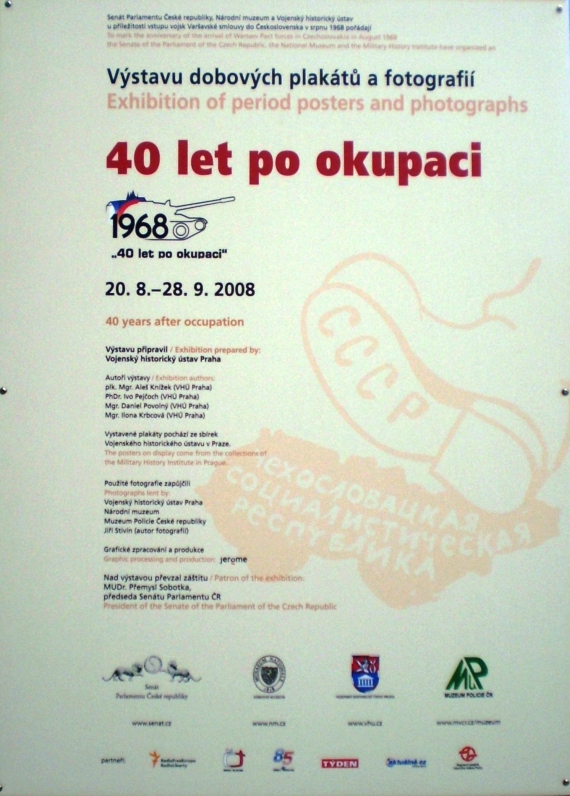

The reality of this invasion had hitherto been rather personally academic for most of us as individuals in (what was then) Western Europe; but here was a Czech citizen who had lived through it, explaining what it had meant to her, her family and her friends… and telling us how, later, these same people had been part of the extraordinary Velvet Revolution which was the basis of the transformation of the then-repressive Czechoslovakia into the present democratic state of the Czech Republic.
Mindful of these sobering thoughts, we left the graceful gardens and returned down towards the River Vltava, to the Dvorak Concert Hall (Rudolfinum) which had brought us to Prague, travelling with the Royal Liverpool Philharmonic Orchestra for their performances at the Prague Festival.

Outside the Hall was another exhibition of posters and photographs, relating the happenings of the invasion and its long aftermath.


In a way this felt surreal. Here we all were, discussing the events as history, but they had happened right where we stood, involving in critically personal ways people whom we knew as friends. For a while they had had no choice but to bear the crushing burdens of occupation stoically…

…. but eventually the protests grew to a great clamour, and after many long years, in 1989 the Velvet Revolution came about, mercifully without a huge toll of human life.
And amongst those leading this Revolution had been many writers and artists, including Vaclav Havel who was later to become the President of the Czech Republic, and his friend the musician Libor Pesek – a renown conductor who has had a long and close relationship with the RLPO, the Orchestra with which we were now visiting Prague.

Thus did the tale round upon itself. We stood there, in the heart of the Prague, testimony by our presence to the history and vibrancy of that great city, talking between ourselves as citizens of Europe and the world, and free to read, say and do as we wished.
No longer were the Prague Spring and the Velvet Revolution merely events on a timeline. They were instead vital elements of the spirit and understandings of real people, standing right next to us.
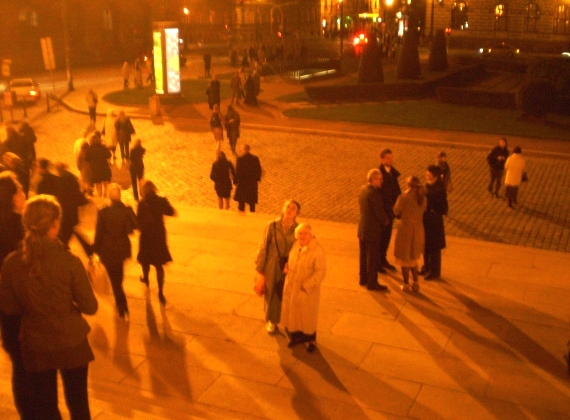
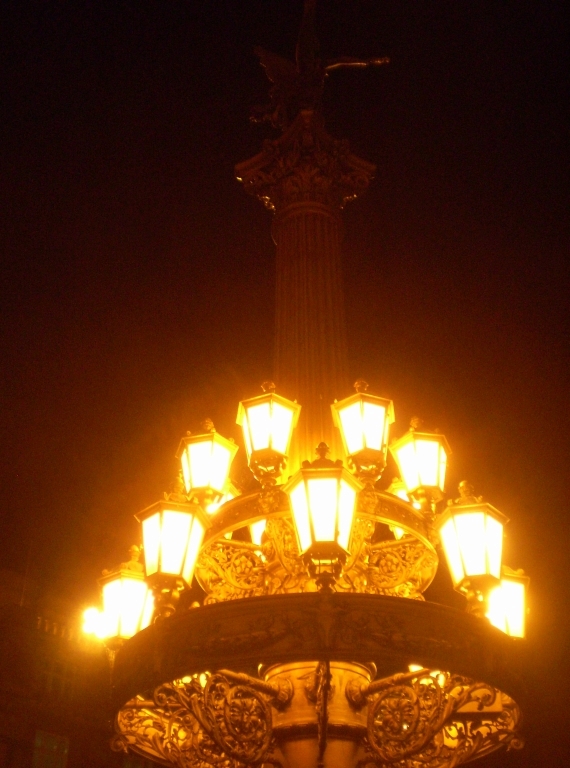
And that was something we pondered as we spent the evening in the Rudolfinum, hearing the RLPO concert which was the reason for our visit.
The concert, as we’d hoped, was a triumph; but, enjoying the music, we mused too that so much more so was the human spirit which had made it possible – the determination of a fiercely brave and proud people who, as we carried on our mundane existence in the democracies of Western Europe, had had to summon every ounce of endurance and strength to let the light of self-determination shine in their culturally blessed, historic city and homeland.
HOTFOOT Concert 2008 – Cafe Europe (Liverpool)
 HOTFOOT 2008, in Liverpool’s Philharmonic Hall on Sunday 7 September [NB: 7 pm], is the twelfth such annual concert. Promoted as ever by HOPES: The Hope Street Association, the theme for the city’s 2008 European Capital of Culture year is ‘Cafe Europe‘, with music devised by local children working alongside professional musicians from HOPES.
Natural Vs. Physical Science Research Points Up Regeneration Added-Value
 Are the Natural and Physical Sciences squaring up for inter-disciplinary combat? Each requires huge sums of money to maintain research momentum, but who decides what research offers best value? How can we measure Particle Physics ‘against’ say, environmental technologies? With their vast ‘pure research’ budgets to secure, perhaps the Physicists will now also discover that evaluating research investment regenerational impacts supports their case.
The rumblings of dissent between the physical and natural scientists are getting louder. There is a view abroad that investment in areas like Particle and Theoretical Physics is too expensive, when we need urgently to develop sustainable, ‘One Planet Living‘ technologies.
Applied or fundamental research?
Today’s Guardian newspaper (6 September ’08) has an article about the Large Hadron Collider (LHC) – a facility (apparatus or laboratory) in Geneva which will cost £5bn over the next 20 years – which adds substance to these rumblings. Prof. Sir David King, previously the UK Government’s Chief Scientific Adviser, argues that ‘big’ money for scientific research is best spent encouraging top scientists to address climate change and related environmental issues; Britain has so far contributed about £500m to the LHC.
The Physicists however argue that thus far we know about only 5% of what constitutes the universe; we cannot stop exploration of the fundamental nature of matter.
Valid views
Both perspectives are valid. But which will hold sway?
The environmental research argument is compelling to people who know little about science, as well as many (often including natural scientists who feel short of funding) who do. The fundamental, ‘science for the sake of knowledge’ position is also persuasive, but perhaps only really to those who already perceive the deep intellectual challenges of exploring the nature of matter.
Political decisions
It was probably alright to leave science decisions to the scientists a century ago, when the Haldane Principle decreed that political involvement in research decisions was unacceptable. But things have changed, and science is now infinitely more expensive than it was then.
How, on behalf of UK plc, should the Government allocate its cash? Decisions on specific scientific programmes are still made by the Research Councils; but overall allocations are decided by the politicians.
The socio-economic case
Some while ago, practitioners in the Arts and Culture began to espouse the ‘socially useful’ position: what they do should be supported because it helps community development and regeneration generically, and makes jobs.
My expectation is that, finally, the physical scientists may catch on to the same notion.
Currently, there is little of any discussion about how investment in Big Science – the large research facility programmes – impacts on the locations in which it is placed. In the future this may change.
Jobs and infrastructure
Some 10,000 scientists are employed by (and were attracted to work in) the LHC; and that’s before we get to the armies of scribes and other support staff required for such a programme. This, inevitably, must have a huge impact on the various economies in which LHC is embedded.
Scientists until now have held the idea that ‘value-added‘ – the additional socio-economic regenerational (as opposed to simply business) impact of research investment, over and above its scientific value as such – is irrelevant to their decisions about which proposals to support. Research funds may be from the public purse, but regenerational impact, we are told, is irrelevant to decisions about where programmes are located.
Shifting criteria
This high-minded dismissal of non-science-related socio-economic impact, I predict, is about to come to an end. Many technologists and natural scientists, like their more arty colleagues, now make compelling cases for how useful their work will be to society, within quite short time spans.
This is the only way practitioners in the more abstract and fundamental physical sciences can go, in terms of short-term impact. They will have to begin, however reluctantly, to acknowledge the legitimacy of questions about the ways their huge budgets can, alongside unravelling the mysteries of the universe, provide improvements to local economies, infrastructures and regional regenerational prospects.
You read it here first.
Read also:
Science, Regeneration & Sustainability
From Regeneration To Sustainability: A Northern Take On Knowledge
Liverpool’s Hope Street HOTFOOT Tee-Shirts, 1996 –
 Every year from 1996 HOPES has produced a limited edition T-shirt for everyone involved to wear for the Hope Street Festival; and only in that first year was there no special performance at the Philharmonic Hall. So 1997 marked the first of the subsequently annual HOPES HOTFOOT concerts which celebrate the exciting and diverse communities in Liverpool’s Hope Street Quarter. That’s a lot of people – orchestra musicians, singers, helpers and supporters
Hot Water Bills In The Land Of 2000 Hours’ Sunshine
 Energy is a commodity with variable value, it seems, depending on where you are. ‘We Greeks,’ said a fellow-traveller on the train as we departed Athens, ‘could have free hot water and free lighting all year; but we prefer to pay… Why put an annual 2000 hours of sunshine to good use, when we can produce energy more expensively in other ways?‘ He was, of course, being ironic.
August Moon And Little Cat On Lykavitos (Lycabettus) Hill, Athens
 Tonight is full moon in Athens, Greece, when by tradition everyone attends free events till late on the ancient sites; and this year there’s also a partial lunar eclipse over the city. But for this feral kitten, silently padding the very highest point atop Lycabettus Hill in search of restaurant diners’ scraps, it’s just business as usual.

Every year since 1953, the August Moon Festival in Athens on the night of the full moon – believed to be the most beautiful such event of the year – has been a celebration open to everyone, with free performances of opera, traditional dance and classical music on the Acropolis and Roman Agora, as well as events located in other unique and incomparable historic sites of Athens such as the Odeion of Herodus Attikus .
This is truly an occasion, if you are in Athens at the right time, not to be missed! (And if you’re somewhere else in Greece, you may still be lucky anyway – consult the Greek Ministry of Culture for possible events in other locations.)
Rationales For Community Leadership (And Their Outcomes)
 How do people come to be leaders in their communities? Are they anointed or appointed? Do they take or earn the authority to represent their peers? What are the rationales behind their belief that they should lead? Do others agree? And what are their objectives, and why? It all depends on where you’re coming from, and what sort of ‘community’ it is. So how should those who work in regeneration with communities and their leaders approach this complex and delicate issue?
The answer to these questions is, of course, that there is in fact No One Answer.
People come to be leaders through many different routes. For some authority and legitimacy is always a struggle. For others it just comes with who you are.
Different ‘communities’ for different purposes
This is a tale of different ‘communities‘ in different places and at different times. Some communities are geographically based, some interest based, some economic, some cultural.
‘Communities’ can comprise locations defined by their mono-cultural base (whether Protestant, Punjabi or Presbyterian), whilst at the other end of the spectrum some exist only as loosely connected groups of people who enjoy Politics, Portsmouth City or Painting. Leadership in these different communities will obviously not be of just one kind.
Intentions and expected outcomes
The intended outcomes of the leadership role vary. Some people believe they’re there to uphold tradition and (in their mind) maintain stability in an unstable world. Others seek to be leaders precisely so they can change things.
Traditional leaders and those (at the opposite end of the spectrum) who are of the ‘change the world’ tendency often to see their remit as wide. Others have more piece-meal and modest expectations, perhaps to improve things in a specific and direct way.
Authority to lead
The really interesting thing is that traditionalists and revolutionaries alike usually derive their authority from (what they perceive as) universal social values or mores. But those who seek more modest and specific changes tend to legitimise their positions in reasoned ways, perhaps in terms of the avoidance of harm or similar logically justifiable and rational objectives.
There is a chasm between those who exert overall authority as such – whether to maintain the status quo or radically to alter it – and those who seek to manage specific change, which they believe can be demonstrated to be for the better.
And these forms of influence are not randomly distributed. They tend to be associated with differences in community / cultural experience, age, gender and class. One person’s assumption of power and influence may well become, without any such overt intention, another person’s disempowerment.
Competing beliefs and challenges
Community leadership and wider social interests are sometimes hard to bring together in a world where there are competing beliefs about what legitimate authority in a community might be; and indeed about what constitutes a ‘community’.
Here lies one of the biggest challenges for those of us who seek to work with people in their (and our) own localities. Delivering stability and change together is hard to handle well.
In diversity lies strength?
Where the bottom line is overt – in for instance FTSE 100 Board Rooms – the evidence is incontrovertible, that diversity of gender (e.g. The McKinsey Report: Women Matter) and culture enhances good decision-making.
But how can (or ‘should’) we apply that knowledge in communities where at present the bottom line is not overt (what exactly is being ‘lead’?) and is certainly not up for discussion?
Read also
Social Diversity & Inclusion
and
‘Workable’ Regeneration: Acknowledging Difference To Achieve Social Equity (‘Regeneration Rethink’)
Athens Music
 Music in Athens, Greece, comes in all sizes and modes – from ancient instruments through traditional music, jazz and classical concerts and back to simple melody and rhythm.
This is a city comfortable with accomplishment of all kinds and in many genres, with events listed and unlisted. In the Summer, when formal venues are closed, the streets become a natural location for the more adventurous performer.
This informal piece looks at some Summer musical offerings in Athens. It includes (below) a list of links to and phone numbers for events which I discovered, though not necessarily attended or checked out. If you know more about these or other events which readers might find of interest, please tell us via the Comments box at the end of this article. Thank you!

The range of ‘street music’ in the capital city of Greece, Athens, is an eye-opener to those of us from colder climes. Athens is a city where the traditions of ancient and non-Western people meet those of us accustomed to the folk music and formal classical music modes of Northern and Central Europe. Here is a place where the cembalon of Eastern Europe is heard alongside African percussion, the guitars and bouzoukis of the Mediterranean (and later Ireland) and the brass instruments of every part of the world.
So there’s plenty of music, much of it very relaxed and informal, for visitors in Athens – and if you know of other events not mentioned below, please do tell us about them via the Comments box at the end of this page.

Whatever your preference, there will be something to enjoy – and to engage your interest and imagination. One of the great things about ‘street music’ is that it’s for everyone, young and old alike. Just as we have found when occasionally we can perform in public spaces in Liverpool, it’s the children who stop and listen and watch, often keen that they should not be moved on by parents or carers until they have heard their fill.


For some musicians however this is serious stuff. They have instruments and recordings of their work to sell, music to make to earn a crust. For others perhaps it’s a bit of fun, a way of passing time during the Summer months. It’s not difficult as a listener to tell who has which intention; but only rarely is there simply no evidence of skill when the performance, however fleeting perhaps as players stroll between cafe venues, begins.


But not all music is performed on the street. Athens has the attributes of all great capital cities – concert halls, an opera house (even if it does perhaps require relocation and an upgrade) and museums such as that for Maria Callas dedicated with whatever degree of enthusiasm to Greek classical music performers and composers of Greece – some of whom are listed (along with the main cultural venues around Athens) below, drawing for composers’ names on the cataloguing work done during the Athens Cultural Olympiad of 2004.


Nonetheless, there are forms of music which occur throughout the year in any city. Jazz bands and stringed instrument performers can play wherever they can find a space, and in almost any combination of instruments and performers; just as traditional dancers can congregate and entertain wherever numbers can be mustered – though certainly this is not how things happen at the treasure which is the Dora Stratou Theatre, a national institution to encourage traditional dance forms, offering performances throughout the Summer.


The choice is the listener’s. Formal or informal entertainment? Go for something new, or stick with the tried and tested? In Athens it’s best to have one’s listening mode in gear, ready for the next experience. It could even be during an unsheduled coffee stop. And who knows, you could even end up buying an instrument all of your own…

See more of Hilary’s photographs: Camera & Calendar
and read more about Music, Musicians & Orchestras, Travel & Tourism and Cities in Transition.
If you have recommendations for, or if you promote, musical events and venues in and around the Athens area, please post details (with contact information, indicating whether the occasion is regular, or one-off) in the Comments box below.
Some Greek music composers:
Yannis Andreou Papaioannou (1901-1989), Dimitris Dragatakis (1914-2001), Nikolaos Halikiopoulos-Mantzaros (1795-1872), Manolis Kalomiris (1883-1962), Alekos Kontis (1899-1965), Georgios Lambelet (1875-1945), Loris Margaritis (1895-1953), Dimitri Milropoulos (1896-1962), Andreas Nezeritis (1897-1980), Georgios Poniridis (1887-1982), Mikis Theodorakis (1925-), Marios Varvoglis (1885-1967), Alekos Xenos (1912-1995)
More information on events:
Athens Concert Hall (Megaro Mousikis), Vas. Sofias & Petrou Kikkali Street, tel: (from UK) (0030) 210 728 2333
Athinais Cultural Centre, Kastorias 34-36, Votanikos, tel: (00 30) 210 348 0000
August Moon Festival (free, on the night of the full moon, at a variety of ancient historic sites in Athens))
Dora Stratou Dance Theatre, 8 Stouliou Street, Plaka (offices) and Philopappou Hill (theatre), tel: (00 30) 210 324 4395 / (0030) 210 324 6188
Hellenic Festival, various venues, tel: (0030) 210 327 2000
“Melina” – Municipality of Athens Cultural Centre, Herakliedon 66, Thissio, tel: (00 30) 210 345 2150
Municipality of Athens Cultural Centre, Akadimias 50, tel: (00 30) 210 362 1601
National Opera, Akadimias 59, tel: (00 30) 210 364 3725
Technopolis (and the Maria Callas Museum), Pireos 100, Gazi, tel: (00 30) 210 346 1589
Vyronas Music Festival, tel: (00 30) 210 766 2066 or (0030) 210 765 5748
Aegina International (Summer) Music Festival [Tickets available at the “Eleni” shop next to the Aegina Port Authority building, tel: (0030) 22970 25593, & on the door.]
And more Festivals and events…
The Royal Liverpool Philharmonic Orchestra At the BBC Proms
 The RLPO finished their season in style this evening, with a sell-out BBC Proms concert in London’s Royal Albert Hall. There was a real excitement as the audience departed after the performance, matched by the sense of achievement RLPO players derive from working with Principal Conductor Vasily Petrenko. This is surely how professional orchestral musicians like to feel at the end of a year’s hard work.

A date at the Royal Albert Hall for the BBC Proms is a highlight of the season for any orchestra, and this was no exception for the RLPO, an orchestra with a distinguished history. Vasily Petrenko and the RLPO‘s programme for the evening was the World Premiere of Graven Image for Orchestra by the RLPO’s Composer in the House, Kenneth Hesketh, Beethoven‘s Piano Concerto No. 4 in G Minor, Opus 45 (soloist Paul Lewis) and the Rachmaninov Symphonic Dances, Opus 45, with Mussorgsky‘s Gopak as an encore.
And happily even those who couldn’t join the Proms audience in person were able at absolutely no cost to do so, as for every Prom, live via BBC Radio 3.
Reviews for the concert reflected the enthusiasm on the night.
But now the players are off for a well-earned break, applause still ringing in their ears….
See more of Hilary’s photographs: Camera & Calendar
and read more about Music, Musicians & Orchestras


 Dreaming Realist