Category Archives: Travel
JoelBird (Joel Phelan) Private View, Calderstones Park, Liverpool
 We were delighted this evening to attend the Private View of Joel Phelan‘s JoelBird paintings (acrylic on canvas) in the Coach House of Calderstones Park, Liverpool. Joel, a locally-born artist, is also a talented musician (JubJub / Eto The Band). He has created wonderfully life-like yet ‘designed’ impressions of birds which we see in our local parks. It would be great if these works inspired other younger people in the city to observe more closely the natural world around them.


Read more web reports on Liverpool, European Capital Of Culture and see more photographs of Locations & Events.
More information on Joel Phelan’s work: JoelBird
The Liverpool Biennial Spider Hovers Over Exchange Flags
 This spider, set against the austere statue of Lord Nelson and a backdrop of Liverpool’s historic Town Hall, has so much more to offer than La Princesse, the monster mechanical arachnid costing millions which scoured our streets a short while ago.
La Princesse was piece of engineering; Ai Weiwei’s bejewelled spider is a work of art. It trusts us to see in it what we will – it’s magical, creative and beautiful all at once, leaving the imagination to work its fancies.

More information: Liverpool Biennial 2008 plus The Observer Review of ‘Web of Light’ and the Liverpool Biennial.
See more of Hilary’s photographs here: Camera & Calendar; and read more articles about Cultural Liverpool.
Making Liverpool Prosper Beyond ’08 – The Debate
 Regeneration has been headline news in Liverpool these past few weeks, as the debate continues about Dr. Tim Leunig and his Policy Exchange report, Cities Unlimited, in which it is suggested that Liverpool’s time is over. This evening Prof. David Robertson of Liverpool John Moores University and Dr Leunig of the London School of Economics presented their opposing views on Liverpool’s future in Liverpool Cathedral.
True to the demands of academic candour, both speakers offered evidenced-based if very different understandings of the harsh reality of modern day Northern city economic prospects.
There was no contest in terms of the evidence presented in Cities Unlimted; the debate promoted by Dean Justin Welby this week, on Thursday 16 October 2008, was about what the established socio-economic data on Liverpool means, and whether it alone can tell us what is likely to happen to Liverpool as a city.
Interpreting the evidence
For Tim Leunig – an economist and authority on the history of the cotton trade – the essential message was, ‘Liverpool’s time is past’. He was, he said quite obviously sincerely, very sorry about this, and he didn’t wish anyone to be upset, but that’s how he believes things are.
For David Robertson – a policy adviser to the Government on life-long learning – the message was rather more upbeat, ‘Liverpool’s fate is in its own hands; everything’s now up for grabs.’
And of course for some people, though probably not so many of those in the audience, the real issue might well have been, ‘What’s your problem? Liverpool’s great anyway.’

An opportunity to make a point
A similar debate, also chaired by Roger Phillips, was held in the Cathedral just last year, as part of the farewell events organised by the then Dean, Rupert Hoare, when he and leading local expert John Flamson invited us to debate The Future of Liverpool’s Economy at a well-attended seminar on Saturday 27 January 2007, in the Lady Chapel…. and this event in turn followed in the footsteps of Dean Hoare’s illustrious predecessor, Dean Derrick Walters, a man for whom, alongside his calling, hard-headed and warm-hearted regeneration was a way of life.
As last time, the current debate offered an opportunity for those who have considered Liverpool’s prospects carefully to make their point. Even the most optimistic were agreed that a step change is required in how plans for progress should be viewed.
… and to face up to the facts
The message of hope, for those who wish to hear it, is – as indeed we have consistently argued on this weblog – that things can change. History tells us what’s already happened, not what will happen.
Currently, Liverpool isn’t that good at creativity and innovation (it doesn’t feature in the Intellectual Property or patent stakes) and there are many challenges for educational, health and other major features of the local population. But with a will to achieve, things can be done.
We need to make a frank assessment of where Liverpool’s going. History is in the past, not a predictor of what is yet to come about. To quote David Robertson:
What we’ve inherited can be unpacked for the future.
The moment of truth has arrived for Liverpool… We need to understand the limits of what we can do, to understand our strengths and focus on how we can succeed.
An enduring analysis
This was the message in the Cathedral last year, it’s the message now, and it will continue to be the message.
I just hope enough people in this city are beginning to listen.

Read more about The Future of Liverpool.
For further commentary on this debate see Larry Neild’s article, a report in the (Liverpool edition of) the Daily Post and the account by Adrian McEwen.
Liverpool’s ‘Sage’ Of Sefton Park
 Is it Merlin, or is it some other mystical creature, whose likeness arose silent and unannounced from the lone long-topped tree trunk in the heart of Sefton Park? One August morning, in the midst of the more expected park renovations of 2008, there ‘he’ was, the beautifully sculpted Sage of Sefton Park, the beginning, we can only hope, of a serendipitous array of creations in the park, for us to enjoy and create further in our imaginations as we wish.


It’s heartening that, even so long after it was first suggested, a tree sculpture has now appeared in our park, a place subject, for many months now, to less engaging and sometimes jarring disruption.
Who sculpted our ‘Sage’ and why or how, we don’t at present know [later: or at least we didn’t then]; but perhaps that mystery can be resolved [please see Comments below]? Is ‘he’ Merlin the wizard or some other mystical creature? Does he have a message, or is he simply there to lift our imaginations and to add some fun as we stroll by, or as we pop into the cafe with the kids for a little treat?
May this be the start of much more creativity and friendly magic for the imagination, in this special urban green space right by the centre of our city.

Read more about Sefton Park, and see more photographs at Camera & Calendar.
John Willman, Tim Leunig And North West England
 John Willman is UK Business Editor of the Financial Times, so his take on the UK economy was an important contribution to the NWDA 2008 Annual Conference in Liverpool. His message, whilst analytically cautious in the present market chaos, came over as generally upbeat. Would that Tim Leunig, the academic who advised the economic emphasis should Go South, had seen things in the same light. Better surely for the North and the South of England, if we face the UK’s regional (and centralist) challenges, than if we run away?
The headline message from John Willman‘s talk came over to me as: Tim Leunig is mistaken. And the UK economy is fundamentally strong.
Leunig’s recent staggering judgement (in the report Cities Unlimited, by the free market leaning independent think tank Policy Exchange) that in general developers should abandon the North of England for the delights of the Golden Triangle – he suggests more development around Oxbridge, which will supposedly realign the North-South markets – in my view takes some beating for silliness. John Willman appeared to be of a similar mind.
The great Victorian cities
Far from suggesting, as Leunig seems to, that Greater London should become even more overheated, Willman made the case that the ‘great Victorian cities’ are the best equipped for the new ‘global living’. There is, he said, a Kit: some combination of conference centres, art galleries, a four-star hotel, some culture and festivals, and maybe a port.
In these respects the major English cities of the North (of the Core Cities, only Bristol is South) have the edge on continental European cities such as Bordeaux and Porto. They’re also great and fascinating cities (as I too can attest), but they’re probably 15 years behind their parallels in Britain: Their docksides have yet to be developed for the new leisure economies, for instance.
North-South divide: London ‘vs’ the rest
The debate about the North-South divide, Willman told us, is sterile. It’s useless to ‘blame’ London. The UK capital is a truly global city; in this, the North can never expect or even hope to compete. It’s just not a realistic objective to close the gap.
And London, with the mayoral model which elected mayor Ken Livingstone provided, showed how a ‘get things done’ city can operate.
The national and global economy
Despite the panic, only 3% of UK mortgages are in default. Willman judged that Britain is still doing pretty well as the sixth largest manufacturer in the world, a supplier of very high quality products.
In these respects the UK economy is well placed for the globalised world; as is North West England, with its emphasis on the service economies, life sciences, media and creative products and the current / forthcoming energy industries (including nuclear energy) .
The Wimbledon effect
The UK is an open economy, which in some senses punches above its weight. Britain demonstrates the ‘Wimbledon effect‘: we don’t necessarily take the headlines, but we do host the event.
In fact, the consultants Saffron Brand recently reported that perhaps the UK sells its story ‘too well’ – some of our cities are actually more highly rated than cold analysis suggests they might be.
A strong basic economy
Willman’s overall judgement at the NWDA 2008 Annual Conference was that UK economy is ‘so much stronger than 30 years ago’.
Perhaps some of us continue to see the elephant in the room – climate change and environmental sustainability – as an critically important challenge, still to be adequately (and very urgently) addressed.
Whatever… Would that Tim Leunig and others like him were as willing as Willman, on the basis of the evidence over many decades, to recognise that people everywhere have to believe in themselves to make their economies work effectively at all.
Read more about Regions, Sub-Regions & City Regions
and about Economics Observed.
Prague, Forty Years On (And The Velvet Revolution)
 The events of the 1960s are simply history for many of us today, but a visit to Prague (September 2008) provides a reminder that for some, the memory of those events is still very much alive. The Czech Republic is now a vital, thriving and democratic country as a part of main-stream Europe, thanks to the Velvet Revolution of 1989. Yet there are plenty of Czech citizens who recall the trauma of those times as integral to their personal ‘lived experience’.
These thoughts became very focused for me today, when we took a walk around Prague with a citizen of that city, our good friend Dada. Our exploration began with a look at the gardens of the Czech Senate, which lie above the commercial centre of the city, simply designed yet formal and splendidly impressive all at once:

But as we wandered it became apparent that these were not just gardens; they were host also to an exhibition with more than token impact. For here before us was a real military tank….

And here too were notices about the objects on show, telling us (Dada explained) about the tragic events of forty years ago, in 1968: the failure of the Prague Spring which would have relaxed the grip of Communism, and the invasion of Czechoslovakia – as it then was – by Russia.
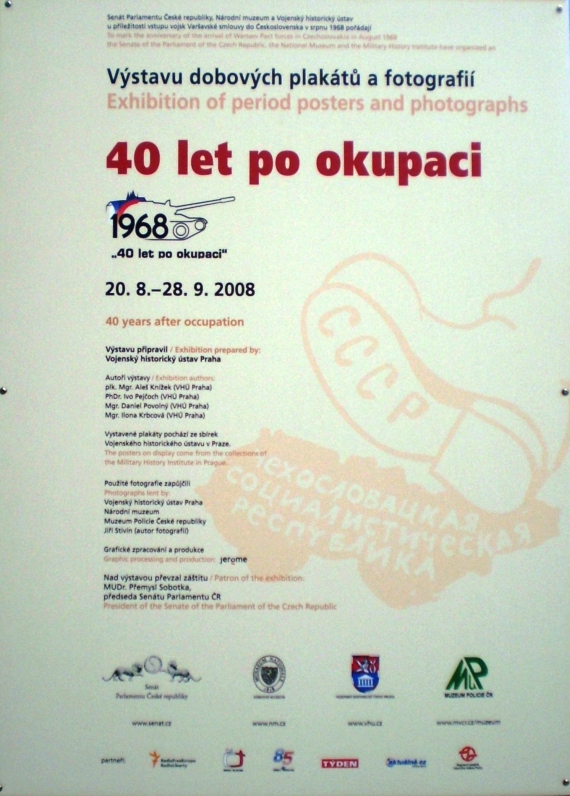

The reality of this invasion had hitherto been rather personally academic for most of us as individuals in (what was then) Western Europe; but here was a Czech citizen who had lived through it, explaining what it had meant to her, her family and her friends… and telling us how, later, these same people had been part of the extraordinary Velvet Revolution which was the basis of the transformation of the then-repressive Czechoslovakia into the present democratic state of the Czech Republic.
Mindful of these sobering thoughts, we left the graceful gardens and returned down towards the River Vltava, to the Dvorak Concert Hall (Rudolfinum) which had brought us to Prague, travelling with the Royal Liverpool Philharmonic Orchestra for their performances at the Prague Festival.

Outside the Hall was another exhibition of posters and photographs, relating the happenings of the invasion and its long aftermath.


In a way this felt surreal. Here we all were, discussing the events as history, but they had happened right where we stood, involving in critically personal ways people whom we knew as friends. For a while they had had no choice but to bear the crushing burdens of occupation stoically…

…. but eventually the protests grew to a great clamour, and after many long years, in 1989 the Velvet Revolution came about, mercifully without a huge toll of human life.
And amongst those leading this Revolution had been many writers and artists, including Vaclav Havel who was later to become the President of the Czech Republic, and his friend the musician Libor Pesek – a renown conductor who has had a long and close relationship with the RLPO, the Orchestra with which we were now visiting Prague.

Thus did the tale round upon itself. We stood there, in the heart of the Prague, testimony by our presence to the history and vibrancy of that great city, talking between ourselves as citizens of Europe and the world, and free to read, say and do as we wished.
No longer were the Prague Spring and the Velvet Revolution merely events on a timeline. They were instead vital elements of the spirit and understandings of real people, standing right next to us.
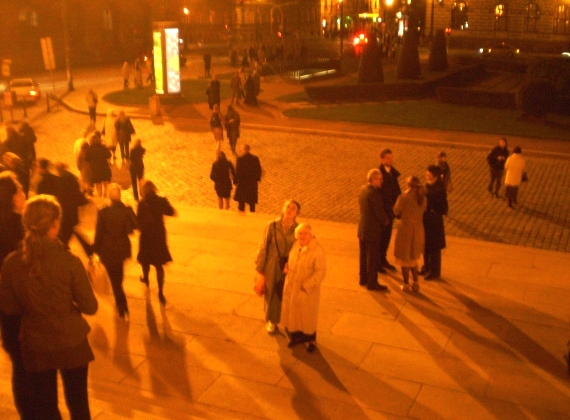
And that was something we pondered as we spent the evening in the Rudolfinum, hearing the RLPO concert which was the reason for our visit.
The concert, as we’d hoped, was a triumph; but, enjoying the music, we mused too that so much more so was the human spirit which had made it possible – the determination of a fiercely brave and proud people who, as we carried on our mundane existence in the democracies of Western Europe, had had to summon every ounce of endurance and strength to let the light of self-determination shine in their culturally blessed, historic city and homeland.
HOTFOOT Concert 2008 – Cafe Europe (Liverpool)
 HOTFOOT 2008, in Liverpool’s Philharmonic Hall on Sunday 7 September [NB: 7 pm], is the twelfth such annual concert. Promoted as ever by HOPES: The Hope Street Association, the theme for the city’s 2008 European Capital of Culture year is ‘Cafe Europe‘, with music devised by local children working alongside professional musicians from HOPES.
Liverpool’s Hope Street HOTFOOT Tee-Shirts, 1996 –
 Every year from 1996 HOPES has produced a limited edition T-shirt for everyone involved to wear for the Hope Street Festival; and only in that first year was there no special performance at the Philharmonic Hall. So 1997 marked the first of the subsequently annual HOPES HOTFOOT concerts which celebrate the exciting and diverse communities in Liverpool’s Hope Street Quarter. That’s a lot of people – orchestra musicians, singers, helpers and supporters
Hot Water Bills In The Land Of 2000 Hours’ Sunshine
 Energy is a commodity with variable value, it seems, depending on where you are. ‘We Greeks,’ said a fellow-traveller on the train as we departed Athens, ‘could have free hot water and free lighting all year; but we prefer to pay… Why put an annual 2000 hours of sunshine to good use, when we can produce energy more expensively in other ways?‘ He was, of course, being ironic.
August Moon And Little Cat On Lykavitos (Lycabettus) Hill, Athens
 Tonight is full moon in Athens, Greece, when by tradition everyone attends free events till late on the ancient sites; and this year there’s also a partial lunar eclipse over the city. But for this feral kitten, silently padding the very highest point atop Lycabettus Hill in search of restaurant diners’ scraps, it’s just business as usual.
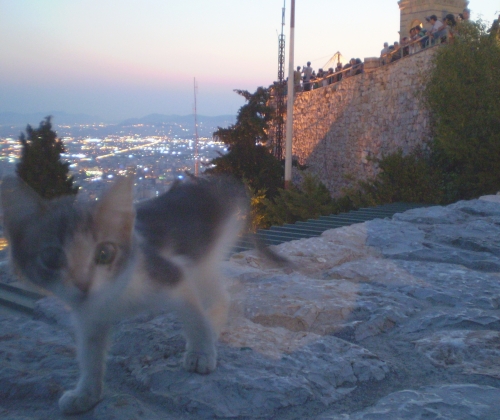
Every year since 1953, the August Moon Festival in Athens on the night of the full moon – believed to be the most beautiful such event of the year – has been a celebration open to everyone, with free performances of opera, traditional dance and classical music on the Acropolis and Roman Agora, as well as events located in other unique and incomparable historic sites of Athens such as the Odeion of Herodus Attikus .
This is truly an occasion, if you are in Athens at the right time, not to be missed! (And if you’re somewhere else in Greece, you may still be lucky anyway – consult the Greek Ministry of Culture for possible events in other locations.)


 Dreaming Realist