Category Archives: Sustainability As If People Mattered
90 Years Of Women’s Emancipation – And Feminism
 Just 90 years ago on this date was the first time any woman in the UK was ‘allowed’ to vote. Some people still alive now were born when women’s emancipation did not exist; and even in 1918 the Representation of the People Act permitted only specified women over 30 this privilege. It was to be another ten years before women gained equal voting rights with men.
From the time of the Representation of the People Act of 6 February 1918 until the Equal Franchise Act of 2 July 1928, despite this and other first and desperately hard-fought victories, democratic voting rights were still not equal between men and women.
But that was by no means the end of the fight for formal equality. It was, extraordinarily, not until 30 April 1958 – a date still easily within the memory of many people – that the Life Peerages Act enabled just four women gained entry to the House of Lords.
Not there yet
So progress has indeed been made towards women’s equality in the past century. No longer are women paid less in, or indeed debarred if they marry from, professions like teaching; no longer does the law formally and overtly permit differences in the way women and men stand before it.
But still much remains to be done. As Katherine Rake, Director of the Fawcett Society, says in her Guardian interview this week:
We have done as much as we can levering women into a system designed by men for men. Now we have to work for a society where the rules are fitted for everybody…. There has been a huge change in women’s lives, but very little in men’s. [To make further progress] we have got to look at what happens in men’s lives…..
Even now, these battles continue, worldwide….
Unapologetically feminist
So I make no apology for being a long-time committed feminist. Half a century after women’s first step towards full emancipation, the feminist agenda of 1968 was a turning point as I entered adulthood. But the year 2008 still sees a long road ahead.
In my lifetime much has changed; but not enough.
Whilst, for example, the 1975 Sex Discrimination Act brought about a fairer situation for women requiring maternity leave (and , thereby, their partners and families) – though it was too late for some of my friends and me.
Still unequal in work and in power
But gender equality in the workplace is even now nowhere near achieved. British women in full time work are still paid on average 17% less than men similarly employed; and when part-time the difference between men and women is 36%.
And in national politics, where the big decisions are made, women remain even now a minority. The 2005 General Election saw 128 women elected in an assembly of 644, most of them – as Theresa May, a leading Conservative, herself acknowledged, from the Labour Party. (As at the end of 2006, of 712 Lords, 139 were women.)
Gender fatigue there may well be; but this is no time for inaction.
A way to shape the future
There remain enormous gaps, for both men and women, in parts of our lives which, whatever the legal frameworks, still have to be addressed. Men and women remain unequal, for each of them in different ways. (And so as we know do people of different sexualities, of different colour or age, of different beliefs and with different abilities.)
You don’t, actually, need to be a woman to want to seek equality, to hold that feminism is a sensible and decent way to see the world. You just have to be a fair-minded person.
Read more about Gender & Women.
Sefton Park Renovations Have Begun
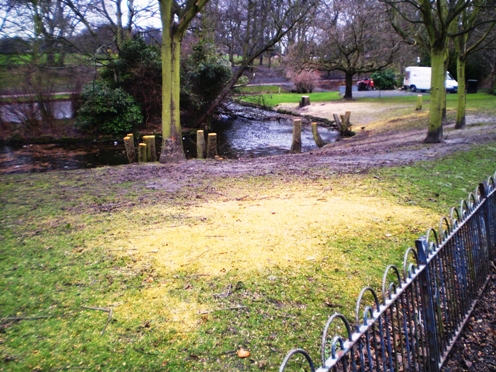
 Mid-winter, and the rawest, sorest part of the oh-so necessary works on Liverpool’s Sefton Park has begun. Here lies the pink ribbon of protest an anonymous tree-lover tied on this felled tree. And here (below) lies scattered the still fresh sawdust of the vigorous cull of trees around the upper lake. Soon, we are assured, these voids will be host to new and vibrant growth. Soon, our park will be even more lovely than before.
More information on Sefton Park is available here.
Photographs of Sefton Park on this website include:
Liverpool’s Sefton Park Trees Under Threat – Unnecessarily? (Photo of the subsequently removed Willow tree in the Cherry Blossom / central lake)
and
Cherry Blossom For May Day In Sefton Park, Liverpool.
For more photographs please see here.
What’s Regeneration For?
 The British Urban Regeneration Association (BURA) annual conference is in Liverpool this year, on 30th and 31st January 2008. The conference, bringing together some 300 people, will see brisk debates between professionals and community leaders from across the U.K. One important focus may be the search for consensus on what regeneration is ‘about’.
BURA is an organisation moving forward with increasing momentum and confidence in both its own role and the direction and meaning of regeneration in Britain.
What is regeneration?
We, as members of the Board of BURA, are beginning to understand anew, or at least consciously to explore in a new way, what ‘regeneration’ means. The discussion will doubtless continue for a long time yet; but for me some clarity is emerging from many years in the business.
Regeneration is much more than ‘construction’, ‘development’ or even ‘capacity building’.
In the end, regeneration is about adding long-term shared value to all these activities.
A win-win
Regeneration’s a real win-win; it’s about creating a more equitable, more sustainable life-context for everyone.
The challenge is, how to do it.
The UK is often said to be at the forefront of regeneration. BURA’s annual conference discussions this week should prove interesting.
Translating Public Policy Into Action
 Evidence-based policy is central to much contemporary governmental thinking. But how the different phases of policy delivery can best engage ‘real people’ is not always clear. This is true whether the intended policy concerns health, the knowledge economy, or even global sustainability. There is still much to be done in understanding human agency and interaction in policy development and delivery.
In many aspects of public policy, from health through life-long learning and the economy to global sustainability, it is not simply the science or knowledge base which is important. Of equal, or sometimes greater, importance is an understanding of how to apply the established evidence which informs policy.
Phases in public policy development
There are, or should be, a number of phases in developing public policy.
The first phase is to derive as much consensus as possible about the necessary evidence base (both scientific and contextual) and the second is to consider how this ‘translates’ – an exercise which is currently being taken forward overtly by the government in relation to scientific knowledge, industry and business.
Securing public agreement or at least encouraging constructive and informed public debate is another phase which must run alongside these first two phases.
This ‘third’ phase is at risk when the established modes of policy development continue.
Public debate
The government has now gone some way to seek proper public debate on issues around science, technology, health and so forth. It is not as yet clear however that the corollary of this emphasis has been absorbed by the wider knowledge-related industries or even by some whose task is to deliver policy for real.
We all know that fundamental research and the intricacies of, say, applied medical knowledge are critical for the future. What is less well understood is that there remain huge gaps in our understandings of how such knowledge becomes operational in the real world.
People are what makes things happen. How they do so, in the contexts of such enormous challenges as global warming, the diseases of contemporary societies and the rapidly changing communities we all live in, has yet to be made clear.
Making things happen depends on people
Despite all our problems, many of us in the western world live in the best conditions human beings have ever known. Ensuring this continues and is shared even more widely is very largely a task for policy makers informed by a social rather than natural scientific knowledge base.
Fundamental science certainly needs to remain at the centre of knowledge creation; but, whether in health, industry or the environment, it must be matched by an equally well researched knowledge of the social world, if there is to be any real hope of public policies to sustain all our futures.
Lighter Evenings, Energy And Health
 ‘Incremental’ is the mode of choice when we talk about the massive changes required for the sustainability of ourselves and our planet. People find it hard to make large or sudden changes, so we try to do them bit by bit. Seen like this, the benefits of daylight ‘saving’, keeping lighter evenings, become increasingly compelling.
The big health news of the past week or two has been obesity… how it’s becoming an epidemic and how difficult it will be to reverse the demands which people being overweight put on the health services and on the exchequer.
Then we are told that we must conserve energy in every way possible. Carbon expenditure must, urgently, be reduced, climate change is happening even more quickly than we had thought.
Looking for solutions
In these contexts it is surprising that the sensible advice about behaviour adaption – go gently, to take people with you – has not yet been applied to the benefits of ‘daylight saving’.
We know that lighter evenings offer more encouragement for people to take exercise; we know that the extra light also reduces fuel demands. (Jim Fiore estimated recently that in the US context ‘only’ 0.25% savings would be achieved – but that’s a massive amount of oil which could be conserved with no effort by anyone.)
Joined up thinking
The clocks go back on Sunday, tomorrow, 28 October, at 2 a.m. From then on until next March (British Summer Times begins on 30 March, with the new US Daylight Saving Time starting on 9 March) we shall have afternoon murk.
Scottish farmers may be happy with these murky afternoons, and they are of course welcome to any arrangement the Scottish Parliament wants to make. For the rest of us, a bit of (evening) light needs to be shed on the subject of incremental health and energy improvements.
The full debate about BST is in the section of this website entitled
BST: British Summer Time & ‘Daylight Saving’ (The Clocks Go Back & Forward)…..
See also:
Making The Most Of Daylight Saving: Research On British Summer Time
Save Our Daylight: Victor Keegan’s Pledge Petition
The Clocks Go Forward…And Back… And Forward…
British Summer Time Draws To A Close
Time Is Energy (And ‘Clocks Forward’ Daylight Uses Less)
The Clocks Go Forward … But Why, Back Again?
Join the discussion of this article which follows the book E-store…
The New Harvest Festival
 This is the time of year when churches urban and rural across the nation urge us to attend their services for Harvest Festival. For many of us however this annual celebration is now marked more secularly, observed at one remove, via our newspapers, rather than physically in our communities. Media celebration of seasonal food is the order of the day.
The Guardian, like other similar publications, is hot on seasonal food. A story in that newspaper today gives a flavour of that theme: ‘Green’ shopping possible on a budget, watchdog says.
What then follows is that irresistible combination of knocking the supermarkets (fair enough if they’re not up to scratch), going rustic with references to in-season fruit and veg. (why not, it really is good for you), and angst about affordability and carbon footprint (fair enough again).
Contemporary perspectives
So here is the contemporary version of We plough the fields and scatter…
Way back over the centuries people have known about crop rotation and storage and the seasons, and have celebrated all this with Harvest Festivals of one sort or another. Now we know about food miles, sustainability and ethical buying.
Appreciating our sustenance
This is the better informed (or at least more techno) version of the wisdom of the ages, translated for those of us who hope for the future but have no bedrock of faith on which to base an annual thanksgiving.
Perhaps it doesn’t matter how we demarcate the changing seasons and the beneficence they offer. What does matter is that at least we notice.
Presidential Schema For The Post-Science Century
 ‘The next president of the United States of America will control a $150 billion annual research budget, 200,000 scientists, and 38 major research institutions and all their related labs. This president will shape human endeavors in space, bioethics debates, and the energy landscape of the 21st century.’ So says Chris Mooney in his seriously impressive review of the options – options in reality about human beings, not ‘just’ about knowledge – awaiting electors of the next President of the USA.
Chris Mooney, in his recent Seed Magazine blog piece entitled Dr President, examines the options for American science and suggests what needs to happen now.
America’s relationship with reality
During the past seven years of the Bush administration, Mooney tells us, America has been subject to ‘what can only be called antiscientific governance’. Scientists, he says, have been ‘ignored, threatened, suppressed, and censored across agencies, across areas of expertise, and across issues…
‘Under George W. Bush—the man who pronounced climate science “incomplete,” who misled the nation in his first major address about the availability of embryonic stem cells for research, who claimed that Iraq was collaborating with Al Qaida—America’s relationship with reality itself has reached a nadir.’
What’s next?
Chris Mooney is right. The status of science is in crisis, at least as far as States-side politics is concerned – and also in terms of what people in many parts of the world, even many sophisticated knowledge economy parts, understand about what science is and does.
‘To better grapple with emerging science controversies’, Mooney proposes that the in-coming president ‘reconstitute something akin to Eisenhower’s President’s Science Advisory Committee, but with a strong emphasis on forecasting the looming problems of tomorrow. …The conversations wouldn’t shy away from controversial or speculative topics. They would be designed, at least in part, to spark discussion in the media, on the Sunday-morning talk shows, and also at the kitchen table.’
Engagement beyond the science
This paper on antiscience, and its resolution through widespread debate and respect for scrutiny of the evidence base, offers many rich seams for us all to explore. But I think it also offers a new perspective on what I might call the ‘Post-Science Century’ which is before us.
The term ‘post-science’ means much more to me than simply the arid ‘total value’ anaylsis deriving from Milton Friedman et al. Instead, it focuses attention on the socio-political impacts and synergies of science and technology (one of a multitude of examples might be IT and the developing world) rather than on measures of money.
No longer can it be said that ‘knowing the science’ is enough – and Mooney is clear on this. We need to understand the future of climatalogical, environmental, genomic, military and many other applications of developing knowledge.
From tested knowledge to the human condition
In seeking to grasp what all these enormous issues, with their huge budgets, mean for each of us, we move from formal and tested knowledge to insights concerning the nature of human experience.
Perhaps it’s an irony of the twentyfirst century that the human condition itself will force us to think about science, rather than any new-found urge to look dispassionately at evidence bases and how to test them. This is what should drive the Science Advisory Council of the next President of the USA.
It’s not what we know, but why we all need to know it, that will spur this critical agenda.
What Makes A Good Regeneration Worker?
 All regeneration and strategic planning professionals need to have excellent formal qualifications and wide experience; the job is far too important for anything less. But what other characteristics are also required to make a good regeneration official into an outstanding agent of delivery on the ground? Here is a list of such characteristics, from a rather specific observational position.
Here are some suggested stereotypical characteristics of the ideal regeneration or urban / rural planning worker:
- Willing to listen and learn; everyone has something to offer
- Open to the idea that communities change over time
- Realistic about the balance in plans and designs of art and application
- Knowledgeable about the area’s infrastructure and transport arrangements
- Involved in the community and active in establishing good local facilities
- Not afraid to challenge the status quo, but also keen to keep the peace
- Gets quickly to the bottom of the issues; there’s lots to do!
- Manifestly focused on what works and what’s sustainable
- Ultra-aware that time is precious; opportunities need to be seized
- Motivated by making things better for all stakeholders
- Sensitive to the requirements of those less able to articulate their needs
Have you spotted the tongue-in-cheek subtext of this list?
The ‘hidden message’ is of course offered only fun; but the actual listed characteristics are in my view a fundamental requirement of any competent regeneration worker, however formally qualified they may be.
What do you think?
This list was devised as part of a discussion about developments inhigh-rise living, for an Urban Design Week Coffee Shop Debate in Liverpool, September 2007. It was also published as a New Start external blog.
Sky-High Homes For The UK’s Regional Cities?
 How many people reading this article actually live in a city centre? How many readers in live a high-rise apartment? And how many of these readers are aged 30-50?
My guess is that fewer readers live in high-rise than have views on them; the evidence certainly shows that most people past a certain age choose to live in suburbia or out-of-town. So is the commercial emphasis on city centre ‘executive’ apartments sustainable?
One young woman I know, a lawyer, lives with her husband in an a sixth floor apartment in Manhattan, New York.
Another, a business consultant, until recently lived in a fourth floor apartment near the commercial centre of London, but has just moved to a town house there.
My husband and I live in suburban Liverpool, and have done for many years.
Economics and demography
Economics and demography are everything in housing. People choose where, ideally, they would like to live, by reference to their family requirements.
Many people, as we all know, are happy to live in high-rise city centre accommodation before they have children, but in the UK, and especially outside London, most would prefer to make their family home in suburbia – as indeed I did.
Other countries, other ways
In other countries the suburban option may be both less available and less often preferred.
Some young couples in the UK, like the ones I know in London, can resolve their requirements by choosing a town house near the city. Others elsewhere, like the couple in New York, don’t feel the necessity to abandon high-rise living as quickly.
Why the difference?
There is less of a tradition in the UK of high-rise living except perhaps, and tellingly, in tenements and council housing.
Other cities such as New York have pressures on land which mean that over time they have adjusted to high-rise.
Sim city for real
Have you ever played Sim-City? In New York space issues have resulted in the creation almost of Sim-City tower living.
Everything is there – the shops, the amenities – including clinics, nurseries and gyms, the work places, and then, above them, with different access, living accommodation, roof gardens etc.
And in the same block as the building will be the link to efficient public transport….
Sustainable living?
These sorts of arrangements make it possible for everyone to live In Town, and many people except those with growing children to prefer to.
It’s time and, importantly, energy efficient to live in, e.g., Manhattan, and the experience is generally holistic. The experience addresses what’s needed in a reasonably sustainable way.
London
Looked at like this, we can see that London is a half-way house between Manhatton and Liverpool.
The UK overall is a very densely populated island, but still only about 5-10% of it is city-space.
Nonetheless, land is very scarce in London, and London has some of the attributes required to make it a preferred city living option. And that city is working hard to improve its offer.
Liverpool
Liverpool, however, is still losing population, albeit at a reducing rate. And we have enough houses but not always ones people like.
Unless the ‘core offer’ on Liverpool city-centre living improves rapidly, I can see little prospect of sustainability in tower-block living here.
Live-ability
We haven’t, yet, factored in the amenities to make Liverpool city-centre ‘people friendly’, as is only too obvious on any Friday night.
For me therefore high-rise in Liverpool, in the brave new world of ‘executive’ apartments, is not where I would currently put my money as a developer.
Quality of experience
Fashion quickly becomes fad and then old hat when the quality of the experience is lacking.
I’d advise investors to think about how NY or London do things – maybe even live there for a while – before they go any further with high-rise in Liverpool.
High rise and high income?
Even a decade or two ago in the UK high-rise still often (except in, say, parts of Edinburgh and London) went with low-income.
Now, conversely, high-rise and high-income seem to go together; which is fine in London; but not elsewhere.
Real executives for ‘executive’ apartments?
Liverpool should put a hold on more high-rise executive apartments until it has a more high-income, young, executives in genuinely sustainable jobs to live in them.
I’d say, let put some functional flesh, some real amenity, on the skeleton of Liverpool’s developing infrastructure
before we go for fashion in housing.
Moving forward sustainably
* Let’s first make Liverpool city centre safe and people-friendly.
* Let’s use professionals to develop the city who have experience of family life and of city centre living, to help us see what more needs to be done.
* Let’s explore what we can do to integrate services, amenities and enterprise with ‘livable’ space.
* Let’s make Liverpool’s city centre sustainable and let’s reverse our population decline before we go big-time in Liverpool for high-rise…. especially if it has more style than substance.
This is an edited version of a talk given by Hilary Burrage as part of a debate in Liverpool during Urban Design Week, hosted by Taylor Young, on 18 September 2007. The event was entitled ‘High rise living getting you down!?’ Almost all speakers in the debate agreed with the position taken here.


 Dreaming Realist