Category Archives: Regeneration, Renewal And Resilience
What Makes A Good Regeneration Worker?
 All regeneration and strategic planning professionals need to have excellent formal qualifications and wide experience; the job is far too important for anything less. But what other characteristics are also required to make a good regeneration official into an outstanding agent of delivery on the ground? Here is a list of such characteristics, from a rather specific observational position.
Here are some suggested stereotypical characteristics of the ideal regeneration or urban / rural planning worker:
- Willing to listen and learn; everyone has something to offer
- Open to the idea that communities change over time
- Realistic about the balance in plans and designs of art and application
- Knowledgeable about the area’s infrastructure and transport arrangements
- Involved in the community and active in establishing good local facilities
- Not afraid to challenge the status quo, but also keen to keep the peace
- Gets quickly to the bottom of the issues; there’s lots to do!
- Manifestly focused on what works and what’s sustainable
- Ultra-aware that time is precious; opportunities need to be seized
- Motivated by making things better for all stakeholders
- Sensitive to the requirements of those less able to articulate their needs
Have you spotted the tongue-in-cheek subtext of this list?
The ‘hidden message’ is of course offered only fun; but the actual listed characteristics are in my view a fundamental requirement of any competent regeneration worker, however formally qualified they may be.
What do you think?
This list was devised as part of a discussion about developments inhigh-rise living, for an Urban Design Week Coffee Shop Debate in Liverpool, September 2007. It was also published as a New Start external blog.
A European Capital Of Culture Without Euros
 Here in Liverpool we are about to start our 2008 Year as European Capital of Culture. But apparently the connection between this year-long Capital of Culture event and hard European cash has yet to dawn on some local businesses. This is serious. Who’s failed to get the message over? And will things improve?
A walk this morning took us through Liverpool’s Sefton Park to Lark Lane, where the Boho action is, to find some brunch.
The brunch was fine; but the bill which followed it left us at best bewildered.
Sterling only
The card machine – as usual these days, the ‘continental’ ‘take it to the table’ type – came up with a sensible sum, requested in either Sterling or Euros. As it happened, we had some Euros on us, so when we’d paid (in Sterling) we asked lightheartedly if we could have paid cash Euros. (The literal conversion rate was 1.645 if anyone wants to know….)
The waitress was aghast. Oh no, she assured us, clearly thinking we’d sought such reassurance, they wouldn’t even think of taking Euros. The cafe never dealt with Euros, the cost would be sky-high, it was quite out of the question…
Bafflement and business
We were unsure how to respond, having originally intended to congratulate the establishment on its forward-planing and preparations for Euro-billing.
Did our waitress know, we asked, what 2008 had in store for Liverpool? She confirmed that she knew 2008 is the Capital of Culture year.
But it’s Liverpool’s ‘European’ Capital of Culture Year, we protested……
The management decides
‘I don’t know about that’, came the reply. ‘Anyway, none of Liverpool’s restaurants are doing Euros. You’ll have to take that up with the management.’
On the contrary, we suggested, perhaps the management needs to take the Euro opportunity up with itself….
The ‘Liverpool experience’ missing link – Europe
So there we have it. At least some of our local businesses, just three months before 2008 begins, still fail utterly to understand that next year is an international, a European, event.
These local ‘enterprises’ haven’t even begun to consider whether a billing system with the potential to offer payment in Euros as well as Sterling might in fact be a business advantage or selling point…. especially in the Boho part of town.
No leadership with the big picture
Could this failure to get the overarching picture be because the city’s leadership has permitted developments (perhaps even decided?) not to move out of the Liverpool comfort zone?
Are city leaders neglecting to emphasise that next year’s celebrations are not ‘only’ an excuse for some (what look to be very promising) major arts events, and for neighbourhood street parties and general local merriment, important though all these are?
2008 opportunities squandered?
If the whole rationale for Liverpool’s European Capital of Culture 2008 Year is put aside, if the business opportunities are not seized, all that enormous amount of (our) money already spent will have been squandered.
I really hope someone will be getting things into gear pretty pronto.
No Top-Level Diversity Leaves Liverpool’s Leadership Lacking
 Civic leadership in action requires a range of perspectives and understandings. No single ‘type’ of person can hold all the wisdom to take communities forward in this complex age. A range of experience is required. The overwhelmingly white, male hegemony in Liverpool’s corridors of power is a civic embarrassment, demonstrating a fundamental lack of will to learn from the richly diverse insights of its citizens.
For everyone to flouish, civic direction must draw on the life experience of us all. Sadly however this is a lesson yet to be learnt in Liverpool.
In April Liverpool’s Liberal Democrat-led City Council set up the long-needed Countdown Group in an attempt to sort the physical regeneration of Liverpool before our big European Capital of Culture year in 2008.
Currently, in September, Council leaders are doing the same with the Board of the Culture Company, with even less time for manoeuvre to achieve success.
Singular perspective
Both the Countdown programme and Culture Board are now led exclusively by white men. But with such a singular perspective, how can these City Council appointees even hope to do a decent job for everyone?
It needs saying yet again: Liverpool’s political leaders have no idea how to engage all the richly diverse talents of this city’s citizens.
Exclusion zone
Such wilful exclusion of women, and of people from the Black and Minority Ethnic (BME) communities, demonstrates a huge failure by our political leaders to reflect on inclusion before they act – a consistent omission which may well impact on the success of 2008 and beyond.
Wherever the debates about inclusion in all senses may take us, the evidence to hand suggests Liverpool probably has the most sexist Council leadership in England.
Diversity Index
I award Liverpool City Council 0 / 5 for leadership on this website’s Diversity Index.
An editied version of this commentary was published as a letter in the Daily Post on 17 September 2007 and the Liverpool Echo of 21 September. Responses and commentary from other correspondents, endorsing the view, were also published on 18 September and 21 September.
Sky-High Homes For The UK’s Regional Cities?
 How many people reading this article actually live in a city centre? How many readers in live a high-rise apartment? And how many of these readers are aged 30-50?
My guess is that fewer readers live in high-rise than have views on them; the evidence certainly shows that most people past a certain age choose to live in suburbia or out-of-town. So is the commercial emphasis on city centre ‘executive’ apartments sustainable?
One young woman I know, a lawyer, lives with her husband in an a sixth floor apartment in Manhattan, New York.
Another, a business consultant, until recently lived in a fourth floor apartment near the commercial centre of London, but has just moved to a town house there.
My husband and I live in suburban Liverpool, and have done for many years.
Economics and demography
Economics and demography are everything in housing. People choose where, ideally, they would like to live, by reference to their family requirements.
Many people, as we all know, are happy to live in high-rise city centre accommodation before they have children, but in the UK, and especially outside London, most would prefer to make their family home in suburbia – as indeed I did.
Other countries, other ways
In other countries the suburban option may be both less available and less often preferred.
Some young couples in the UK, like the ones I know in London, can resolve their requirements by choosing a town house near the city. Others elsewhere, like the couple in New York, don’t feel the necessity to abandon high-rise living as quickly.
Why the difference?
There is less of a tradition in the UK of high-rise living except perhaps, and tellingly, in tenements and council housing.
Other cities such as New York have pressures on land which mean that over time they have adjusted to high-rise.
Sim city for real
Have you ever played Sim-City? In New York space issues have resulted in the creation almost of Sim-City tower living.
Everything is there – the shops, the amenities – including clinics, nurseries and gyms, the work places, and then, above them, with different access, living accommodation, roof gardens etc.
And in the same block as the building will be the link to efficient public transport….
Sustainable living?
These sorts of arrangements make it possible for everyone to live In Town, and many people except those with growing children to prefer to.
It’s time and, importantly, energy efficient to live in, e.g., Manhattan, and the experience is generally holistic. The experience addresses what’s needed in a reasonably sustainable way.
London
Looked at like this, we can see that London is a half-way house between Manhatton and Liverpool.
The UK overall is a very densely populated island, but still only about 5-10% of it is city-space.
Nonetheless, land is very scarce in London, and London has some of the attributes required to make it a preferred city living option. And that city is working hard to improve its offer.
Liverpool
Liverpool, however, is still losing population, albeit at a reducing rate. And we have enough houses but not always ones people like.
Unless the ‘core offer’ on Liverpool city-centre living improves rapidly, I can see little prospect of sustainability in tower-block living here.
Live-ability
We haven’t, yet, factored in the amenities to make Liverpool city-centre ‘people friendly’, as is only too obvious on any Friday night.
For me therefore high-rise in Liverpool, in the brave new world of ‘executive’ apartments, is not where I would currently put my money as a developer.
Quality of experience
Fashion quickly becomes fad and then old hat when the quality of the experience is lacking.
I’d advise investors to think about how NY or London do things – maybe even live there for a while – before they go any further with high-rise in Liverpool.
High rise and high income?
Even a decade or two ago in the UK high-rise still often (except in, say, parts of Edinburgh and London) went with low-income.
Now, conversely, high-rise and high-income seem to go together; which is fine in London; but not elsewhere.
Real executives for ‘executive’ apartments?
Liverpool should put a hold on more high-rise executive apartments until it has a more high-income, young, executives in genuinely sustainable jobs to live in them.
I’d say, let put some functional flesh, some real amenity, on the skeleton of Liverpool’s developing infrastructure
before we go for fashion in housing.
Moving forward sustainably
* Let’s first make Liverpool city centre safe and people-friendly.
* Let’s use professionals to develop the city who have experience of family life and of city centre living, to help us see what more needs to be done.
* Let’s explore what we can do to integrate services, amenities and enterprise with ‘livable’ space.
* Let’s make Liverpool’s city centre sustainable and let’s reverse our population decline before we go big-time in Liverpool for high-rise…. especially if it has more style than substance.
This is an edited version of a talk given by Hilary Burrage as part of a debate in Liverpool during Urban Design Week, hosted by Taylor Young, on 18 September 2007. The event was entitled ‘High rise living getting you down!?’ Almost all speakers in the debate agreed with the position taken here.
Translational Science In Transition: The New Science Policy
 Who owns Big Science in the UK? Does government science policy sit within wider public policy, or is it stand alone? The Cooksey Review has stirred strong feelings amongst medical scientists, and also further afield. Few science policy questions can be determined without understanding the wider public policy context.
Who pays for what in the constant race to stay at the global cutting edge in science and technology is a hot debate. Often neglected is an acknowledgement of the multiplicity of stakeholders, but this is an area which the scientists themselves sometimes ignore.
Getting to the bottom of who can / should pay for science and innovation in the UK is a difficult task. When all relevant interests – science and technology, policy makers, the economy / electorate – are perceived there is more clarity, but only rarely does this happen. The issue is however making headway as a result of changes resulting from the 2007 Budget, which promises an increase in investment in public science of 2.5 per cent from 2008-09 to 2010-11..
Both the Cooksey Review on funding for health research, and the (connected) introduction of the new Department for Innovation, Universities and Skills focus on ensuring that progress in scientific research and wider value for money go hand in hand.
Value for whom?
The really big question here is, who benefits from investment in what sort of science? This is surely the nub of the issue, but it needs a wide perspective to answer the question properly.
The emphasis seems so far to be on the ‘translation’ of blue sky research findings into marketable commodities – an entirely sensible idea in general., but not a complete one. The core issue of how much benefit accrues to whom when commodities become marketable is not easily resolved.
Whether the product eventually taken to market is a medical drug, a form of renewable energy or a development in nanotechnology, there are likely to be direct and indirect benefits and costs.
Medical priorities in research
One person’s or sector’s gain may be another’s loss – an obvious but frequently forgotten matter from the perspective of practising scientists.
This may be particularly true in the case of medical scientists, who are currently it seems most agitated, and who often have a specific, and possibly tragic, individual human condition in mind as they undertake their work. Nonetheless, this human priority cannot stand alone.
Medical scientists have not always covered themselves in glory when it comes to collaborating within the Big Science framework – the Daresbury crisis of a few years ago comes to mind – and for some of medical researchers the universe probably finishes at the point where abstract research translates (to use the new term) into pharmaceuticals. This is why, when public money is involved, others must take a wider view.
Science policy and public policy
Policy in government-sponsored science is not, contrary to much of the discussion, a singular issue. For a start, there is policy about science; and then there is policy relating science and the general public interest. These two are inter-connected, but not always the same.
Science policy variously (as examples, and in no order of priority) might be about:
* ‘translating’ or bringing blue sky research to the market;
* meeting a specific human or technical need;
* continuing promising lines of investigation which may or may not eventually go anywhere;
* establishing or maintaining national reputation, or that of an institution and / or individual/s.
Public policy relating to science might, e.g., concern:
* developing local science-based businesses;
* linking scientific and technical / medical research outcomes to the wider economy;
* developing programmes or projects in geographical or otherwise specifically identified areas, to progress regeneration or other ambitions for general benefit;
* seeking answers to particular policy conundrums or challenges, by way of developing the evidence-base available to decision-makers.
Contextual perspectives on science
To make sense of these difficult and often conflicting priorities between science and public policy requires seeing the wider contexts in which science and technology operate.
Social, economic and political backdrops are not secondary matters when government is paying directly for science to be done. They are central and critical, right from the beginning.
‘Translating’ science is ultimately about taking blue sky research to market, but it is also in another sense about making sure that stakeholders – the general public – know and are comfortable with what, through their taxes, they are paying for.
Consensus on taking science forward
From this point of view scientists need to accept that, if government pays directly, it wants to know how the research will take public policy forward.
Politicians are not usually keen to write open cheques for unknown outcomes, nor should they be.
Scientists paid by government are usually there to do their part within a policy framework geared to fairly tight timescales, to make the evidence-base available or to develop a required product. As such they rarely have the luxury of following their noses in research, just because it looks interesting.
Government funding
Sometimes there is a case for blue sky research directly funded by government, but probably, given budgetary constraints and the constant need to be immediately answerable to the electorate, not often.
The right way to support (most) blue-sky research is through the universities’ wider funding and large science-led corporations.
Such investment will, if directed wisely, bring reward in the longer term, when investors can as a result make the evidence-based case for government to invest in developing the applications of their new-found knowledge.
Croxteth And Norris Green, Liverpool
 Croxteth and Norris Green in Liverpool have recently become tragic headline news. But the no-hope issues behind the grim developments in these areas of North Liverpool have been simmering for many years. The Crocky Crew and Nogzy ‘Soldiers’ are not new. The challenge is how to support local people to achieve their higher expectations and horizons.
My first ‘real’ job post-college was as a junior social worker in Norris Green and Croxteth, Liverpool.
The task allotted me all that time ago was to visit every one of the 200+ people in the area, many of them living on the Boot Estate, who were on the Social Services list and had not been seen (‘assessed’) in the past year or two. And so, equipped only with the list, a degree certificate and a bus pass, I set about my first professional posting.
Forgotten land
Nothing, not my inner-city school, not my academic training, not my voluntary work, could have prepared me for what I was to see.
Here were elderly men who seemed to survive solely on Guinness, bread and marg; here were children with disability so severe that they had to live day-in, day-out in their parents’ lounge; here were old ladies who promised fervently to pray for me, simply because I was the first person they had spoken with for weeks.
Here, in fact, was a land, originally designed as the vision for the future, which, by those far-off days of the early 1970s, few knew, and almost everyone had forgotten.
For some, a zero-expectations environment
This was a Liverpool where there were people who, expecting nothing, eked an existence. It was the home of the dispossessed, the displaced and the despairing. Every day was like every other day in that concrete wilderness of dust, derelict front ‘gardens’, broken windows and enormous, fierce Alsation dogs.
No-one, or so it seemed, went to work. No-one ever seemed to leave the Norris Green ‘estate’, designed as a circular enclosure with concentric streets of council housing and no indication of via which road one might depart – urban planning surely to guarantee future disaster. There were few amenities (I had to take the bus to get even a sandwich or coffee at lunchtime) and even fewer shops.
Cut off from Croxteth
Until the 1980s Croxteth itself didn’t feature much in the Liverpool mind map as an area to live. Norris Green, the near-neighbour, was cut off from almost everywhere by dual carriageways on every side, and beyond them, on to the South-East was the huge, green Croxteth Estate – to this day the location of a fine country house and gardens open to visitors and in the ownership of the City of Liverpool.
Also near Norris Green was the North-East Liverpool Technical College (which co-incidentally turned out to be my next employer), a provider of day-release training for local Fords apprentices and other ‘tradesmen’ (the only women were student radiographers) and set on a large piece of land. Later, when then-Prime Minister Margaret Thatcher effectively abolished apprenticeships, the NELTC site was sold and became, with the farming land next to the Croxteth Estate, the location of a private development of pleasant housing for people who worked in the surrounding areas.
Broken hopes and promises
And later still the Norris Green council housing residents were promised their own improvements, as part of the Boot Estate programme – a programme which raised, and then dashed, the hopes of those from this place of quiet desperation who had dared to look to beyond their immediate horizons.
Little surprise – though unspeakably sad – that from this strange amalgam of development and despair have arisen the Nogzy ‘soldiers’ and the Crocky Crew of Liverpool’s current tragic troubles. Set alongside an area of new (relative) affluence, Norris Green is an enclosed place still, it must feel, without either hope or many stories of success.
Nothing excuses the illegal drugs economy and vicious violence – the fatal shooting by a local youth of Rhys Jones, who lived in Croxteth and was aged just eleven – of which we have all recently read; but one does begin to see through this disturbing grey blur how it might have come about.
Facing the future
There are many serious and good people who live and work in Norris Green and Croxteth. Life for them at present must feel extremely difficult, and the way forward by any account challenging. Support for what they do is obviously a critical first requirement.
But beyond that, I look back to a conversation between my supervising senior social worker and myself, when I left the employ of the Social Services.
I was leaving, I told my boss back then, because I believed that resolution of the issues required deep economic and political engagement, as well as the personal approach.
Strategies for hope
Many years later I still hold that conviction. Since that time Government and European funding of multiple millions has come to Liverpool; and now – in theory at least – we know so much more about positive strategic and sustainable intervention that we could ever have known then.
The traditional challenges of all-embracing absolute material poverty are in truth behind us. No longer can poverty alone be used to ‘explain’ the grim situation that we see.
New challenges
What we now face in Norris Green, Croxteth and some other city areas in Liverpool and elsewhere is the gang-led imposition by the few on the many of a sometimes suffocating, stultifying local culture; a culture, it is said, created intentionally by illegal drugs dealers who enforce it via the callous manipulation of alienated local children.
Nothing can change what has already happened. But I hope one outcome of recent awful events will be a compelling sense of urgency about getting things sorted, before more people’s lives are ruined and even more people believe that for them there is no hope.
Liverpool Vision’s Jim Gill Reflects On Hope Street Quarter
 The public realm refurbishment of Hope Street, the thoroughfare which defines Liverpool’s cultural quarter, was finally completed in May 2007. This has offered an opportunity to reflect on, and learn some lessons from, the decade of activity culminating in Hope Street’s new look. Jim Gill, Chief Executive of Liverpool Vision, agreed to share his perceptions of that decade and what it has achieved for Hope Street and the City of Liverpool.
Brent’s Only Grade 1 Listed Building: St. Andrew’s Old Church, Kingsbury
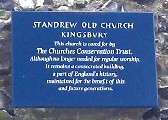 Almost within throwing distance of the new Wembley Stadium in Brent there lies another, vastly older but sadly forgotten building – the 11th Century St. Andrew’s Old Church, in the grounds of the present fine establishment. Father John Smith and his parishioners are working hard to renew the present grim Church Hall and to reclaim the old church and churchyard for the local community.

 For Father John Smith these small red bricks have a special significance; they suggest there was a church on the site of the photograph even back in Saxon times. The bricks are the original Roman evidence of the ancient (eleventh century) church which lies adjacent to the ‘new’ St Andrew’s Church, Kingsbury, within the grounds of his incumbency.
There is a great ambition in the parish congregation for the ‘old’ church and, especially the churchyard, with its many historic graves, to become a place of rest and respite in this busy part of London. Local people are giving their time and energy generously to clear the pathways and make more evident the generous clues to the area’s history which the overgrown graves can offer.
This plan, part of an intended programme to replace the past-its-best Church Hall with a lively and responsive building which will serve all who live in the area, is surely one which many will wish to support.
-

- Father John T. Smith











Fast Trains And The North-South Divide
 Is large-scale sustainable transport possible? Should we welcome Britain’s fastest-ever domestic train, which has arrived in Southampton this week? The UK’s North- South economic divide brings these questions into sharp focus. The further one is from London, the more important connectivity can become. So is carbon footprint a critical issue only after the economics have been taken care of?
Economics and environment don’t always mix. For some the pressing need is to reduce travel. For others, it is vital to improve physical connection. These complicated issues have come up the agenda again this week, with the news that the Go-Ahead Group has arranged imminent delivery of 29 high-speed Hitachi trains from Japan, which will operate from 2009 on the South Eastern network.
Low expectations?
Whilst commuters in the South are getting excited about travel times and accessibility to the Capital, those in more northerly parts of the UK are likely to be less enthused. For many the expectation of poor transport is a way of life, and there is a feeling – perhaps unjustly in respect of some local northern operators – that nothing is going to happen to change this. For others, the temptation is to believe that yet again the South is benefiting and the rest are not. Few Northerners are as yet willing to ditch their cars.
Will the new fast trains effect a change of heart? The optimists for train travel think that signs we are catching up with the Europeans will focus a national clamour for this form of transport. More dour observers suggest that because of potential damage to the environment we should not be encouraging travel anyway.
Sustainable transport, sustainable economies
I’m generally on the side of the optimists here. There’s little chance of sustainable living across Britain whilst inequalities (not just North-South, but certainly including that) are so great. I’d like to see more trains, and faster ones, right across the country. This is one area of environmental concern where we really can ask the technical people to work on the ‘clean and green’ agenda.
Science can’t solve all eco- problems, but in terms of transport and communications, we shouldn’t write technology off yet. The challenge now is for the politicians to come up with proposals which will match economic balance across the North and South with the possibilities opening up in transport.
Nothing in life stays still. Sustainability in communities of whatever size must start from the ‘can do’, the will to be positive and fair, because any other starting point is doomed in the long-run to failure.
Unique Selling Points In Regeneration, Or Just ‘Special’ Ones?
 Regeneration and development are often focused on what’s ‘unique’ and ‘special’ about a location. What does it have which others don’t have? This is a good question, but it needs a context. There are many ways to define ‘special’ – and even more to define ‘unique’. Not all of these special qualities translate well beyond local boundaries. Maybe it’s when locations work with outsiders to find commonalities and difference that they can make this ‘USP’ regenerational focus most effective? But how can this be done? And by whom?
Marketing and renewal have in recent times become closely connected in terms of what happens to areas which require ‘regeneration‘. Along with the basics of reasonable housing and facilities, there is often a clear focus on what sort of ‘unique selling point’ (USP) a location can offer, as plans are made to develop and energise a rather stagnant local economy / community.
As an initial strategy this is sensible. Asking people to reflect on the defining features of their locality is a good way to support emerging ideas about how to improve things. Direct stakeholders’ views are always crucial to the exercise.
Local perspectives
It is not always reasonable to expect those who live in a place to be aware of what is unique about their location, and what may not be. How can we be sure?
But encouraging the view that a place is better / more interesting than anywhere else can be a political or cynical ploy, not a genuine attempt to move forward. How much easier to leave people in their comfort zone, than to challenge local assumptions which perhaps make a difficult situation more immediately palatable for those who have to cope with it every day…
Wider responsibilities?
One aspect of regeneration in practice is a responsibility by those who take the lead, to ensure that the wider picture is at least available to direct stakeholders. No-one can insist that everyone has a wider view, but it seems reasonable to require at minimum that this is easily available. (Not all regeneration powers-that-be would agree about this requirement, of course; and many of them are not equipped for various reasons to do it.)
Finding common ground
Suggestions that things could be better if we emulated others elsewhere – or indeed the proposal that, instead of insisting we’re unique, we acknowledge commonality with others who also do things well / have a given local attribute – need not be negative.
Offered positively, information about other places and ways of doing things becomes a strength. Why not share a problem or a benefit? Increasingly, disparate geographical areas are coming together in this way. The North of England Mills and Canals conferences have been going for some years; BURA has recently identified both the Seaside and Universities as shared challenges and opportunities for the towns and cities concerned; rural areas have long-time histories of sharing good practice in agricultural produce shows and much else.
Taking it to the people
These good ideas now need to become more visible. For regeneration to be effective ordinary people, the immediate stakeholders in the process – not just the experts – must understand what’s happening and why. And part of that much-needed understanding is sharing commonality (specialness) as well as defining uniqueness.
Is there a role here for new ways to reach regenerating communities on the world-wide web? And, if so, who’s going to make it happen?


 Dreaming Realist