Category Archives: Regeneration, Renewal And Resilience
BURA’s Regeneration Equality And Diversity Network Has Lift-Off
 Today (20 February 2008) saw the formal launch of the British Urban Regeneration Association (BURA)’s Equality and Diversity Framework and Network. The event, at the Abbey Community Centre in Westminster, was attended by people from across the regeneration world, and produced much discussion about how BURA and its partners could move forward.
In my role as BURA Champion for Equality and Diversity I was lucky enough to join our President, Sir Jeremy Beecham, and other colleagues, in presenting and discussing initial ideas about this challenging issue.
Your views too are welcome. To begin the debate, this is what I said:
BURA Regeneration Equality and Diversity Framework Launch
Wednesday 20 February 2008, Westminster, London
This event was set up, as Sir Jeremy explained, because of serious concerns which the BURA Board has about inclusivity in regeneration.
The evidence is before our eyes; the top of the profession is overwhelmingly populated by white men.
Regeneration fits the white male stereotype for leadership in Britain only too well; and the stereotype extends even to the BURA Board itself, where Directors are elected from amongst our hundreds of members.
Something has to be done. No-one disputes that, as regeneration practitioners, we must address inclusion; but few of us have articulated how this intention fits in with regeneration. And fewer still I suspect, are sure how to do it.
The BURA Board has therefore decided to invite your help and support as we move forward on this challenging issue.
What is inclusivity and why does it matter?
A look at the work of the Equality and Human Rights Commission gives us a good feel for what an inclusive society might look like.
It would be a society in which people had safe and secure opportunities to enjoy a happy and healthy life.
In this society people of every sort would find themselves in positions of influence and leadership, and able to work towards a situation which in turn releases the potential of others.
This would be a society in which we, as regeneration practitioners, understood the impact of our work on all our fellow citizens, and then applied that knowledge across all our activities.
It would be a society in which, say, Asian women in Bury had as much opportunity to develop their interests and employment potential as white men in Cheltenham. It would be a society in which families in both these communities were equally likely to see their children born healthy and strong, with an equal expectation of a long and happy life.
In a nutshell, it would be a society which is stable and sustainable.
And if regeneration isn’t about achieving socio-economic stability and environmental sustainability, I don’t know what is.
Regeneration is more than the sum of its parts
I believe firmly that the task of today’s regeneration practitioners is to work themselves out of a job. We need to believe at a very deep level that ‘regeneration’ is not the same as ‘construction’, or ‘remediation’, or even as ‘planning’.
Critical though these callings are, real regeneration is much more than that.
After 30 years of regeneration in Britain, we should now be seeking very actively to reinvent ourselves as ‘sustainability practitioners’, as professionals who work to maintain an equitable, healthy and safe environment for everyone.
This reinvention of ourselves would require massive changes in the way we work, in our collaborations across disciplinary boundaries, and in our perceptions of how fellow citizens who are not exactly like ourselves experience their lives.
We can’t do that if we don’t understand how to achieve inclusivity, and why it matters.
But there is a very long way to go.
What is BURA doing about itself?
* Firstly, we have undertaken a thorough audit of our own organisation.
* We have looked at the gender and ethnicity of all members of staff and the Board, going back for three years, and for staff we have correlated this with salary bands. We shall report these findings to the Board when it next meets, and post a summary of this information thereafter on our website.
* We will also decide as a Board, in consultation with, we hope, our new Chief Executive, how much more data it might or might not be appropriate to record about the Board and staff.
* And we shall consult too on whether and, if so, how we need to look at the ‘inclusion’ characteristics of all BURA members.
* We would hope at the same time to start research on these characteristics as they apply to the regeneration sector as a whole, and to see how this compares with the data for the British population overall.
What is BURA doing to support progress in regeneration overall?
* Importantly, we are not seeking to compete with anyone; we are offering a supportive network which encompasses the whole spectrum of interests – inclusive, not competitive, with the sole aim of moving this positive agenda forward.
* Also, we recognise that no-one as yet has all the answers; we are simply trying, with everyone else, to identify both the challenges and the opportunities.
* We are launching today a Regeneration Equality and Diversity Framework, an ‘umbrella’ group welcoming people and organisations from every part of regeneration, ‘professional’ to ‘community’, to address a wide range of issues around equality and diversity.
This group will not seek to undertake work already done by others, but will help to link together the inclusion themes which regeneration good practice must address.
Some examples of what the BURA E&D Framework seeks to achieve
* We will support the exchange of information and views about what are the most immediate challenges for Equality and Diversity in regeneration in the UK.
* We will seek to collaborate with government at local and national level, and with research bodies already examining aspects of Equality and Diversity.
* We will develop the BURA website as a free open-access resource, available to all, hosting weblinks to legal and professional aspects of regeneration practice – including equality and legal audits – and enabling wider discussion between BURA members and partners.
* We will offer practical help and support to people from different communities who wish to become involved in regeneration – perhaps for instance by offering bursaries and work placements – in a collaboration between BURA and our members and corporate partners.
* But most of all, we will seek to work with all of you to make the BURA Regeneration Equality and Diversity Framework not just a talking shop, but a vibrant and positive reality.
In for the duration
* This is however slow-burn. We’re asking the questions but we don’t as yet have many of the answers; everyone here today can help.
* The BURA Board are unanimous that we must work hard to make our Equality and Diversity Framework a reality, not just an ambition.
We very much hope that you will want to be part of this reality.
Contact Hilary at BURA
Launching The BURA Regeneration Equality And Diversity Framework
 Next week sees the launch in Westminster, London of the British Urban Regeneration Association (BURA) Regeneration Equality and Diversity Framework.
The BURA Board has unanimously resolved to try honestly to do what regeneration is supposed to do – reduce inequality and discrimination through the creation of environments where people can lead sustainable, happy and fulfilling lives.
From the regeneration perspective, equality and diversity are difficult things to get one’s head around. There are so many variables.
I tend therefore to approach these issues from the ‘other end’, and to ask myself the Big Question: what might a community look like when we’ve finished ‘regenerating’ it?
Put that way, things begin to fall into place.
Two futures
Two outlooks are possible for a place or community which has received the full attention of the regeneration professionals.
Either it will thrive, moving forward to a happier future, where people feel fulfilled and their needs are met in a much more embedded way than before; or it will in time lose its expensive new patina and sink into a deeper, sadder, less secure state even than before.
These different outcomes depend largely on the extent to which that community has been enabled to achieve sustainability.
Three aspects to sustainability
Sustainability has three major aspectss: physical (‘environmental’), economic and social. None of these can be achieved longer term without the others.
Sustainability is impossible without equality and diversity; so regeneration too is underpinned by them.
A stark truth
The Commission for Racial Equality’s final blast at the regeneration business, when in late 2007 that organisation became a part of the new Equality and Human Rights Commission, was well placed. It demonstrated, starkly, that ‘race’ issues remain desperately under-addressed in regeneration.
And it certainly made the Board of the British Urban Regeneration Association (BURA) sit up. Already painfully aware of a lack of diversity at the top table, now we had undeniable evidence about one critically core aspect of disadvantage.
Many realities, many ways forward
The more we looked at disadvantage – whether resulting from age, religion and belief, disability, gender, race or sexual orientation – the more it seemed to stem from the same issues; issues most often around opportunities and resources which people feel they have been denied.
The multiple realities of ‘ordinary’ people’s lives are what define our communities and how they interface with the wider society. This then, surely, is what regeneration is all about?
Where to begin?
So here is BURA’s starting point.
As leading players in regeneration, BURA’s Board has resolved to try honestly to do what regeneration is supposed to do – which is to reduce inequality and discrimination through the creation of environments where people can lead happy and fulfilling lives.
To do this we will look carefully and immediately at how we can put our own house in order; we will listen to and liaise with as many other interested parties as we can; we will seek out, and where necessary and possible commission, research which informs our ambition; and we will take the message wherever it needs to go.
We introduced the BURA Regeneration Equality and Diversity Framework concept at our 2008 annual conference, in January. We shall launch it formally at our London event on 20 February; and we will monitor our progress thoroughly as we move forward.
We hope you too will want to be part of this journey.
Hilary Burrage is a member of the BURA Board, and BURA Equality and Diversity Champion. (hilary@bura.org.uk)
The BURA Equality and Diversity campaign is supported by New Start and Ecotec.
This article is a version of the piece published in New Start, 15 February 2008.
See also: New Start survey reveals doubts over cohesion and New Start Editorial of 13 February 2008.
Sefton Park Renovations Have Begun
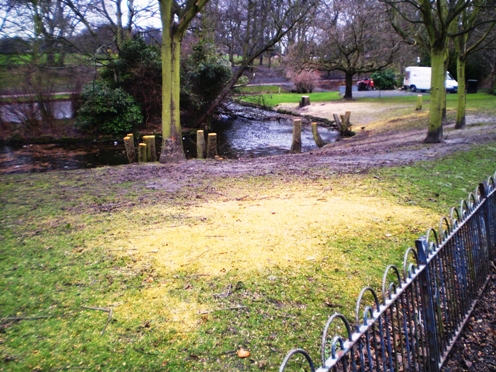
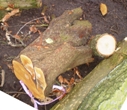 Mid-winter, and the rawest, sorest part of the oh-so necessary works on Liverpool’s Sefton Park has begun. Here lies the pink ribbon of protest an anonymous tree-lover tied on this felled tree. And here (below) lies scattered the still fresh sawdust of the vigorous cull of trees around the upper lake. Soon, we are assured, these voids will be host to new and vibrant growth. Soon, our park will be even more lovely than before.
More information on Sefton Park is available here.
Photographs of Sefton Park on this website include:
Liverpool’s Sefton Park Trees Under Threat – Unnecessarily? (Photo of the subsequently removed Willow tree in the Cherry Blossom / central lake)
and
Cherry Blossom For May Day In Sefton Park, Liverpool.
For more photographs please see here.
Woman Home Secretary Speaks Out On Street Fears At Night
 Home Secretary Jacqui Smith has told it as it is: many of us, men and especially women, are fearful of being out alone at night. Only really unimaginative or insensitive people – or perhaps some opportunist political opponents – would disagree with Ms Smith. This is not a new state of affairs. We have but to recall past feminist campaigns to ‘reclaim the night’ to know that.
So Jacqui Smith, the UK’s first woman Home Secretary, doesn’t enjoy being out alone at night.
This is surely not a new or startling revelation. The Home Secretary’s ‘admission’ – to me, a simple statement of a truth recognised by many – feels far more like reality than much of what we read in the papers.
Reclaim (‘retake’) the night
The idea that there is something to fear, out alone at night, is instilled in many girls (and some boys) from a very early age. In 1976 a movement began to recognise and act on this fear, by ‘reclaiming the night‘ from the men who were deemed to make it dangerous.
Women across Europe and the USA marched thirty years ago to demonstrate their belief that streets should be safe 24/7; but only more recently has this action begun again.
Telling it as it is
It feels very disingenuous that male politicians should denounce a woman in their midst who speaks candidly on a matter as fundamental as personal safety.
I hope these same men would not encourage their own female friends and family to walk the streets unaccompanied at night.
Making the streets safer
Sometimes people have to travel alone in the dark. To make their journeys safer, it is first necessary to speak the truth, to acknowledge realities, even when unpleasant.
Only after we know and understand problems can we ameliorate them.
Let’s start by thanking Jacqui Smith for being candid; and then let’s see how we can all, together, conscious femininists or not, reclaim those scary streets.
What’s Regeneration For?
 The British Urban Regeneration Association (BURA) annual conference is in Liverpool this year, on 30th and 31st January 2008. The conference, bringing together some 300 people, will see brisk debates between professionals and community leaders from across the U.K. One important focus may be the search for consensus on what regeneration is ‘about’.
BURA is an organisation moving forward with increasing momentum and confidence in both its own role and the direction and meaning of regeneration in Britain.
What is regeneration?
We, as members of the Board of BURA, are beginning to understand anew, or at least consciously to explore in a new way, what ‘regeneration’ means. The discussion will doubtless continue for a long time yet; but for me some clarity is emerging from many years in the business.
Regeneration is much more than ‘construction’, ‘development’ or even ‘capacity building’.
In the end, regeneration is about adding long-term shared value to all these activities.
A win-win
Regeneration’s a real win-win; it’s about creating a more equitable, more sustainable life-context for everyone.
The challenge is, how to do it.
The UK is often said to be at the forefront of regeneration. BURA’s annual conference discussions this week should prove interesting.
Translating Public Policy Into Action
 Evidence-based policy is central to much contemporary governmental thinking. But how the different phases of policy delivery can best engage ‘real people’ is not always clear. This is true whether the intended policy concerns health, the knowledge economy, or even global sustainability. There is still much to be done in understanding human agency and interaction in policy development and delivery.
In many aspects of public policy, from health through life-long learning and the economy to global sustainability, it is not simply the science or knowledge base which is important. Of equal, or sometimes greater, importance is an understanding of how to apply the established evidence which informs policy.
Phases in public policy development
There are, or should be, a number of phases in developing public policy.
The first phase is to derive as much consensus as possible about the necessary evidence base (both scientific and contextual) and the second is to consider how this ‘translates’ – an exercise which is currently being taken forward overtly by the government in relation to scientific knowledge, industry and business.
Securing public agreement or at least encouraging constructive and informed public debate is another phase which must run alongside these first two phases.
This ‘third’ phase is at risk when the established modes of policy development continue.
Public debate
The government has now gone some way to seek proper public debate on issues around science, technology, health and so forth. It is not as yet clear however that the corollary of this emphasis has been absorbed by the wider knowledge-related industries or even by some whose task is to deliver policy for real.
We all know that fundamental research and the intricacies of, say, applied medical knowledge are critical for the future. What is less well understood is that there remain huge gaps in our understandings of how such knowledge becomes operational in the real world.
People are what makes things happen. How they do so, in the contexts of such enormous challenges as global warming, the diseases of contemporary societies and the rapidly changing communities we all live in, has yet to be made clear.
Making things happen depends on people
Despite all our problems, many of us in the western world live in the best conditions human beings have ever known. Ensuring this continues and is shared even more widely is very largely a task for policy makers informed by a social rather than natural scientific knowledge base.
Fundamental science certainly needs to remain at the centre of knowledge creation; but, whether in health, industry or the environment, it must be matched by an equally well researched knowledge of the social world, if there is to be any real hope of public policies to sustain all our futures.
King’s Cross: Community And Colossal Opportunity Combined
 The renewal of King’s Cross – St Pancras and all that surrounds it is long overdue, but it looks to be a spectaclar project worth the wait. The final moves to achieve success in terms of the local community will however require those who should, to put their heads above the parapet so that everything comes together to make the best possible result. This project will ‘work’ for everyone as long as people really try to collaborate to get it right.
Having travelled on the bus past King’s Cross – St. Pancras on very many occasions, I can only say my heart lifted when, at last, evidence of its renaissance began to materialise.
Community links and challenges
It’s surely a unique and exciting challenge to put together a project as enormous and impactful as this. The project hits many buttons – strategic place, infrastructure, heritage, economic benefit; we could go on… King’s Cross is in anyone’s books a very spectacular and special piece of real estate.
Of course there’s still a possibility that King’s Cross will somehow miss on that vital community connection; but only if people on all sides of the equation let it. This is where civic and corporate leadership have such a critical part to play, right from day one.
Different from, say, Canary Wharf?
Given the common emphasis on transport hubs, there have been comparisons, but Canary Wharf is different. Just for a start, Canary Wharf is not at the heart of what’s to become the most important international ‘green’ hub connecting the UK and mainland Europe, and for another thing the Wharf is a glass and concrete creation with not too much reference to a long and glorious heritage.
King’s Cross is a genuine opportunity to build on a very high profile USP with enormous promise for all stakeholders.
Doubters and objectors
There are always people who oppose what’s happening. The financial and other costs of the debate with them may well be high, but in the end everyone has to be heard for progress to be made in a well-founded way. The line must be drawn somewhere, but the views of those with reservations are valuable because they help to pinpoint potential hazards further down that line.
But it’s up to everyone to make sure that in the end King’s Cross really works. This is a programme with serious commonality of interest between developers, the wider economic infrastructure and real people on whom the project impacts day by day.
Delivering success
Having seen examples elsewhere of exiting programmes based with various degrees of success in challenging locations, I’d say everyone, but everyone, involved has to ask, what more might I need to be doing to make King’s Cross fulfil its whole potential?
Of all the ‘Rules of Regeneration’, the first rule here must be: listen, seek to understand and where possible accommodate all stakeholders. And the second rule is, always remember someone has to be brave and take the lead, accountably and visibly.
Realistically forward-facing
This is not a time for pursuing plans regardless or for heads-in-the-sand-style denial of problems; but nor, most certainly, is it a time for standing back. King’s Cross is an <opportunity which comes only very rarely…. Here we have a genuinely future-facing adventure which everyone in town can share and actually see taking shape.
I watch from my bus as things come together week by week and I wish all involved the very best.
A version of this article was published on the New Start blog of 8 November 2007.
Orchestral Salaries In The UK
 Professional orchestra musicians’ employment and pay is a mystery to most people. Do players have ‘real’ jobs, too? is a common question. And is it all very glamorous? The latest survey of orchestral pay in the UK gives some answers – not much glamour, not too much pay, and little time for anything else. But for many players the commitment remains.
The Musicians’ Union has recently published their second annual report on Orchestral Pay in the U.K. Leaving aside the self-governing London orchestras, the BBC Symphony and other BBC orchestras, English National Opera (ENO) orchestra and the Royal Opera House (ROH) orchestra (all of which, with London weightings, do somewhat – though only comparatively – better), the M.U. report, as we shall see from the details below, makes pretty dismal reading.
Who are the musicians?
Almost every established player in the major regional orchestras is a permanent staff member (London is different). These ‘chairs’ are coveted positions amongst performers, who are usually graduates from the most prestigious music colleges and / or the top music conservatoires.
Musicians supply their own instruments and equipment for work, the initial costs of which can amount to more than an annual salary.
The ‘regional’ orchestras
Orchestras outside London surveyed by the M.U. in August 2007 were: the regional BBC orchestras, Bournemouth Symphony Orchestra (BSO), the City of Birmingham Orchestra (CBSO), Manchester’s Halle Orchestra, the Opera North Orchestra, the Royal Liverpool Philharmonic Orchestra (RLPO), the Royal Scottish National Orchestra (RSNO), Scottish Opera, the Ulster Orchestra and Welsh National Opera (WNO).
The fortunes of these orchestras fluctuate quite widely over the years, especially since the standardised regional orchestras contract for the BSO, CBSO, Halle, RLPO and RSNO was abandoned. All are dependent on civic support as well as national. [See The Association of British Orchestras for general information about these orchestras.]
Orchestral salary scales
Orchestras generally divide their players up into ‘Section Principals’ and ‘Principals’ (who sit at the front of their instrumental section) and ‘Tutti’ (formerly called ‘Rank & File’!). The M.U. estimates there are approximately 600 fully professional string players employed by British orchestras – which means about one in every 100,000 of the UK population has this occupation.
With a few exceptions, string players (violins, violas, cellos, basses) are the only Tutti musicians, and they make up the larger part of most orchestras.
Who gets paid what?
Concentrating on the regional orchestras, we see a variation of minimum salary in August 2007 as follows:
Section Principals: BBC Regional ~ hourly playing rate of £24.22 (£32,118 p.a.) through to CBSO ~ £33.09 (£45,205 p.a.).
Principals: RLPO ~ £21.44 (£28,298 p.a.) through to CBSO ~ £28.49 (£33,159 p.a.).
Tutti: RLPO ~ £18.20 (£24,024 p.a.) through to CBSO ~ £22.43 (£27,348 p.a.).
In some cases there are increments and / or long service awards which take experienced players above these levels, but these additional sums, usually only a very few thousand per annum, rarely raise salaries significantly above the starting point. Likewise, some, but not all, orchestras pay musicians an additional fee for recordings, media relays etc. [Some details of comparable orchestral salaries in the USA are available here.]
Comparison with other UK salaries
To set these figures in context:
* The average wage in 2007 for all full-time workers across the UK is £29,999 p.a.; or £27,630 specifically for Liverpool.
* The average salary of professionals in IT, an occupation which perhaps begins to approach comparable levels of skill to orchestral musicians (though there are many fewer performers) is £37,000 p.a.
* For graduates overall, an average additional £10,000 p.a. has accrued to their income after ten years’ service; this annual income will then continue to increase for another ten or twenty years.
Back of an envelope calculations using these comparative data perhaps suggest that over a lifetime orchestral musicians will receive approximately half the income of other professionals at comparative levels of skill.
Annual orchestral performing and other work arrangements
The regional orchestras vary in the number of annual playing ‘on stage’ hours they demand from their musicians. Of the orchestras above (not including the BBC orchestras, at 1,326 hours each, and ENO (874 hours) or ROH (860 hours)) the fewest performing hours are required of musicians in the opera orchestras (1,128 each) and the most by the RLPO (1,320).
How these hours are distributed is laid down in detailed contracts. For health reasons, such as risk of hearing loss and repetitive strain injury, players rarely play on the platform for over 6 hours per day. (They may well practise for more than that.) Scheduled ‘unsocial ‘hours – Sundays, Bank Holidays, and very early or late – and other erratic scheduling, with the attendant risks to wellbeing and mental health – are normally paid at the same rate as other hours.
Stress at work is seen as part of the job. There are also travelling hours etc which may add some 30-40% in time commitment – even though much time away from home is still ‘free’ in every sense of the word; neither paid nor, obviously, available for, say, teaching or other alternative opportunities for income.
Not a professional wage?
Most people who attend classical concerts see well-dressed and self-evidently skilled musicians and assume from this that orchestral incomes will be to some extent commensurate with appearances.
The truth is different. Many musicians, even at this level and with years of experience, barely scrape a living, often working almost every day for weeks to make ends meet. Relatively few within the profession achieve comfortable incomes and the view that orchestral playing is not a ‘real’ profession, with eventual progression and hope of greater reward, is widespread amongst foot soldiers at least – large numbers of whom, a previous M.U. survey has revealed, also incur occupationally induced ill-health or injury.
Artistic development
Sadly, players’ negative perceptions are reinforced by an absence of continuing professional development in their core skill, i.e. instrumental performance.
Players can often work for decades without receiving support as artists, or to maintain and develop their instrumental technique, let alone the money to pay very costly professional coaching fees. Artistic human resource investment is not high on (or simply missing altogether from) the priority list for most orchestra budgets.
Skills and experience lost
U.K. orchestras are becoming younger in age profile. The salary figures above offer an insight into why experience is frequently lost, as players leave mid-career for other ways to support their families or preferred lifestyle.
Youth and vigour are wonderful to behold; but knowledge, insight and long-term commitment would in a more ideal world also be valued.
Music not money
Fortunately, for many musicians and their audiences the imperative towards the extraordinary inner world of classical music continues to bring them together even against the rationale of external economics.
But it would be risky to permit the future for UK orchestras to depend on this inner imperative.
Read more articles in Music, Musicians & Orchestras
Life In A Professional Orchestra: A Sustainable Career?
The Healthy Orchestra Challenge
Musicians in Many Guises
Where’s The Classical Music In The Summer? An Idea…
British Orchestras On The Brink…..Again
Presidential Schema For The Post-Science Century
 ‘The next president of the United States of America will control a $150 billion annual research budget, 200,000 scientists, and 38 major research institutions and all their related labs. This president will shape human endeavors in space, bioethics debates, and the energy landscape of the 21st century.’ So says Chris Mooney in his seriously impressive review of the options – options in reality about human beings, not ‘just’ about knowledge – awaiting electors of the next President of the USA.
Chris Mooney, in his recent Seed Magazine blog piece entitled Dr President, examines the options for American science and suggests what needs to happen now.
America’s relationship with reality
During the past seven years of the Bush administration, Mooney tells us, America has been subject to ‘what can only be called antiscientific governance’. Scientists, he says, have been ‘ignored, threatened, suppressed, and censored across agencies, across areas of expertise, and across issues…
‘Under George W. Bush—the man who pronounced climate science “incomplete,” who misled the nation in his first major address about the availability of embryonic stem cells for research, who claimed that Iraq was collaborating with Al Qaida—America’s relationship with reality itself has reached a nadir.’
What’s next?
Chris Mooney is right. The status of science is in crisis, at least as far as States-side politics is concerned – and also in terms of what people in many parts of the world, even many sophisticated knowledge economy parts, understand about what science is and does.
‘To better grapple with emerging science controversies’, Mooney proposes that the in-coming president ‘reconstitute something akin to Eisenhower’s President’s Science Advisory Committee, but with a strong emphasis on forecasting the looming problems of tomorrow. …The conversations wouldn’t shy away from controversial or speculative topics. They would be designed, at least in part, to spark discussion in the media, on the Sunday-morning talk shows, and also at the kitchen table.’
Engagement beyond the science
This paper on antiscience, and its resolution through widespread debate and respect for scrutiny of the evidence base, offers many rich seams for us all to explore. But I think it also offers a new perspective on what I might call the ‘Post-Science Century’ which is before us.
The term ‘post-science’ means much more to me than simply the arid ‘total value’ anaylsis deriving from Milton Friedman et al. Instead, it focuses attention on the socio-political impacts and synergies of science and technology (one of a multitude of examples might be IT and the developing world) rather than on measures of money.
No longer can it be said that ‘knowing the science’ is enough – and Mooney is clear on this. We need to understand the future of climatalogical, environmental, genomic, military and many other applications of developing knowledge.
From tested knowledge to the human condition
In seeking to grasp what all these enormous issues, with their huge budgets, mean for each of us, we move from formal and tested knowledge to insights concerning the nature of human experience.
Perhaps it’s an irony of the twentyfirst century that the human condition itself will force us to think about science, rather than any new-found urge to look dispassionately at evidence bases and how to test them. This is what should drive the Science Advisory Council of the next President of the USA.
It’s not what we know, but why we all need to know it, that will spur this critical agenda.
Liverpool: Governance, Growth And Going (Somewhere)
 Abrupt curtailment of the 2007 Mathew Street Festival, silly ideas about removing fish so the docks become a concert arena, questions about preparations for the Big Year…. Liverpool 2008 is a drama unto itself. The leading arts venues have devised a good cultural programme for European Capital of Culture Year, but concerns about what else must be done remain.


 Dreaming Realist