Category Archives: Liverpool And Merseyside
No Top-Level Diversity Leaves Liverpool’s Leadership Lacking
 Civic leadership in action requires a range of perspectives and understandings. No single ‘type’ of person can hold all the wisdom to take communities forward in this complex age. A range of experience is required. The overwhelmingly white, male hegemony in Liverpool’s corridors of power is a civic embarrassment, demonstrating a fundamental lack of will to learn from the richly diverse insights of its citizens.
For everyone to flouish, civic direction must draw on the life experience of us all. Sadly however this is a lesson yet to be learnt in Liverpool.
In April Liverpool’s Liberal Democrat-led City Council set up the long-needed Countdown Group in an attempt to sort the physical regeneration of Liverpool before our big European Capital of Culture year in 2008.
Currently, in September, Council leaders are doing the same with the Board of the Culture Company, with even less time for manoeuvre to achieve success.
Singular perspective
Both the Countdown programme and Culture Board are now led exclusively by white men. But with such a singular perspective, how can these City Council appointees even hope to do a decent job for everyone?
It needs saying yet again: Liverpool’s political leaders have no idea how to engage all the richly diverse talents of this city’s citizens.
Exclusion zone
Such wilful exclusion of women, and of people from the Black and Minority Ethnic (BME) communities, demonstrates a huge failure by our political leaders to reflect on inclusion before they act – a consistent omission which may well impact on the success of 2008 and beyond.
Wherever the debates about inclusion in all senses may take us, the evidence to hand suggests Liverpool probably has the most sexist Council leadership in England.
Diversity Index
I award Liverpool City Council 0 / 5 for leadership on this website’s Diversity Index.
An editied version of this commentary was published as a letter in the Daily Post on 17 September 2007 and the Liverpool Echo of 21 September. Responses and commentary from other correspondents, endorsing the view, were also published on 18 September and 21 September.
Sky-High Homes For The UK’s Regional Cities?
 How many people reading this article actually live in a city centre? How many readers in live a high-rise apartment? And how many of these readers are aged 30-50?
My guess is that fewer readers live in high-rise than have views on them; the evidence certainly shows that most people past a certain age choose to live in suburbia or out-of-town. So is the commercial emphasis on city centre ‘executive’ apartments sustainable?
One young woman I know, a lawyer, lives with her husband in an a sixth floor apartment in Manhattan, New York.
Another, a business consultant, until recently lived in a fourth floor apartment near the commercial centre of London, but has just moved to a town house there.
My husband and I live in suburban Liverpool, and have done for many years.
Economics and demography
Economics and demography are everything in housing. People choose where, ideally, they would like to live, by reference to their family requirements.
Many people, as we all know, are happy to live in high-rise city centre accommodation before they have children, but in the UK, and especially outside London, most would prefer to make their family home in suburbia – as indeed I did.
Other countries, other ways
In other countries the suburban option may be both less available and less often preferred.
Some young couples in the UK, like the ones I know in London, can resolve their requirements by choosing a town house near the city. Others elsewhere, like the couple in New York, don’t feel the necessity to abandon high-rise living as quickly.
Why the difference?
There is less of a tradition in the UK of high-rise living except perhaps, and tellingly, in tenements and council housing.
Other cities such as New York have pressures on land which mean that over time they have adjusted to high-rise.
Sim city for real
Have you ever played Sim-City? In New York space issues have resulted in the creation almost of Sim-City tower living.
Everything is there – the shops, the amenities – including clinics, nurseries and gyms, the work places, and then, above them, with different access, living accommodation, roof gardens etc.
And in the same block as the building will be the link to efficient public transport….
Sustainable living?
These sorts of arrangements make it possible for everyone to live In Town, and many people except those with growing children to prefer to.
It’s time and, importantly, energy efficient to live in, e.g., Manhattan, and the experience is generally holistic. The experience addresses what’s needed in a reasonably sustainable way.
London
Looked at like this, we can see that London is a half-way house between Manhatton and Liverpool.
The UK overall is a very densely populated island, but still only about 5-10% of it is city-space.
Nonetheless, land is very scarce in London, and London has some of the attributes required to make it a preferred city living option. And that city is working hard to improve its offer.
Liverpool
Liverpool, however, is still losing population, albeit at a reducing rate. And we have enough houses but not always ones people like.
Unless the ‘core offer’ on Liverpool city-centre living improves rapidly, I can see little prospect of sustainability in tower-block living here.
Live-ability
We haven’t, yet, factored in the amenities to make Liverpool city-centre ‘people friendly’, as is only too obvious on any Friday night.
For me therefore high-rise in Liverpool, in the brave new world of ‘executive’ apartments, is not where I would currently put my money as a developer.
Quality of experience
Fashion quickly becomes fad and then old hat when the quality of the experience is lacking.
I’d advise investors to think about how NY or London do things – maybe even live there for a while – before they go any further with high-rise in Liverpool.
High rise and high income?
Even a decade or two ago in the UK high-rise still often (except in, say, parts of Edinburgh and London) went with low-income.
Now, conversely, high-rise and high-income seem to go together; which is fine in London; but not elsewhere.
Real executives for ‘executive’ apartments?
Liverpool should put a hold on more high-rise executive apartments until it has a more high-income, young, executives in genuinely sustainable jobs to live in them.
I’d say, let put some functional flesh, some real amenity, on the skeleton of Liverpool’s developing infrastructure
before we go for fashion in housing.
Moving forward sustainably
* Let’s first make Liverpool city centre safe and people-friendly.
* Let’s use professionals to develop the city who have experience of family life and of city centre living, to help us see what more needs to be done.
* Let’s explore what we can do to integrate services, amenities and enterprise with ‘livable’ space.
* Let’s make Liverpool’s city centre sustainable and let’s reverse our population decline before we go big-time in Liverpool for high-rise…. especially if it has more style than substance.
This is an edited version of a talk given by Hilary Burrage as part of a debate in Liverpool during Urban Design Week, hosted by Taylor Young, on 18 September 2007. The event was entitled ‘High rise living getting you down!?’ Almost all speakers in the debate agreed with the position taken here.
Sefton Park’s Grebes And Swans
 Yesterday we saw the grebes on Sefton Park lake in Liverpool. There were the two adults who caused such excitement when they arrived some three years ago, plus two quite large chicks, all bobbing up and down happily in the centre of the lake. Then, a little further on we saw swans, a pair with four cygnets this year.
Like the grebe chicks, the cygnets are now almost full-size, but just a bit more fluffy and woolly coloured than their parents.
The grebes
This is the first time we’ve actually ever seen the grebes’ family; perhaps the young ones lurk near the island at the top end of the lake until they’re large enough to survive in more open water – though even today we saw the parents feeding their young straight from a catch of minnows.
Cygnets and swans
The swans, however, are less shy and their young have been ‘on show’ for several months. Perhaps their size is adequate protection without further caution. This year four out of an original five cygnets have survived, which seems to be about par for their annual breeding activity.
So how many cygnets must this pair of swans have produced over the years? And where do they all go?
Read more articles on Liverpool’s Great Parks & Open Spaces: Sefton Park
Liverpool’s Sefton Park, Swans, Herons And Grebes
Sefton Park, Liverpool: Winter Solstice 2006
Cherry Blossom For May Day In Sefton Park, Liverpool
Friends Of Sefton Park
Croxteth And Norris Green, Liverpool
 Croxteth and Norris Green in Liverpool have recently become tragic headline news. But the no-hope issues behind the grim developments in these areas of North Liverpool have been simmering for many years. The Crocky Crew and Nogzy ‘Soldiers’ are not new. The challenge is how to support local people to achieve their higher expectations and horizons.
My first ‘real’ job post-college was as a junior social worker in Norris Green and Croxteth, Liverpool.
The task allotted me all that time ago was to visit every one of the 200+ people in the area, many of them living on the Boot Estate, who were on the Social Services list and had not been seen (‘assessed’) in the past year or two. And so, equipped only with the list, a degree certificate and a bus pass, I set about my first professional posting.
Forgotten land
Nothing, not my inner-city school, not my academic training, not my voluntary work, could have prepared me for what I was to see.
Here were elderly men who seemed to survive solely on Guinness, bread and marg; here were children with disability so severe that they had to live day-in, day-out in their parents’ lounge; here were old ladies who promised fervently to pray for me, simply because I was the first person they had spoken with for weeks.
Here, in fact, was a land, originally designed as the vision for the future, which, by those far-off days of the early 1970s, few knew, and almost everyone had forgotten.
For some, a zero-expectations environment
This was a Liverpool where there were people who, expecting nothing, eked an existence. It was the home of the dispossessed, the displaced and the despairing. Every day was like every other day in that concrete wilderness of dust, derelict front ‘gardens’, broken windows and enormous, fierce Alsation dogs.
No-one, or so it seemed, went to work. No-one ever seemed to leave the Norris Green ‘estate’, designed as a circular enclosure with concentric streets of council housing and no indication of via which road one might depart – urban planning surely to guarantee future disaster. There were few amenities (I had to take the bus to get even a sandwich or coffee at lunchtime) and even fewer shops.
Cut off from Croxteth
Until the 1980s Croxteth itself didn’t feature much in the Liverpool mind map as an area to live. Norris Green, the near-neighbour, was cut off from almost everywhere by dual carriageways on every side, and beyond them, on to the South-East was the huge, green Croxteth Estate – to this day the location of a fine country house and gardens open to visitors and in the ownership of the City of Liverpool.
Also near Norris Green was the North-East Liverpool Technical College (which co-incidentally turned out to be my next employer), a provider of day-release training for local Fords apprentices and other ‘tradesmen’ (the only women were student radiographers) and set on a large piece of land. Later, when then-Prime Minister Margaret Thatcher effectively abolished apprenticeships, the NELTC site was sold and became, with the farming land next to the Croxteth Estate, the location of a private development of pleasant housing for people who worked in the surrounding areas.
Broken hopes and promises
And later still the Norris Green council housing residents were promised their own improvements, as part of the Boot Estate programme – a programme which raised, and then dashed, the hopes of those from this place of quiet desperation who had dared to look to beyond their immediate horizons.
Little surprise – though unspeakably sad – that from this strange amalgam of development and despair have arisen the Nogzy ‘soldiers’ and the Crocky Crew of Liverpool’s current tragic troubles. Set alongside an area of new (relative) affluence, Norris Green is an enclosed place still, it must feel, without either hope or many stories of success.
Nothing excuses the illegal drugs economy and vicious violence – the fatal shooting by a local youth of Rhys Jones, who lived in Croxteth and was aged just eleven – of which we have all recently read; but one does begin to see through this disturbing grey blur how it might have come about.
Facing the future
There are many serious and good people who live and work in Norris Green and Croxteth. Life for them at present must feel extremely difficult, and the way forward by any account challenging. Support for what they do is obviously a critical first requirement.
But beyond that, I look back to a conversation between my supervising senior social worker and myself, when I left the employ of the Social Services.
I was leaving, I told my boss back then, because I believed that resolution of the issues required deep economic and political engagement, as well as the personal approach.
Strategies for hope
Many years later I still hold that conviction. Since that time Government and European funding of multiple millions has come to Liverpool; and now – in theory at least – we know so much more about positive strategic and sustainable intervention that we could ever have known then.
The traditional challenges of all-embracing absolute material poverty are in truth behind us. No longer can poverty alone be used to ‘explain’ the grim situation that we see.
New challenges
What we now face in Norris Green, Croxteth and some other city areas in Liverpool and elsewhere is the gang-led imposition by the few on the many of a sometimes suffocating, stultifying local culture; a culture, it is said, created intentionally by illegal drugs dealers who enforce it via the callous manipulation of alienated local children.
Nothing can change what has already happened. But I hope one outcome of recent awful events will be a compelling sense of urgency about getting things sorted, before more people’s lives are ruined and even more people believe that for them there is no hope.
Liverpool Vision’s Jim Gill Reflects On Hope Street Quarter
 The public realm refurbishment of Hope Street, the thoroughfare which defines Liverpool’s cultural quarter, was finally completed in May 2007. This has offered an opportunity to reflect on, and learn some lessons from, the decade of activity culminating in Hope Street’s new look. Jim Gill, Chief Executive of Liverpool Vision, agreed to share his perceptions of that decade and what it has achieved for Hope Street and the City of Liverpool.
Liverpool’s Sefton Park Trees Under Threat – Unnecessarily?
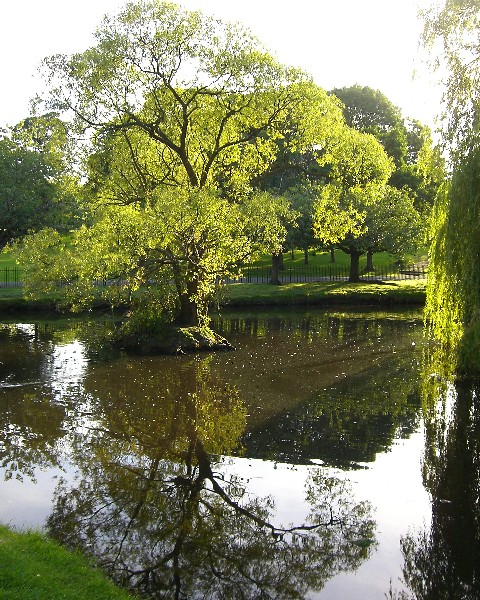
 The heritage people are (at last) about to make improvements to Sefton Park. Much of the intended work is welcomed by everyone. So why must they remove certain trees – such as a lovely willow – which those who use the park as a local place for peace and quiet have come to regard as part of that tranquility? I hope they change their minds soon.
See also: What Now For Liverpool’s Sefton Park?
Cherry Picking Liverpool’s Sefton Park Agenda
Sefton Park’s Grebes And Swans
Liverpool’s Sefton Park, Swans, Herons And Grebes
Sefton Park, Liverpool: Winter Solstice 2006
Cherry Blossom For May Day In Sefton Park, Liverpool
Solar Lighting Could Solve The Parks Problem
Friends Of Sefton Park
A Summerful Of Children’s Music Workshops In Liverpool
 Summer 2007 has been a special opportunity for HOPES and Live-A-Music to provide Children’s Music Workshops, thanks to generous funding from Awards for All. The workshops, held alternately in the city centre and a close-by suburb, have focused on themes developed by the children themselves – in one case, a ‘symphony’ featuring global warming, drifting snow, salsa / jazz and a roller-coaster! Following sessions in July and mid-August, the next workshops in the series are on Saturday 8 September in Mossley Hill Parish Church Hall.
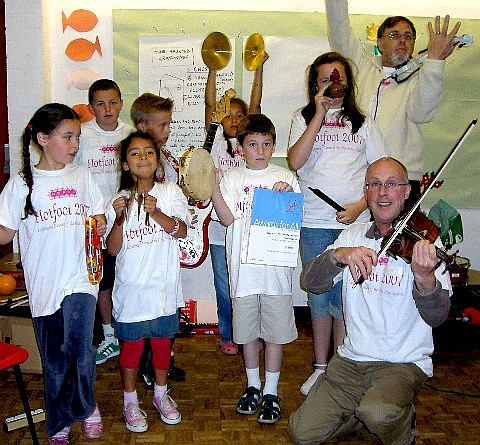
These workshops have proved a great hit with budding musicians of all sorts – players of everything from the trumpet to the triangle It’s not very often that parents and children of considerable musical experience and none can come together from all around Liverpool to sing, dance and make their very own music.
Details of the 8th September sessions follow below. Here are some photographs of the workshops at Mossley Hill Church Hall , Liverpool 18, on 30/31 July, and at St. Bride’s Church, Liverpool 8, on 13/14 August.

HOPES and the Live-A-Music workshop leaders are very grateful to Awards for All, who have substantially funded these Children’s / Family Music sessions.
The next workshops: when, where and how
The next two children’s music workshops are scheduled for Saturday 8 September at 10.30 – 12.15 and 1 – 2.45 pm. The venue is Mossley Hill Parish Church Hall, Rose Lane, L18 8DB. These sessions are part of the current series of Live-A-Music workshops organised by Richard Gordon-Smith with Martin Anthony (Tony) Burrage, and supported by HOPES: the Hope Street Association with generous funding from Awards for All.
Cost and conditions
The cost per child per session is just £3. Parents and other carers are welcome to accompany children and join in at no extra cost if they so wish. We ask that any children under seven are always accompanied by a parent and / or older sibling because this helps them to feel confident and happy.
Children attending both the morning and the afternoon sessions may bring a packed lunch, subject to their parents’ written consent. (Specific details of conditions are here; but NB session timings have been revised at the request of parents.)
Booking and further information
Booking beforehand is appreciated because it helps with planning for the workshops, but children may simply turn up on Saturday 8th if they wish. Please email us to book places, or for further details. You are also welcome to use this email address to tell us you would like to go on the emailing list for notice of future workshop sessions.
And have fun
These children’s workshops are an opportunity to explore and develop imaginations and musical skills, whatever the previous experience of music. They’re for children (with their parent/s if that’s wished) to enjoy and create new musical ideas, to tell stories in sound, and to have fun.
HOTFOOT 2007: Sunday 22 July, 7 pm, Liverpool Philharmonic Hall
 HOPES: The Hope Street Association marks the thirtieth anniversary of the inaugural Hope Street Festival with a HOTFOOT 2007 concert offering many elements of previous such events. Tayo Aluko, Tony Burrage, Richard Gordon-Smith, Sarah Helsby-Hughes, Hughie Jones, Roger Phillips and Surinder Sandhu join children from Merseyside schools and the stalwart HOPES Festival Orchestra and Choir for an event not be missed.
Liverpool One: The Grosvenor Development Growing
 The deadlines for Liverpool city centre renewal now loom. Whilst the Big Dig continues to present us all with challenges, Liverpool One, the enormous Grosvenor development, is becoming a discernable entity.

Lewis’s, Lime Street And Liverpool Losing Out
 Liverpool city centre is in a state of flux, as the Big Dig re-routes and bewilders in equal measure. The aim is that the city centre will become a pleasant, business-friendly place to be. The disgraceful state of Renshaw Street, linking Lime Street Station to the city south end, sadly belies that intent. It’s scruffy and delapidated; does it have to be like this?


The steel-grey vistas above are what first greet visitors to Liverpool’s city centre. The once-mighty Lewis’s department store and the street from there to the main train station look much as some of us recall them thirty years ago, except perhaps they are less well scrubbed. And to add to this we now have the challenge of the City Centre Movement Strategy (CCMS) ‘in action’ every time we come into town.
The Big Dig as a way of life
To those familiar with Liverpool’s city centre the Big Dig has become a way of life. Intended to make the heart of Liverpool ‘fit for purpose’ for the celebratory years of 2007 and 2008, this now seemingly perennial feature of the city centre experience feels to have become a liability for Liverpool’s citizens, rather then an opportunity to enhance our future.
Many are asking whether a city which has suffered so much digging of holes and diversion of traffic in all directions can actually survive as an economic entity until the works are finally completed. The word is that some local businesses are going to the wall, especially in the train station area around Liverpool Lime Street, RenshawStreet and the Adelphi Hotel (not, it seems, itself under duress).
Enterprise endangered
Certainly, there have already been casualties. Heart & Soul, Chumki Banerjee’s signature bistro restaurant just around the corner on Mount Pleasant, has closed and Lewis’s Ltd (quite a different retail company from John Lewis) is rumoured after many years – it was founded in 1856 – to be folding imminently (mid-May 2007). There are also suggestions that
some other long-established local stores are at risk.
A relaxed approach to regeneration?
No-one denies that improvements to the city centre are required; but many question the apparently relaxed approach the City Council and others have taken to achieving this.
Work on the Big Dig seems at best to be nine-to-five, and nobody, as far as one can tell, has a responsibility actually to clean up the grimly grey and crumbling retail and commercial buildings along Renshaw Street from Lime Street.
Take a fresh look – and freshen up!
Is it surprising that businesses in this well-established part of town are feeling the pinch? Who would choose to walk from Lime Street up to Lewis’s along a street resembling the set of a 1960s kitchen sink melodrama, when they can instead take the
crossing outside the station into the pedestrian zone?
Perhaps some city leaders need to walk this walk, as well as talking the theoretical talk about the local infrastructural wonders we can soon expect.
Support the positive
There will always be brave souls who find a way forward. Fleur Hair and Beauty, previously located in the now-collapsing Lewis’s department store, has taken a walk across the road to the Adelphi Hotel Health Club, where the business can re-consolidate. No doubt there are others too who have faced the future and re-grouped.
Things are never static, especially in the world of enterprise, and to some extent this is good. That, however, does not excuse the failure of city local leaders to address problems which are beyond
the control of all but the very largest businesses.
Challenging market conditions
This is a city with more than the usual proportion of small and medium sized enterprises (compared to large ones – but still low in proportion to the public sector). These SMEs, often owned and run by individuals who actually live in Liverpool, have little slack in their business plans to accommodate civic laxity.
Not all businesses are equally effectively run, but Liverpool can’t afford the luxury of just letting private sector interests go to the wall without any support.
Nurture the positives
As I have said before, Regeneration Rule No. 1 has to be:
First nurture the positive assets you already have.
It’s not just the interests of visitors to our 2007 and 2008 celebrations that we must protect. The concerns of local workers and entrepreneurs are also core.
They, after all, are the people who hope still to be here in 2009.
 Fleur Health & Beauty
Spindles Health Club
The Britannia Adelphi Hotel
Ranelagh Place (Renshaw Street)
Liverpool L3 5UL
0151-709 7200 x 044
And a happy PS: Fleur has now re-opened her salon in the ‘rescued’ Lewis’s, to run alongside the Adelphi salon – Lewis’s, Ranelagh Street, 0151-709 7000.


 Dreaming Realist
