Category Archives: Education, Health And Welfare
Lighter Evenings, Energy And Health
 ‘Incremental’ is the mode of choice when we talk about the massive changes required for the sustainability of ourselves and our planet. People find it hard to make large or sudden changes, so we try to do them bit by bit. Seen like this, the benefits of daylight ‘saving’, keeping lighter evenings, become increasingly compelling.
The big health news of the past week or two has been obesity… how it’s becoming an epidemic and how difficult it will be to reverse the demands which people being overweight put on the health services and on the exchequer.
Then we are told that we must conserve energy in every way possible. Carbon expenditure must, urgently, be reduced, climate change is happening even more quickly than we had thought.
Looking for solutions
In these contexts it is surprising that the sensible advice about behaviour adaption – go gently, to take people with you – has not yet been applied to the benefits of ‘daylight saving’.
We know that lighter evenings offer more encouragement for people to take exercise; we know that the extra light also reduces fuel demands. (Jim Fiore estimated recently that in the US context ‘only’ 0.25% savings would be achieved – but that’s a massive amount of oil which could be conserved with no effort by anyone.)
Joined up thinking
The clocks go back on Sunday, tomorrow, 28 October, at 2 a.m. From then on until next March (British Summer Times begins on 30 March, with the new US Daylight Saving Time starting on 9 March) we shall have afternoon murk.
Scottish farmers may be happy with these murky afternoons, and they are of course welcome to any arrangement the Scottish Parliament wants to make. For the rest of us, a bit of (evening) light needs to be shed on the subject of incremental health and energy improvements.
The full debate about BST is in the section of this website entitled
BST: British Summer Time & ‘Daylight Saving’ (The Clocks Go Back & Forward)…..
See also:
Making The Most Of Daylight Saving: Research On British Summer Time
Save Our Daylight: Victor Keegan’s Pledge Petition
The Clocks Go Forward…And Back… And Forward…
British Summer Time Draws To A Close
Time Is Energy (And ‘Clocks Forward’ Daylight Uses Less)
The Clocks Go Forward … But Why, Back Again?
Join the discussion of this article which follows the book E-store…
The New Harvest Festival
 This is the time of year when churches urban and rural across the nation urge us to attend their services for Harvest Festival. For many of us however this annual celebration is now marked more secularly, observed at one remove, via our newspapers, rather than physically in our communities. Media celebration of seasonal food is the order of the day.
The Guardian, like other similar publications, is hot on seasonal food. A story in that newspaper today gives a flavour of that theme: ‘Green’ shopping possible on a budget, watchdog says.
What then follows is that irresistible combination of knocking the supermarkets (fair enough if they’re not up to scratch), going rustic with references to in-season fruit and veg. (why not, it really is good for you), and angst about affordability and carbon footprint (fair enough again).
Contemporary perspectives
So here is the contemporary version of We plough the fields and scatter…
Way back over the centuries people have known about crop rotation and storage and the seasons, and have celebrated all this with Harvest Festivals of one sort or another. Now we know about food miles, sustainability and ethical buying.
Appreciating our sustenance
This is the better informed (or at least more techno) version of the wisdom of the ages, translated for those of us who hope for the future but have no bedrock of faith on which to base an annual thanksgiving.
Perhaps it doesn’t matter how we demarcate the changing seasons and the beneficence they offer. What does matter is that at least we notice.
Translational Science In Transition: The New Science Policy
 Who owns Big Science in the UK? Does government science policy sit within wider public policy, or is it stand alone? The Cooksey Review has stirred strong feelings amongst medical scientists, and also further afield. Few science policy questions can be determined without understanding the wider public policy context.
Who pays for what in the constant race to stay at the global cutting edge in science and technology is a hot debate. Often neglected is an acknowledgement of the multiplicity of stakeholders, but this is an area which the scientists themselves sometimes ignore.
Getting to the bottom of who can / should pay for science and innovation in the UK is a difficult task. When all relevant interests – science and technology, policy makers, the economy / electorate – are perceived there is more clarity, but only rarely does this happen. The issue is however making headway as a result of changes resulting from the 2007 Budget, which promises an increase in investment in public science of 2.5 per cent from 2008-09 to 2010-11..
Both the Cooksey Review on funding for health research, and the (connected) introduction of the new Department for Innovation, Universities and Skills focus on ensuring that progress in scientific research and wider value for money go hand in hand.
Value for whom?
The really big question here is, who benefits from investment in what sort of science? This is surely the nub of the issue, but it needs a wide perspective to answer the question properly.
The emphasis seems so far to be on the ‘translation’ of blue sky research findings into marketable commodities – an entirely sensible idea in general., but not a complete one. The core issue of how much benefit accrues to whom when commodities become marketable is not easily resolved.
Whether the product eventually taken to market is a medical drug, a form of renewable energy or a development in nanotechnology, there are likely to be direct and indirect benefits and costs.
Medical priorities in research
One person’s or sector’s gain may be another’s loss – an obvious but frequently forgotten matter from the perspective of practising scientists.
This may be particularly true in the case of medical scientists, who are currently it seems most agitated, and who often have a specific, and possibly tragic, individual human condition in mind as they undertake their work. Nonetheless, this human priority cannot stand alone.
Medical scientists have not always covered themselves in glory when it comes to collaborating within the Big Science framework – the Daresbury crisis of a few years ago comes to mind – and for some of medical researchers the universe probably finishes at the point where abstract research translates (to use the new term) into pharmaceuticals. This is why, when public money is involved, others must take a wider view.
Science policy and public policy
Policy in government-sponsored science is not, contrary to much of the discussion, a singular issue. For a start, there is policy about science; and then there is policy relating science and the general public interest. These two are inter-connected, but not always the same.
Science policy variously (as examples, and in no order of priority) might be about:
* ‘translating’ or bringing blue sky research to the market;
* meeting a specific human or technical need;
* continuing promising lines of investigation which may or may not eventually go anywhere;
* establishing or maintaining national reputation, or that of an institution and / or individual/s.
Public policy relating to science might, e.g., concern:
* developing local science-based businesses;
* linking scientific and technical / medical research outcomes to the wider economy;
* developing programmes or projects in geographical or otherwise specifically identified areas, to progress regeneration or other ambitions for general benefit;
* seeking answers to particular policy conundrums or challenges, by way of developing the evidence-base available to decision-makers.
Contextual perspectives on science
To make sense of these difficult and often conflicting priorities between science and public policy requires seeing the wider contexts in which science and technology operate.
Social, economic and political backdrops are not secondary matters when government is paying directly for science to be done. They are central and critical, right from the beginning.
‘Translating’ science is ultimately about taking blue sky research to market, but it is also in another sense about making sure that stakeholders – the general public – know and are comfortable with what, through their taxes, they are paying for.
Consensus on taking science forward
From this point of view scientists need to accept that, if government pays directly, it wants to know how the research will take public policy forward.
Politicians are not usually keen to write open cheques for unknown outcomes, nor should they be.
Scientists paid by government are usually there to do their part within a policy framework geared to fairly tight timescales, to make the evidence-base available or to develop a required product. As such they rarely have the luxury of following their noses in research, just because it looks interesting.
Government funding
Sometimes there is a case for blue sky research directly funded by government, but probably, given budgetary constraints and the constant need to be immediately answerable to the electorate, not often.
The right way to support (most) blue-sky research is through the universities’ wider funding and large science-led corporations.
Such investment will, if directed wisely, bring reward in the longer term, when investors can as a result make the evidence-based case for government to invest in developing the applications of their new-found knowledge.
Croxteth And Norris Green, Liverpool
 Croxteth and Norris Green in Liverpool have recently become tragic headline news. But the no-hope issues behind the grim developments in these areas of North Liverpool have been simmering for many years. The Crocky Crew and Nogzy ‘Soldiers’ are not new. The challenge is how to support local people to achieve their higher expectations and horizons.
My first ‘real’ job post-college was as a junior social worker in Norris Green and Croxteth, Liverpool.
The task allotted me all that time ago was to visit every one of the 200+ people in the area, many of them living on the Boot Estate, who were on the Social Services list and had not been seen (‘assessed’) in the past year or two. And so, equipped only with the list, a degree certificate and a bus pass, I set about my first professional posting.
Forgotten land
Nothing, not my inner-city school, not my academic training, not my voluntary work, could have prepared me for what I was to see.
Here were elderly men who seemed to survive solely on Guinness, bread and marg; here were children with disability so severe that they had to live day-in, day-out in their parents’ lounge; here were old ladies who promised fervently to pray for me, simply because I was the first person they had spoken with for weeks.
Here, in fact, was a land, originally designed as the vision for the future, which, by those far-off days of the early 1970s, few knew, and almost everyone had forgotten.
For some, a zero-expectations environment
This was a Liverpool where there were people who, expecting nothing, eked an existence. It was the home of the dispossessed, the displaced and the despairing. Every day was like every other day in that concrete wilderness of dust, derelict front ‘gardens’, broken windows and enormous, fierce Alsation dogs.
No-one, or so it seemed, went to work. No-one ever seemed to leave the Norris Green ‘estate’, designed as a circular enclosure with concentric streets of council housing and no indication of via which road one might depart – urban planning surely to guarantee future disaster. There were few amenities (I had to take the bus to get even a sandwich or coffee at lunchtime) and even fewer shops.
Cut off from Croxteth
Until the 1980s Croxteth itself didn’t feature much in the Liverpool mind map as an area to live. Norris Green, the near-neighbour, was cut off from almost everywhere by dual carriageways on every side, and beyond them, on to the South-East was the huge, green Croxteth Estate – to this day the location of a fine country house and gardens open to visitors and in the ownership of the City of Liverpool.
Also near Norris Green was the North-East Liverpool Technical College (which co-incidentally turned out to be my next employer), a provider of day-release training for local Fords apprentices and other ‘tradesmen’ (the only women were student radiographers) and set on a large piece of land. Later, when then-Prime Minister Margaret Thatcher effectively abolished apprenticeships, the NELTC site was sold and became, with the farming land next to the Croxteth Estate, the location of a private development of pleasant housing for people who worked in the surrounding areas.
Broken hopes and promises
And later still the Norris Green council housing residents were promised their own improvements, as part of the Boot Estate programme – a programme which raised, and then dashed, the hopes of those from this place of quiet desperation who had dared to look to beyond their immediate horizons.
Little surprise – though unspeakably sad – that from this strange amalgam of development and despair have arisen the Nogzy ‘soldiers’ and the Crocky Crew of Liverpool’s current tragic troubles. Set alongside an area of new (relative) affluence, Norris Green is an enclosed place still, it must feel, without either hope or many stories of success.
Nothing excuses the illegal drugs economy and vicious violence – the fatal shooting by a local youth of Rhys Jones, who lived in Croxteth and was aged just eleven – of which we have all recently read; but one does begin to see through this disturbing grey blur how it might have come about.
Facing the future
There are many serious and good people who live and work in Norris Green and Croxteth. Life for them at present must feel extremely difficult, and the way forward by any account challenging. Support for what they do is obviously a critical first requirement.
But beyond that, I look back to a conversation between my supervising senior social worker and myself, when I left the employ of the Social Services.
I was leaving, I told my boss back then, because I believed that resolution of the issues required deep economic and political engagement, as well as the personal approach.
Strategies for hope
Many years later I still hold that conviction. Since that time Government and European funding of multiple millions has come to Liverpool; and now – in theory at least – we know so much more about positive strategic and sustainable intervention that we could ever have known then.
The traditional challenges of all-embracing absolute material poverty are in truth behind us. No longer can poverty alone be used to ‘explain’ the grim situation that we see.
New challenges
What we now face in Norris Green, Croxteth and some other city areas in Liverpool and elsewhere is the gang-led imposition by the few on the many of a sometimes suffocating, stultifying local culture; a culture, it is said, created intentionally by illegal drugs dealers who enforce it via the callous manipulation of alienated local children.
Nothing can change what has already happened. But I hope one outcome of recent awful events will be a compelling sense of urgency about getting things sorted, before more people’s lives are ruined and even more people believe that for them there is no hope.
A Summerful Of Children’s Music Workshops In Liverpool
 Summer 2007 has been a special opportunity for HOPES and Live-A-Music to provide Children’s Music Workshops, thanks to generous funding from Awards for All. The workshops, held alternately in the city centre and a close-by suburb, have focused on themes developed by the children themselves – in one case, a ‘symphony’ featuring global warming, drifting snow, salsa / jazz and a roller-coaster! Following sessions in July and mid-August, the next workshops in the series are on Saturday 8 September in Mossley Hill Parish Church Hall.
These workshops have proved a great hit with budding musicians of all sorts – players of everything from the trumpet to the triangle It’s not very often that parents and children of considerable musical experience and none can come together from all around Liverpool to sing, dance and make their very own music.
Details of the 8th September sessions follow below. Here are some photographs of the workshops at Mossley Hill Church Hall , Liverpool 18, on 30/31 July, and at St. Bride’s Church, Liverpool 8, on 13/14 August.

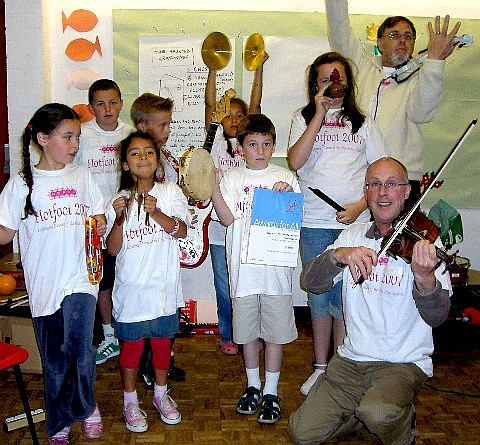
HOPES and the Live-A-Music workshop leaders are very grateful to Awards for All, who have substantially funded these Children’s / Family Music sessions.
The next workshops: when, where and how
The next two children’s music workshops are scheduled for Saturday 8 September at 10.30 – 12.15 and 1 – 2.45 pm. The venue is Mossley Hill Parish Church Hall, Rose Lane, L18 8DB. These sessions are part of the current series of Live-A-Music workshops organised by Richard Gordon-Smith with Martin Anthony (Tony) Burrage, and supported by HOPES: the Hope Street Association with generous funding from Awards for All.
Cost and conditions
The cost per child per session is just £3. Parents and other carers are welcome to accompany children and join in at no extra cost if they so wish. We ask that any children under seven are always accompanied by a parent and / or older sibling because this helps them to feel confident and happy.
Children attending both the morning and the afternoon sessions may bring a packed lunch, subject to their parents’ written consent. (Specific details of conditions are here; but NB session timings have been revised at the request of parents.)
Booking and further information
Booking beforehand is appreciated because it helps with planning for the workshops, but children may simply turn up on Saturday 8th if they wish. Please email us to book places, or for further details. You are also welcome to use this email address to tell us you would like to go on the emailing list for notice of future workshop sessions.
And have fun
These children’s workshops are an opportunity to explore and develop imaginations and musical skills, whatever the previous experience of music. They’re for children (with their parent/s if that’s wished) to enjoy and create new musical ideas, to tell stories in sound, and to have fun.
This Website As A Learning Resource
 This website seems to be used as a learning resource, as well as by a more general readership. Teachers and students refer to it for a range of reasons; and amongst these is the opportunity for people whose first language is not English to read short articles linked to other websites on the same topics. So, how do / could you use this site as an educational resource?
Your views and advice, as teachers and as students or general readers, about how this ‘learning resource’ facility might be extended, would be most welcome. As myself a qualified teacher who worked in education for many years, I am always enthusiastic about the development of new learning materials and ways of teaching. If only the internet had been available when education was my day job…..
I look forward to your ideas and contributions on this topic.
Thank you!
Things To Do When You’re 11 – 15
 11, 12, 13, 14, 15? At last you can start making your own choices. Your parent/s have the final say, but increasingly you’re trusted just to get on with it. You know how important school is, and maybe you have ideas about a career, but there’s still space for fun in with the serious stuff. Sometimes you can even combine the two….
And that’s the idea, along with some general Be Happy Rules, behind the list which follows of ‘Things To Do’. You can try them, or you might not, but perhaps the list will spark off more ideas to keep you trying out new adventures and developing new skills.
OK, here goes. Why don’t you:
Get physical
Learn to roller or ice-skate, walk to school, swim competitively, train for the 5 /10k. Take the challenge to try something different from your normal team game or school activities. Remember, exercise is for life, so to gain the full benefits start now and enjoy.
Annotate your friends
You’d be astonished how quickly time will fly! To remember your friends now for the future, make a book, video or other record of
who they are and how they are part of your life. Get them to add their own contributions to your ’collection’; but do ensure that what you record is something they’d still like to see in ten years’ time.
Help raise environmental awareness
Learn to calculate your carbon footprint – and then help others to do the same. Can you predict what is most ‘carbon costly’? Might you / others change anything you do because of what you learn? That carbon score might just deliver some surprises!
Become a fashionista
Can you find a sewing machine somewhere? Why not design and make your own clothes, from scratch or by adapting gear you already have? Girl or guy, choose a style, fabric or colour you
like, and go for it. It’s never too early to make your own style statement.
Find you way around
You’re well past the ‘Are we nearly there now?’ stage, so learn to map-read – street maps, rights of way, routes in or out of town, journeys to other places; all make more sense (and are much more interesting) if you can interpret the map.
Create a little happiness
Everyone worries and feels down sometimes, but you can decide now to start life as you mean to go on – by making the best of things whenever possible. Give yourself a private project to observe what makes people you care for and admire really, positively happy; and then see what you can do, as a part of your daily routine, to create more of this wonderful state of being for
yourself and others.
Do your bit for the environment now
Plant a shrub or tree, or some vegetables or flowers, then nurture them and watch them grow. Maybe you can make this the beginning of your new ‘green’ habit? Could you even, perhaps, share this activity with others in your family?
Gain skills for independence
Regardless of gender, you’ll need to look after yourself ‘properly’ in the not-too-distant future. Sure, you’re excellent on computers, but do you know how to operate the washing machine, redecorate a room or cook a decent meal? Having these skills is not only useful, they can also be the way to impress your family and friends. So if you’ve got it, flaunt it – think where cooking has taken Jamie Oliver!
Write your own ‘future diary’
You’re beginning to think seriously about your future. Now is the time to ’vision’ it, however straightforward or ambitious your intentions. Use your ‘future diary’ to imagine what life in your possible line of work might be like in five, ten or fifteen years. How might your workday go? How might you feel about it? And, most importantly, if you like what you ‘see’, what do you need to do to get there?
Do your own thing
Maybe you want to do things your way, no bright-ideas-from-elsewhere style? Well, within the boundaries of what’s sensible and positive, just go for it.
But whatever you do, please remember just to check with your parents first – plus, you never know, they may perhaps even
have just a few good ideas of their own!
Have you read….?
Things To Do When You’re 16 – 18
What To Do At Any Age – Be Happy
* Life is not a rehearsal
* Smile when you can
* Do acts of random kindness
* Try no-TV days
* Be cautious sometimes, cynical never
* Use your pedometer
* Treat yourself daily to a ‘Went Right’ list
And why not add your own take on Things To Do When You’re 11–15 via the Comments box below…
Things To Do When You’re 16 – 18
 16, 17 and 18 are when it really starts to buzz. What you choose now will have impact for a long time to come. Horizons are expanding as comfort zones are challenged. Opportunities grasped now, at work and at play, will shape the adventure to follow. So go for it, looking forward and with a zest for life.
This is a time for action, but it’s also the time to set yourself some groundrules for the future – not ‘don’t do this’ restrictions, but an approach to life which will serve you well in years to come. If you haven’t already, check out the general Be Happy Rules for some ideas; happiness (or at least peace of mind) is often a matter of choice.
Then, future chemist, carer or caterer, you might like to give these suggestions a try…..
Get moving
You’re finally old enough to get a Driving Licence! So do it properly, and learn to drive with pride and care. Those driving lessons are about one of your first adult responsibilities; please take good advice and use your newly-won freedom skilfully.
And maybe you’d also like to sail, ski, horseride, hill-walk, who
knows…? Get out and about, using your strength and stamina to explore a whole new world.
Keep what you’ve got
Perhaps you’ve been having football, music, hockey, dance, chess or other lessons along with your school studies; and maybe the demands of exams are pushing these aside. Fair enough, but don’t lose it altogether. Keep your hand in where and when you can.
These interests are investments in your future – and excellent ways to spend a bit of ‘me time’ now, if you’re feeling stressed out.
Plan and enjoy
Is there something you would especially like to have or do? Give this one a bit of thought, and plan how you’ll do it. Maybe you’ll
do it alone, or maybe with others, but now’s the time to get the act together; manoeuvre, save, persuade – and then be sure to enjoy!
And, whatever it is, big or small, it will look good on your CV too.
Be vote-wise
Somewhen soon you’ll have a chance to vote. Make sure you are ready for this, that you know the actual practicalities of voting (where to go, which forms to complete etc) and that you understand the party-political options on offer.
‘They’re all the same’ is not an adult way to respond to politics and our hard-won right to vote; so if you don’t like what’s being said, be sure your voice is heard and do your best to make things better.
History B.Y. (Before You)
It’s never too early to start a habit which will serve you well for many decades…. get to know your neighbourhood, town or city and find out why it’s like it is. Who ‘made’ it? And who’s in charge now?
What’s behind the local names for streets and areas? Are there local stories passed down from generation to generation? There are some fascinating tales to be told, and it’s great to be in the know.
Become a people watcher
Late teens is a time when career choices loom large. It doesn’t matter whether your ambition is a steady job or a heady career, you need to know something about how it all happens – so remember to people-watch! How have people in occupations which interest you got there (or not)? What seems to make them
happy, and what worries them?
It may be easy to find out, or it may require some work, but with luck you’ll discover everyone’s happy to share their personal take on chosen occupations. These are big career decisions you’re about to make.
Go camping
It might be your backyard (to practise), it might be a bus-ride away, or it could be another continent, but try life under canvas. In years gone by camping was a well-established and often very soggy part of growing up. Thankfully, modern arrangements are both more civilised and less regimented.
This is a brilliant way to adventures and self-sufficiency (plan before you plunge!), perhaps just for a day or two, perhaps for a whole summer somewhere really exciting and new.
Get involved
No matter what your background and experience to date, there are now comfort zones to breach and challenges ahead. Always value your family and friends, but also see where else you can go. Is there a ‘cause’ or charity you might support, or something you’d really like to help with? Are there younger children in your school you’d like to encourage? Or older people in your community who’d enjoy your company?
You’ll probably gain as much as you give, and it’s never naff to care enough to share.
Learn First Aid
This is a strictly practical aspect of your developing skills. If your school, college or workplace doesn’t teach First Aid, ask why not. And if it does, make sure you’ve done the course.
Learning how to save a life is a valuable investment of anyone’s time.
Get green gym-ing
Is there a green gym in your part of the world? A place with open-access exercise points, perhaps in the local college grounds or park, where everyone can get fit and enjoy fresh air at the same time? If there isn’t, are you going to get one installed, and then use it? … maybe even help to construct it yourself?
‘Green’ themes are the future, and especially yours as a young person. If green gyms aren’t your thing, perhaps there’s another eco- / fitness project you would enjoy? Discuss and decide what’s best, and don’t take No for an answer! Good luck.
Have you read …?
Things To Do When You’re 11 – 15
Things To Do When You’re 19 – 21
What To Do At Any Age – Be Happy
* Life is not a rehearsal
* Smile when you can
* Do acts of random kindness
* Try no-TV days
* Be cautious sometimes, cynical never
* Use your pedometer
* Treat yourself daily to a ‘Went Right’ list
And why not share your alternative ideas here, too? You can add your own take on Things To Do When You’re 16 – 18 via the Comments box below…

The Live-A-Music Children’s Workshops, 5 April 2007: A Fun-Packed Family Day
 The Live-A-Music Children’s Workshops on 5 April in Mossley Hill Parish Church Hall, Liverpool 18 were action-packed, with much creative sparking between the children, musicians and ‘supporting cast’ of accompanying (grand) parents and younger brothers and sisters. Themes included ‘Music, Myth and Magic’, ‘Animal Samba’ and ‘Symphony’ – with the children also performing a work of their own.








These Live-A-Music workshops ran during the day on Thursday 5 April 2007, in Mossley Hill Parish Church Hall, Rose Lane, Liverpool 18. Background information about the workshops is available on this website. Further workshops are planned for the Summer school holidays.
For more details of the Summer arrangements, or to discuss how Live-A-Music can work to support your own educational / social engagement proposals, please email us.
Things To Do When You’re 19 – 21
 You’re very likely at college now, or learning on-the-job. Enjoy these new experiences! Ages 19, 20 and 21 for most young adults are ‘me time’, time to spread your wings and test the limits. Whatever you’re doing, use your freedom and energies to invest in your future, whilst you have some fun right now.
You’ll already have devised your own Be Happy Rules; and only you can be sure what’s right for you. But have you considered these ideas as you consider the options ahead ….?
Climb a mountain
Did you know there are well over two hundred Munroes (mountains over 3,000 feet) in Scotland? Can you name the highest peaks in England, Scotland and Wales? (or whichever country you live in?) Why not face the challenge, and get to the top of a mountain every year?
But treat your mountains with respect; they require knowledge, the right gear, fitness and large quantities of common sense, even if you simply walk up them. So do it properly, perhaps with your college sports advisers or the Youth Hostel Association (YHA). Get prepared, form a team and reach the peak/s in style. That way you’ll return safely and come to a whole new understanding of how aching limbs can be the mark of real achievement.
Sort your gap year – or not
Are you planning a gap year? Can you say clearly why this is a good choice of how to spend your time? If you can, then go for it; the world is your oyster.
But if you don’t in all honesty know why you want that year out, maybe you need to think again. There are plenty of other ways to have adventures, without the enormous costs, and interruption to your studies / employment which a gap year imposes.
Step outside the stereotype
Is your idea of a good night out a visit to the pub? Or a concert? Or maybe just staying in with a new computer game? Just a few times a year, why not try something completely different? Sports, if you’re arty, the theatre if you’re an action (wo)man, a brisk walk in the park if you’re a bookworm? But be prepared. You’ll enjoy it more if you’ve got your head round the new experience – find knowledgeable friends, discover the plot of the play, pack a picnic and plan your route (or choose consciously to explore) – all before you start.
Penetrate the political
You’ve already discovered the practicals of actually how to vote, and in truth you do know you really must to use that vote. So now’s the time to get a proper grasp. If you don’t understand why the mainstream political parties spend so much time and energy disagreeing with each other, make it your business to find out.
There are fundamental differences between politicians’ perceptions of how the world works, and it’s these you’ll need to explore before you decide how to mark that ballot paper.
Eat well, stay well
We all need treats but we also know that food is fuel. It’s what makes us whole. What sort of a body do you want? How do you feel about the things that happen to food – its origins or its carbon footprint – before it reaches your plate?
Perhaps you could experiment occasionally with different styles of eating. Keep a diet (as in ‘food’, never as in ‘not eating’) diary and see how you feel after a few days with a particular mode for your meals. Does low GI help? Are you a high-cal person? Do you enjoy veggie? What we eat is what we are and only you can determine that for you, for the long-term.
Learn another language
Here’s a good excuse to get an InterRail card, or even to make your inter-continental booking to an adventure. Tell everyone you’re off to study another language…. and then do just that. It’s a lot easier to learn new languages – especially ones unlike your mother tongue – when you’re young, than later on!
You can find introductory ‘foreign’ language courses everywhere these days; you could even get a programme for your iPod. Then, when you’ve got to grips with the basics, pack your phrase book and passport, and practise on real people in the country of your choice. (No cheating, ‘letting’ people practise their English on you instead.) You’ll be amazed how much you can pick up in just a week or two if you try.
Re-think your family
Everyone sees their family as the backcloth to their lives. But now you’re fully independent, you can do a double take. Your parents aren’t just Mum and Dad any more, they can become people in their own right as much for you as they already are for their neighbours, colleagues and friends.
Why not choose to spend some time with family members, actually talking to them about their past experiences and their hopes for the future? There are doubtless many tales to be told, and perhaps some dreams still to be realised. So offer a listening ear, and explore a whole new way of looking at your nearest and dearest.
Play mind games
No, not by psyching other people out, but by having a go at new mental challenges – chess, cards, computers, what you will. A busy brain now will stay active longer, and nurturing ‘mental fitness’ is probably the biggest investment in your personal future that you could make.
Plus, it’s fun….
Be an eco- envoy
Whatever your situation, you can do your bit for the future. Even if you’re ‘between jobs’ (ask yourself, Why?, if you are…) you can do things to help your community along.
For instance, many young people say the environment is a big concern. Perhaps you can find a role at work, college or wherever you are, turning this concern into positive action? This is truly an area where every little helps.
Believe in yourself
Nobody finds life a doddle. No matter how old and wise or hard and cynical they might seem, almost everyone worries about whether they’ve done the ‘right thing’ and whether they are liked by others. And, whether they recall it or not, they, like you, have had to negotiate the tricky years of young adulthood.
So, be gentle as you judge yourself. Conceit may not take you far, but self-belief is essential. Accept the ‘failures’ and mistakes, and learn from them; but much more importantly, do build on your successes. They are the base-line of your life ahead.
Have you read….?
Things To Do When You’re 16 – 18
Things To Do When You’re 22 – 25
What To Do At Any Age – Be Happy
* Life is not a rehearsal
* Smile when you can
* Do acts of random kindness
* Try no-TV days
* Be cautious sometimes, cynical never
* Use your pedometer
* Treat yourself daily to a ‘Went Right’ list
And why not share your alternative ideas here, too? You can add your own take on Things To Do When You’re 19 – 21 via the Comments box below…


 Dreaming Realist
