Category Archives: Arts, Culture And Heritage
Carols Round The Christmas Tree At Sudley House, 2007
 Sunday 23 December 2007 was the date for an occasion to remember: Carols Round the Christmas Tree at Sudley House, the historic home of a Victorian Mayor of Liverpool. The free singalong afternoon concert saw almost three hundred people came to enjoy the company and the carolling with Live-A-Music and the Children’s Choir.
This event was supported by the National Museums Liverpool and offered a warm welcome to everyone. The musicians (Martin Anthony (Tony) Burrage, John Peace, Richard Gordon-Smith and Hilary Burrage) were all members of Live-A-Music, a group also known as Elegant Music. The children’s choir of Mossley Hill Parish Church also performed.
Sudley House has an excellent tearoom for refreshments throughout the afternoon, and provides full disabled access. It is set in peaceful parkland and offers spectacular views across the River Mersey to the Wirral and beyond, to Moel Famau in Wales.
Visitor information and location and travel advice for Sudley House is available here.
See also:
Sudley House: Victorian Home Of A Mayor Of Liverpool
Liverpool’s Ancient Chapel Of Toxteth, Dingle Gaumont Cinema, The Turner Nursing Home & Dingle Overhead Railway Station
Autumn Glory In Sefton Park
Sefton Park, Liverpool: Winter Solstice 2006
For more articles please visit History of Liverpool and The Music.
Sudley House: Victorian Home Of A Mayor Of Liverpool
 Aigburth is a long-established residential area within sight of Liverpool Cathedral. Amongst the many surprises in this enduring part of the city is the National Museum Liverpool’s newly refurbished Sudley House, tucked away behind Rose Lane, Carnatic Halls and Mossley Hill Church. Bequeathed to the City by Emma Holt, daughter of a Victorian merchant, it offers a major art collection.


Sudley House contains works by artists such as Gainsborough, Reynolds, Landseer and Turner. This is the only surviving Victorian merchant art collection in Britain still hanging in its original location.
The earliest resident of the house was Nicholas Robinson, a rich corn merchant, who bought the land and built the original house somewhere between 1811 and 1823. The architect may have been Thomas Harrison. Robinson was Mayor of Liverpool in 1828-9. He lived in the house until his death in 1854, and his two daughters continued to live there until their own deaths in 1883.
Sudley was then sold to George Holt, a ship owner and merchant, who made many alterations to the property. He acquired the art collection which remains in the house, which, with its contents, was in 1944 bequeathed to the City of Liverpool by his daughter Emma.
See also: History of Liverpool
Carols Round The Christmas Tree At Sudley House
Liverpool’s Ancient Chapel Of Toxteth, Dingle Gaumont Cinema, The Turner Nursing Home & Dingle Overhead Railway Station
Autumn Glory In Sefton Park
Sefton Park, Liverpool: Winter Solstice 2006
Please see additional photographs at Camera & Calendar
More information on Sudley House and visitor arrangements is available here.
Orchestral Salaries In The UK
 Professional orchestra musicians’ employment and pay is a mystery to most people. Do players have ‘real’ jobs, too? is a common question. And is it all very glamorous? The latest survey of orchestral pay in the UK gives some answers – not much glamour, not too much pay, and little time for anything else. But for many players the commitment remains.
The Musicians’ Union has recently published their second annual report on Orchestral Pay in the U.K. Leaving aside the self-governing London orchestras, the BBC Symphony and other BBC orchestras, English National Opera (ENO) orchestra and the Royal Opera House (ROH) orchestra (all of which, with London weightings, do somewhat – though only comparatively – better), the M.U. report, as we shall see from the details below, makes pretty dismal reading.
Who are the musicians?
Almost every established player in the major regional orchestras is a permanent staff member (London is different). These ‘chairs’ are coveted positions amongst performers, who are usually graduates from the most prestigious music colleges and / or the top music conservatoires.
Musicians supply their own instruments and equipment for work, the initial costs of which can amount to more than an annual salary.
The ‘regional’ orchestras
Orchestras outside London surveyed by the M.U. in August 2007 were: the regional BBC orchestras, Bournemouth Symphony Orchestra (BSO), the City of Birmingham Orchestra (CBSO), Manchester’s Halle Orchestra, the Opera North Orchestra, the Royal Liverpool Philharmonic Orchestra (RLPO), the Royal Scottish National Orchestra (RSNO), Scottish Opera, the Ulster Orchestra and Welsh National Opera (WNO).
The fortunes of these orchestras fluctuate quite widely over the years, especially since the standardised regional orchestras contract for the BSO, CBSO, Halle, RLPO and RSNO was abandoned. All are dependent on civic support as well as national. [See The Association of British Orchestras for general information about these orchestras.]
Orchestral salary scales
Orchestras generally divide their players up into ‘Section Principals’ and ‘Principals’ (who sit at the front of their instrumental section) and ‘Tutti’ (formerly called ‘Rank & File’!). The M.U. estimates there are approximately 600 fully professional string players employed by British orchestras – which means about one in every 100,000 of the UK population has this occupation.
With a few exceptions, string players (violins, violas, cellos, basses) are the only Tutti musicians, and they make up the larger part of most orchestras.
Who gets paid what?
Concentrating on the regional orchestras, we see a variation of minimum salary in August 2007 as follows:
Section Principals: BBC Regional ~ hourly playing rate of £24.22 (£32,118 p.a.) through to CBSO ~ £33.09 (£45,205 p.a.).
Principals: RLPO ~ £21.44 (£28,298 p.a.) through to CBSO ~ £28.49 (£33,159 p.a.).
Tutti: RLPO ~ £18.20 (£24,024 p.a.) through to CBSO ~ £22.43 (£27,348 p.a.).
In some cases there are increments and / or long service awards which take experienced players above these levels, but these additional sums, usually only a very few thousand per annum, rarely raise salaries significantly above the starting point. Likewise, some, but not all, orchestras pay musicians an additional fee for recordings, media relays etc. [Some details of comparable orchestral salaries in the USA are available here.]
Comparison with other UK salaries
To set these figures in context:
* The average wage in 2007 for all full-time workers across the UK is £29,999 p.a.; or £27,630 specifically for Liverpool.
* The average salary of professionals in IT, an occupation which perhaps begins to approach comparable levels of skill to orchestral musicians (though there are many fewer performers) is £37,000 p.a.
* For graduates overall, an average additional £10,000 p.a. has accrued to their income after ten years’ service; this annual income will then continue to increase for another ten or twenty years.
Back of an envelope calculations using these comparative data perhaps suggest that over a lifetime orchestral musicians will receive approximately half the income of other professionals at comparative levels of skill.
Annual orchestral performing and other work arrangements
The regional orchestras vary in the number of annual playing ‘on stage’ hours they demand from their musicians. Of the orchestras above (not including the BBC orchestras, at 1,326 hours each, and ENO (874 hours) or ROH (860 hours)) the fewest performing hours are required of musicians in the opera orchestras (1,128 each) and the most by the RLPO (1,320).
How these hours are distributed is laid down in detailed contracts. For health reasons, such as risk of hearing loss and repetitive strain injury, players rarely play on the platform for over 6 hours per day. (They may well practise for more than that.) Scheduled ‘unsocial ‘hours – Sundays, Bank Holidays, and very early or late – and other erratic scheduling, with the attendant risks to wellbeing and mental health – are normally paid at the same rate as other hours.
Stress at work is seen as part of the job. There are also travelling hours etc which may add some 30-40% in time commitment – even though much time away from home is still ‘free’ in every sense of the word; neither paid nor, obviously, available for, say, teaching or other alternative opportunities for income.
Not a professional wage?
Most people who attend classical concerts see well-dressed and self-evidently skilled musicians and assume from this that orchestral incomes will be to some extent commensurate with appearances.
The truth is different. Many musicians, even at this level and with years of experience, barely scrape a living, often working almost every day for weeks to make ends meet. Relatively few within the profession achieve comfortable incomes and the view that orchestral playing is not a ‘real’ profession, with eventual progression and hope of greater reward, is widespread amongst foot soldiers at least – large numbers of whom, a previous M.U. survey has revealed, also incur occupationally induced ill-health or injury.
Artistic development
Sadly, players’ negative perceptions are reinforced by an absence of continuing professional development in their core skill, i.e. instrumental performance.
Players can often work for decades without receiving support as artists, or to maintain and develop their instrumental technique, let alone the money to pay very costly professional coaching fees. Artistic human resource investment is not high on (or simply missing altogether from) the priority list for most orchestra budgets.
Skills and experience lost
U.K. orchestras are becoming younger in age profile. The salary figures above offer an insight into why experience is frequently lost, as players leave mid-career for other ways to support their families or preferred lifestyle.
Youth and vigour are wonderful to behold; but knowledge, insight and long-term commitment would in a more ideal world also be valued.
Music not money
Fortunately, for many musicians and their audiences the imperative towards the extraordinary inner world of classical music continues to bring them together even against the rationale of external economics.
But it would be risky to permit the future for UK orchestras to depend on this inner imperative.
Read more articles in Music, Musicians & Orchestras
Life In A Professional Orchestra: A Sustainable Career?
The Healthy Orchestra Challenge
Musicians in Many Guises
Where’s The Classical Music In The Summer? An Idea…
British Orchestras On The Brink…..Again
The New Harvest Festival
 This is the time of year when churches urban and rural across the nation urge us to attend their services for Harvest Festival. For many of us however this annual celebration is now marked more secularly, observed at one remove, via our newspapers, rather than physically in our communities. Media celebration of seasonal food is the order of the day.
The Guardian, like other similar publications, is hot on seasonal food. A story in that newspaper today gives a flavour of that theme: ‘Green’ shopping possible on a budget, watchdog says.
What then follows is that irresistible combination of knocking the supermarkets (fair enough if they’re not up to scratch), going rustic with references to in-season fruit and veg. (why not, it really is good for you), and angst about affordability and carbon footprint (fair enough again).
Contemporary perspectives
So here is the contemporary version of We plough the fields and scatter…
Way back over the centuries people have known about crop rotation and storage and the seasons, and have celebrated all this with Harvest Festivals of one sort or another. Now we know about food miles, sustainability and ethical buying.
Appreciating our sustenance
This is the better informed (or at least more techno) version of the wisdom of the ages, translated for those of us who hope for the future but have no bedrock of faith on which to base an annual thanksgiving.
Perhaps it doesn’t matter how we demarcate the changing seasons and the beneficence they offer. What does matter is that at least we notice.
Liverpool: Governance, Growth And Going (Somewhere)
 Abrupt curtailment of the 2007 Mathew Street Festival, silly ideas about removing fish so the docks become a concert arena, questions about preparations for the Big Year…. Liverpool 2008 is a drama unto itself. The leading arts venues have devised a good cultural programme for European Capital of Culture Year, but concerns about what else must be done remain.
A Summerful Of Children’s Music Workshops In Liverpool
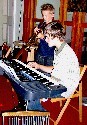 Summer 2007 has been a special opportunity for HOPES and Live-A-Music to provide Children’s Music Workshops, thanks to generous funding from Awards for All. The workshops, held alternately in the city centre and a close-by suburb, have focused on themes developed by the children themselves – in one case, a ‘symphony’ featuring global warming, drifting snow, salsa / jazz and a roller-coaster! Following sessions in July and mid-August, the next workshops in the series are on Saturday 8 September in Mossley Hill Parish Church Hall.
These workshops have proved a great hit with budding musicians of all sorts – players of everything from the trumpet to the triangle It’s not very often that parents and children of considerable musical experience and none can come together from all around Liverpool to sing, dance and make their very own music.
Details of the 8th September sessions follow below. Here are some photographs of the workshops at Mossley Hill Church Hall , Liverpool 18, on 30/31 July, and at St. Bride’s Church, Liverpool 8, on 13/14 August.

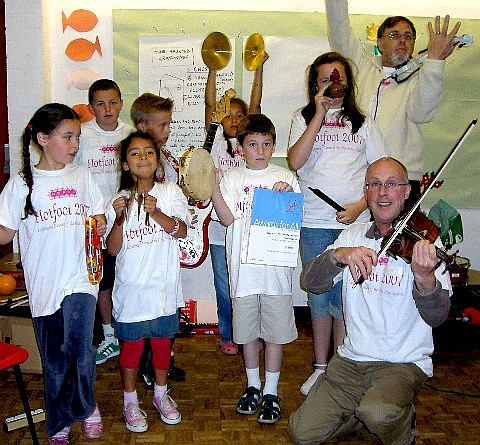
HOPES and the Live-A-Music workshop leaders are very grateful to Awards for All, who have substantially funded these Children’s / Family Music sessions.
The next workshops: when, where and how
The next two children’s music workshops are scheduled for Saturday 8 September at 10.30 – 12.15 and 1 – 2.45 pm. The venue is Mossley Hill Parish Church Hall, Rose Lane, L18 8DB. These sessions are part of the current series of Live-A-Music workshops organised by Richard Gordon-Smith with Martin Anthony (Tony) Burrage, and supported by HOPES: the Hope Street Association with generous funding from Awards for All.
Cost and conditions
The cost per child per session is just £3. Parents and other carers are welcome to accompany children and join in at no extra cost if they so wish. We ask that any children under seven are always accompanied by a parent and / or older sibling because this helps them to feel confident and happy.
Children attending both the morning and the afternoon sessions may bring a packed lunch, subject to their parents’ written consent. (Specific details of conditions are here; but NB session timings have been revised at the request of parents.)
Booking and further information
Booking beforehand is appreciated because it helps with planning for the workshops, but children may simply turn up on Saturday 8th if they wish. Please email us to book places, or for further details. You are also welcome to use this email address to tell us you would like to go on the emailing list for notice of future workshop sessions.
And have fun
These children’s workshops are an opportunity to explore and develop imaginations and musical skills, whatever the previous experience of music. They’re for children (with their parent/s if that’s wished) to enjoy and create new musical ideas, to tell stories in sound, and to have fun.
Brent’s Only Grade 1 Listed Building: St. Andrew’s Old Church, Kingsbury
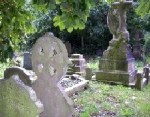
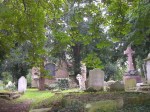
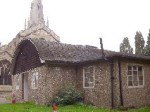
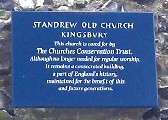 Almost within throwing distance of the new Wembley Stadium in Brent there lies another, vastly older but sadly forgotten building – the 11th Century St. Andrew’s Old Church, in the grounds of the present fine establishment. Father John Smith and his parishioners are working hard to renew the present grim Church Hall and to reclaim the old church and churchyard for the local community.

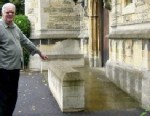
 For Father John Smith these small red bricks have a special significance; they suggest there was a church on the site of the photograph even back in Saxon times. The bricks are the original Roman evidence of the ancient (eleventh century) church which lies adjacent to the ‘new’ St Andrew’s Church, Kingsbury, within the grounds of his incumbency.
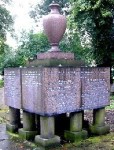
There is a great ambition in the parish congregation for the ‘old’ church and, especially the churchyard, with its many historic graves, to become a place of rest and respite in this busy part of London. Local people are giving their time and energy generously to clear the pathways and make more evident the generous clues to the area’s history which the overgrown graves can offer.
This plan, part of an intended programme to replace the past-its-best Church Hall with a lively and responsive building which will serve all who live in the area, is surely one which many will wish to support.
-

- Father John T. Smith






Singers Show What’s Entertainment And What’s Classical Music
 The BBC Proms offer many different routes to enlightenment, but this is a new one to me. A listing of events for August tells us that some singers are ‘singers’ or ‘vocalists’, and others are sopranos, mezzos, tenors, basses or, indeed, ‘voices’. A look at the particular concert programmes suggests why this may be…
The clue lies in expressions like ‘An evening with..’, followed simply by the names of ‘singers’, or, alternatively, a long and detailed list of exactly what is to be performed, by whom and in what capacity.
Different languages
These are the discourses respectively of popular performance / ‘entertainment’ and on the other hand of ‘high-classical’. The one is awash with generality, the other with detail and implicit demands that we already understand what it’s all about.
Traversing the barriers
Occasionally of course the most-acclaimed performers of ‘high-classical’ cross the boundary to ‘entertainment’; but crossing substantially in the other direction rarely occurs. ‘Entertainers’ may offer a selection of classically-inspired songs; they don’t do full operas.
Is this huge distinction between genres necessary? Perhaps in the performers’ terms it’s inevitable, but in audience terms I’d like to see a bit more effort in general to ‘take’ classical music to people – not pre-concert talks necessarily (to some, an acquired taste) but much, much earlier in the average person’s artistic experience.
Starting early and comfortably
Schools, for instance, need well-versed teachers feeling as comfortable with classical music as most feel with the more popular modes. (A few inspired teachers play music of all kinds to their pupils; would that more did so.) But acquaintance with ‘classical’ music is what’s missing as a result of the austere curriculum experienced by people who were schoolchildren themselves in the 1980s, when the arts were dismissed as almost frivolous.
Singers have it all
The BBC Proms offer an excellent start, but classical music has so much to offer at any time. It’s a real shame that many people find themselves mystified or out of their depth with it.
There are growing numbers of top professional singers, labelled however you like, who enjoy good music of all kinds. These artists would surely agree that, alongside the genuine excitement and glamour of a good popular-music-based ‘show’, classical music also is far too good to miss.
Somerset House Summer Fountains
 Somerset House in London is rightly famous for its Winter skating rink, an imaginative and welcome attraction in the city. High Summer, however, permits another simple way to enjoy this historic venue’s versatile water feature, as the little person here discovered.

See also Camera & Calendar
More information on Somerset House here.
HOTFOOT 2007: Sunday 22 July, 7 pm, Liverpool Philharmonic Hall
 HOPES: The Hope Street Association marks the thirtieth anniversary of the inaugural Hope Street Festival with a HOTFOOT 2007 concert offering many elements of previous such events. Tayo Aluko, Tony Burrage, Richard Gordon-Smith, Sarah Helsby-Hughes, Hughie Jones, Roger Phillips and Surinder Sandhu join children from Merseyside schools and the stalwart HOPES Festival Orchestra and Choir for an event not be missed.


 Dreaming Realist
