Author Archives: Hilary
Fast Trains And The North-South Divide
 Is large-scale sustainable transport possible? Should we welcome Britain’s fastest-ever domestic train, which has arrived in Southampton this week? The UK’s North- South economic divide brings these questions into sharp focus. The further one is from London, the more important connectivity can become. So is carbon footprint a critical issue only after the economics have been taken care of?
Economics and environment don’t always mix. For some the pressing need is to reduce travel. For others, it is vital to improve physical connection. These complicated issues have come up the agenda again this week, with the news that the Go-Ahead Group has arranged imminent delivery of 29 high-speed Hitachi trains from Japan, which will operate from 2009 on the South Eastern network.
Low expectations?
Whilst commuters in the South are getting excited about travel times and accessibility to the Capital, those in more northerly parts of the UK are likely to be less enthused. For many the expectation of poor transport is a way of life, and there is a feeling – perhaps unjustly in respect of some local northern operators – that nothing is going to happen to change this. For others, the temptation is to believe that yet again the South is benefiting and the rest are not. Few Northerners are as yet willing to ditch their cars.
Will the new fast trains effect a change of heart? The optimists for train travel think that signs we are catching up with the Europeans will focus a national clamour for this form of transport. More dour observers suggest that because of potential damage to the environment we should not be encouraging travel anyway.
Sustainable transport, sustainable economies
I’m generally on the side of the optimists here. There’s little chance of sustainable living across Britain whilst inequalities (not just North-South, but certainly including that) are so great. I’d like to see more trains, and faster ones, right across the country. This is one area of environmental concern where we really can ask the technical people to work on the ‘clean and green’ agenda.
Science can’t solve all eco- problems, but in terms of transport and communications, we shouldn’t write technology off yet. The challenge now is for the politicians to come up with proposals which will match economic balance across the North and South with the possibilities opening up in transport.
Nothing in life stays still. Sustainability in communities of whatever size must start from the ‘can do’, the will to be positive and fair, because any other starting point is doomed in the long-run to failure.
Unique Selling Points In Regeneration, Or Just ‘Special’ Ones?
 Regeneration and development are often focused on what’s ‘unique’ and ‘special’ about a location. What does it have which others don’t have? This is a good question, but it needs a context. There are many ways to define ‘special’ – and even more to define ‘unique’. Not all of these special qualities translate well beyond local boundaries. Maybe it’s when locations work with outsiders to find commonalities and difference that they can make this ‘USP’ regenerational focus most effective? But how can this be done? And by whom?
Marketing and renewal have in recent times become closely connected in terms of what happens to areas which require ‘regeneration‘. Along with the basics of reasonable housing and facilities, there is often a clear focus on what sort of ‘unique selling point’ (USP) a location can offer, as plans are made to develop and energise a rather stagnant local economy / community.
As an initial strategy this is sensible. Asking people to reflect on the defining features of their locality is a good way to support emerging ideas about how to improve things. Direct stakeholders’ views are always crucial to the exercise.
Local perspectives
It is not always reasonable to expect those who live in a place to be aware of what is unique about their location, and what may not be. How can we be sure?
But encouraging the view that a place is better / more interesting than anywhere else can be a political or cynical ploy, not a genuine attempt to move forward. How much easier to leave people in their comfort zone, than to challenge local assumptions which perhaps make a difficult situation more immediately palatable for those who have to cope with it every day…
Wider responsibilities?
One aspect of regeneration in practice is a responsibility by those who take the lead, to ensure that the wider picture is at least available to direct stakeholders. No-one can insist that everyone has a wider view, but it seems reasonable to require at minimum that this is easily available. (Not all regeneration powers-that-be would agree about this requirement, of course; and many of them are not equipped for various reasons to do it.)
Finding common ground
Suggestions that things could be better if we emulated others elsewhere – or indeed the proposal that, instead of insisting we’re unique, we acknowledge commonality with others who also do things well / have a given local attribute – need not be negative.
Offered positively, information about other places and ways of doing things becomes a strength. Why not share a problem or a benefit? Increasingly, disparate geographical areas are coming together in this way. The North of England Mills and Canals conferences have been going for some years; BURA has recently identified both the Seaside and Universities as shared challenges and opportunities for the towns and cities concerned; rural areas have long-time histories of sharing good practice in agricultural produce shows and much else.
Taking it to the people
These good ideas now need to become more visible. For regeneration to be effective ordinary people, the immediate stakeholders in the process – not just the experts – must understand what’s happening and why. And part of that much-needed understanding is sharing commonality (specialness) as well as defining uniqueness.
Is there a role here for new ways to reach regenerating communities on the world-wide web? And, if so, who’s going to make it happen?
National Allotments Week (13 – 19 August 2007)
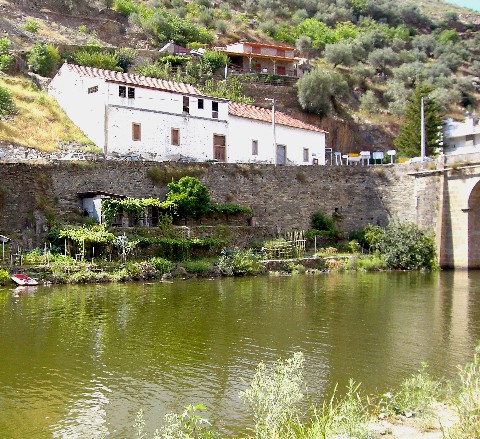
 This week is U.K. National Allotments Week, promoting ‘the awareness and availability of allotments both locally and nationally, to show … the strength of support and interest for the heritage of allotment culture.’ This excellent initiative is quite new, but allotments themselves have stood the test of time. Here is an example from rural Portugal, on a tributary of the Duoro River, of a smallholding which has probably been in place for centuries.
You may also like to see these photographs and articles:
Early Summer In Edinburgh Botanic Gardens
Cherry Blossom For May Day In Sefton Park, Liverpool
Wirral’s Ness Gardens
Sefton Park, Liverpool: Winter Solstice 2006
Flowers In Pots For All
Liverpool Botanic Garden, Edge Lane
Visiting Valencia
Love Parks Week!
Seasonal Food – Who Knows About It?
Read more about National Allotments Week here: National Allotment Gardens Trust
Singers Show What’s Entertainment And What’s Classical Music
 The BBC Proms offer many different routes to enlightenment, but this is a new one to me. A listing of events for August tells us that some singers are ‘singers’ or ‘vocalists’, and others are sopranos, mezzos, tenors, basses or, indeed, ‘voices’. A look at the particular concert programmes suggests why this may be…
The clue lies in expressions like ‘An evening with..’, followed simply by the names of ‘singers’, or, alternatively, a long and detailed list of exactly what is to be performed, by whom and in what capacity.
Different languages
These are the discourses respectively of popular performance / ‘entertainment’ and on the other hand of ‘high-classical’. The one is awash with generality, the other with detail and implicit demands that we already understand what it’s all about.
Traversing the barriers
Occasionally of course the most-acclaimed performers of ‘high-classical’ cross the boundary to ‘entertainment’; but crossing substantially in the other direction rarely occurs. ‘Entertainers’ may offer a selection of classically-inspired songs; they don’t do full operas.
Is this huge distinction between genres necessary? Perhaps in the performers’ terms it’s inevitable, but in audience terms I’d like to see a bit more effort in general to ‘take’ classical music to people – not pre-concert talks necessarily (to some, an acquired taste) but much, much earlier in the average person’s artistic experience.
Starting early and comfortably
Schools, for instance, need well-versed teachers feeling as comfortable with classical music as most feel with the more popular modes. (A few inspired teachers play music of all kinds to their pupils; would that more did so.) But acquaintance with ‘classical’ music is what’s missing as a result of the austere curriculum experienced by people who were schoolchildren themselves in the 1980s, when the arts were dismissed as almost frivolous.
Singers have it all
The BBC Proms offer an excellent start, but classical music has so much to offer at any time. It’s a real shame that many people find themselves mystified or out of their depth with it.
There are growing numbers of top professional singers, labelled however you like, who enjoy good music of all kinds. These artists would surely agree that, alongside the genuine excitement and glamour of a good popular-music-based ‘show’, classical music also is far too good to miss.
Somerset House Summer Fountains
 Somerset House in London is rightly famous for its Winter skating rink, an imaginative and welcome attraction in the city. High Summer, however, permits another simple way to enjoy this historic venue’s versatile water feature, as the little person here discovered.

See also Camera & Calendar
More information on Somerset House here.
Where The Science Meets The Social: The UK’s Wettest Summer On Record
 The rain it raineth every day; but, strange as this British ‘Summer’ weather feels, we know a lot about what’s triggered the deluge. We can debate the extent of global warming, but the big issue is how to ensure it doesn’t carry on. This is where conventional science gives way to understandings of human behaviour. Hearts and minds will help us meet the challenges of climate change, not simply technology.
As everyone keeps telling us, these are uncertain times. You don’t have to have been in the floods to have felt in some way their effects….
But understanding it all is a bit of a challenge. Is it true that climate change is well and truly upon us? (I suspect, on the whole the answer is Yes) Is there anything we can do about it? (Ditto.)
Knowing what we know
And do we need to know more? I’d say Yes again, but it’s a qualified Yes.
We already know a lot; how to reduce and recycle waste, how to travel carbon-lightly, how to share resources for food, water and other essential commodities. What we sometimes don’t know is how to put that ‘knowledge’ into practice.
Taking evidence to policy
The challenges of interpreting the environmental phenomena currently around us are being taken up by some of the brightest natural scientists. Their evidence is and will continue to be both good and available for everyone to consider for themselves.
Now we must move also to include, in a quite fundamental way, the social sciences and the understandings they bring. Best progress towards confronting climate and other fears needs to embrace how people – people of all sorts, not ‘just’ those already committed to doing something, but everyone else as well – feel in their hearts, as well as how in their heads they understand.
Hearts and minds in context
Science in the service of coping with climate change is first and foremost a tool towards sensible actions and policies. It will do
that science no harm at all if it has two conjoined wings, the natural and the social, bringing together the evidence required to make action happen.
This is a dialogue in which everyone can play their part. The challenge is to articulate and explore what best makes people get engaged, positively and in a meaningful way……
A version of this article was first posted on Climatespace on 27 July 2007.
Employment Polarisation, Gender And Regeneration
 An ippr report by Ioannis Kaplanis tells of increasing employment polarisation in Britain – with differences most significant amongst female employees in London. Regional economies must learn from Kaplanis’s studies, looking especially at policies for the full use and retention of women’s high-level skills. One emphasis must surely be on how very senior decision makers outside London (a hugely male population) respond to this challenge.
The Institute for Public Policy Research (ippr) has just published a paper by Ioannis Kaplanis at the London School of Economics. The report, entitled, The Geography of Employment Polarisation in Britain, offers potentially far-reaching implications for renewal and regeneration in the UK.
Polarisation, but not greater absolute poverty
In essence, Kaplanis tells us that polarisation between high-paid and low-paid occupations in Britain has increased significantly since the early 1990s, but that both categories have seen expansion when measured against middle-income activity.
This, Kaplanis suggests, is because technology (and international out-sourcing?) have removed the need for large numbers of middle-level skills, whereas very highly skilled work still requires very highly skilled people – who in turn stimulate the demand for lower-level skills such as domestic cleaning and local leisure facilities. (Perhaps this polarisation is also more likely to occur where there is a lot of private sector activity.)
The gender dimension
Most significant of all, it appears, has been this effect on female employment in London – which is hardly surprising, given that many talented young people go to London to work; and London is where gender discrimination is, if necessary, most challenged and least likely to occur before the highest levels of the glass ceiling. (Merseyside, as a contrasting example, has an appalling senior level employment record in gender terms.)
Add to such a backdrop the obvious fact that women are usually responsible for hiring domestic help (they can’t do home maintenance and have high level jobs…) and we have a win-win for female workers at both ends of the formal skills spectrum.
The regional challenge
There are many other aspects to Kaplanis’s work in addition to gender, but he does note that employment polarisation is now (the converse may have been true until the early 1990s) less evident in the UK regions than in the capital.
So here’s a challenge: get highly-skilled women outside London working at the level of their acquired expertise – and pay and promote them properly.
Then maybe the UK regions would see a turn-around of their still relatively declining fortunes. It’s only one part of the equation, but it might just prompt that desperately needed impetus towards success.
Politicians Work For You ~ The Evidence
 It’s often claimed that politicians are out of touch or otherwise irrelevant to their electorate. The website ‘They Work For You’ is one way in which this claim can be examined, at least for Members of the UK Parliament. But can MPs ever meet all the demands put upon them, and what else do we need to know?
Perhaps the idea that ‘politics is irrelevant’ is actually a ploy, consciously or not, for people to avoid the difficult questions which the political process poses for us all.
Do we actually know what we want from politics? The They Work For You website is one way in which we can all engage; it follows the issues raised by individual Members of Parliament (and others) at Westminster and elsewhere.
What do we want to know?
But obviously numbers of questions asked in decision-making assemblies are by no means the only thing we would like to know about the political process. There are many other important aspects of political work as well.
Some MPs have active websites, some do not. Some meet with their constituents regularly, some probably less often. Some have a schedule of discussions with their local authorities, others make contact less systematically. But all are open to scrutiny by the media and the public.
All things to all (wo)men?
So how should MPs respond to the mis/perception that politics is meaningless? Should they leaflet constituents all the time (green issues here, volunteer delivery energy levels apart?), should they talk to the media (spin?), should they consciously ask questions in Parliament in the knowledge that They Work For You will report these (skewing activity for coverage?), should they do something else?
What would make people think politics has meaning? What would provide public assurance that all politicians are not ‘in it for themselves’?
Or don’t we want to answer these questions, for fear that then we’d have to take responsibility ourselves for what’s happening around us?
Buxton Opera House And Festival
 Buxton Opera House in Derbyshire bears up well for this shot, taken at the end of the wettest June in England since records began, as preparations are finalised for the Buxton Festival. The Festival, this year from 6 – 22 July, attracts over 36,000 people annually to the Peak District and in 2007 will feature more than 110 events in just 17 days – including 7 operas, 16 literary speakers, 36 concerts, an afternoon ballet and a ghost tour.

Details of Buxton Festival 2007 are available here.
HOTFOOT 2007: Sunday 22 July, 7 pm, Liverpool Philharmonic Hall
 HOPES: The Hope Street Association marks the thirtieth anniversary of the inaugural Hope Street Festival with a HOTFOOT 2007 concert offering many elements of previous such events. Tayo Aluko, Tony Burrage, Richard Gordon-Smith, Sarah Helsby-Hughes, Hughie Jones, Roger Phillips and Surinder Sandhu join children from Merseyside schools and the stalwart HOPES Festival Orchestra and Choir for an event not be missed.


 Dreaming Realist